

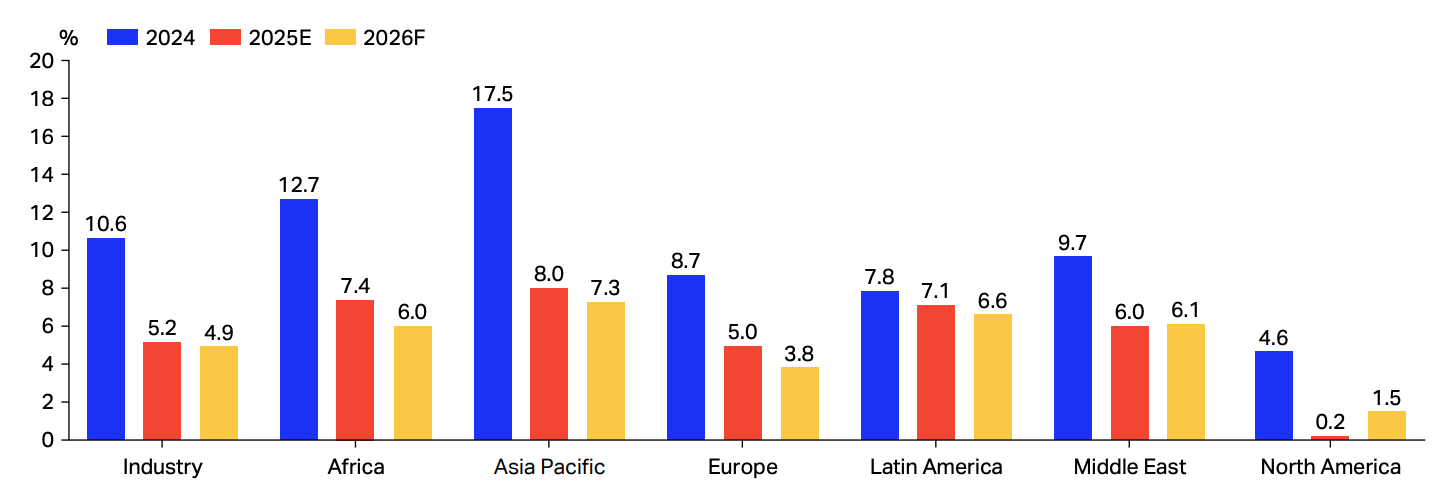
After 2025’s US federal shutdown and its impact on aviation, as well as the introduction of new border controls in the US and in Europe, 2026 is predicted to bring further geopolitical and economic uncertainty to the skies and to travellers. With the International Air Transport Association (IATA) revising down 2026 passenger traffic forecasts from 5.2% growth to 4.9%, airlines are continuing to react with mergers and an offer designed to cater to the growing premium segment, amid an increase in the use of technology aimed at enhancing the passenger experience. Travel Tomorrow looks at trends in aviation for the coming year.
Premium segment growth
Airlines across the world, including American, Air India, JetBlue, and Southwest, have all invested significantly in premium products, which are set to go fleet-wide in 2026. Customer expectations are changing, and free Wi-Fi is increasingly being offered to all, but from extra legroom to priority boarding options to menus designed by pop-up celebrity chefs, there is a flurry of premium and business options to choose from.
Even Southwest Chief Executive Bob Jordan has said the famously even-handed travel champion is “changing to meet the needs of the customer.” It all tallies with IATA’s recent description of “robust demand” for premium products and services across Asia, Europe, and North America, and figures from the Global Business Travel Association (GBTA) showing “remarkable resilience and growth” in European business travel, with spending projected to increase by 8.2% over 2026 to hit nearly €390 billion.

Flyers should therefore pay close attention to changing loyalty schemes, bonuses, and even travel insurance or credit card plans that could offer an array of benefits. As potential perks include special lounge access, airports too are catering to an appetite for premium that is driving what travel site Going has called “K-shaped divergence” –between soaring demand at the top of the market and a decline at the budget end.
Airports as destinations
Skyscanner says that 44% of travellers have sought accommodation that is a destination in itself, and airports too are increasingly buildings of architectural interest that eschew characterless retail spaces in favour of diverse cultural and entertainment experiences. As such, travellers can reasonably expect to while away their transit time in a Michelin-starred restaurant or a karaoke booth, or gazing at exhibitions, such as this year-long Godzilla-themed installation in Tokyo’s Haneda.
Biodata collection and seamless travel
And to give travellers enough time to spend on that offer, “seamlessness” is the word of the moment, whether it’s thanks to overhauled facilities, such as the €500-million makeover at Palma, the ongoing creation of the new Al-Maktoum Airport in Dubai, or a supposedly “smart, green” new airport for Capetown, AI-boosted welcome-bots, baggage-handling, or logistics, or facial recognition checkpoints.
Governments are behind the growth in biodata collection, too, of course, and 2026 is set to see the full rollout of border systems such as the EU’s Entry Exit System, and ETIAS, as well as the US’s ongoing insistence on authenticated travel through REAL-ID and “administrative charges” for those who do not comply.
Mergers and route expansion
Against an economic backdrop of uncertainty, thanks to Trump’s tariffs, a chill on US travel, another potential federal shutdown at the end of January 2026, the long tail of COVID-19 supply chain and staffing issues, and rising airport charges, airline profitability is static at 3.9% year-on-year, the IATA has reported. As a result, airlines continue to consolidate, with a suite of mergers across the airline industry. Alaska Airlines is combining forces with Hawaiian Airlines. Lufthansa is taking on ITA. Air France-KLM is due to close on SAS Scandinavian Airlines, and Korean Air should own Asiana Airlines by the end of 2026.

While some loyalty schemes may close, others are aligning or combining. The good news for travellers is that routes and connectivity are expanding. To name just a few of these: Southwest Airlines has announced route expansions for Southern California and Greater Los Angeles on its summer 2026 schedules, with two brand-new Hawaii routes, additional capacity towards the Pacific Northwest, and extra daily departures from San Diego. ITA is launching new Rome-Houston flights from May 2026 and has eyes on United’s hub at Newark. Air China is opening routes from Beijing and Chengdu to Brussels. Royal Air Maroc is launching a new thrice-weekly Los Angeles—Casablanca route ahead of the North American FIFA World Cup—an event likely to influence demand and pricing for North American flights as the year progresses.