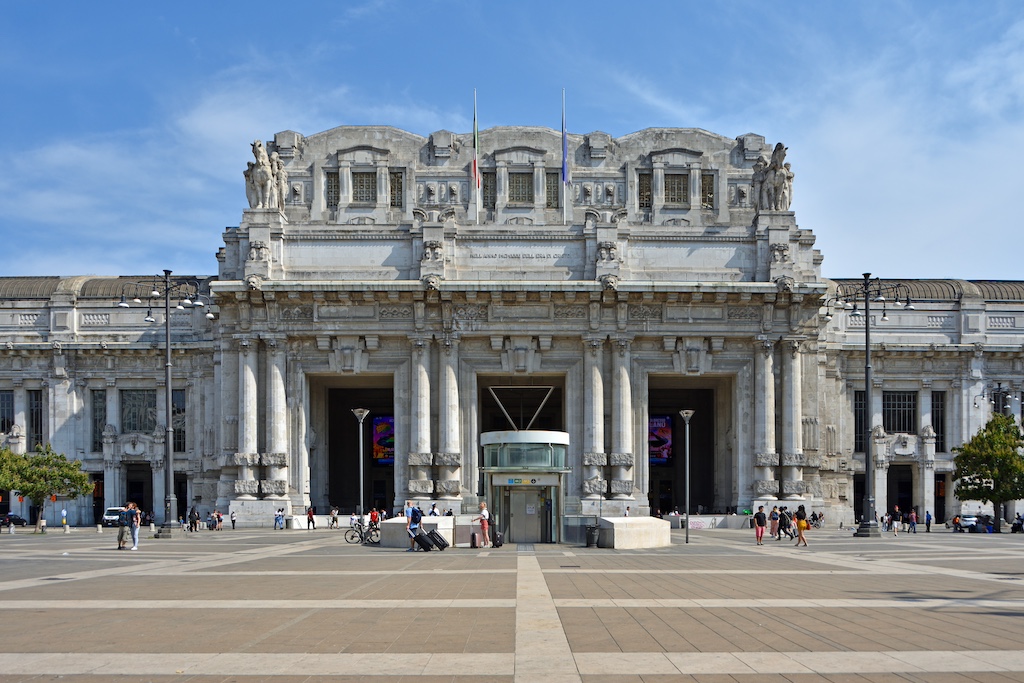



For many visitors to Italy, Milan is a city synonymous with fashion shows and design biennales, the epitome of style and glamour. If they arrive via the city’s main train station, Milano Centrale, they get a flavour of that ostentation at the outset of their trip, surrounded by a building dripping in Roman, Egyptian, Art Deco, and Liberty features chosen by architect Ulisse Stacchini in 1912.
But by the time the station opened in 1931, fascist dictator Benito Mussolini had been in power for nine years, and the symbols of fascism, bundles of sticks portraying ancient Roman authority, had been added to the hub’s design. When Nazi Germany occupied Italy in 1943, another, even more sinister adaptation was to follow.
Beneath the station lay an ingenious mail operation, out of the way of passenger services and hidden from public view, with two platforms at ground level where post would be loaded onto trains, which were then lifted onto the upper departure levels by elevator.
For the Nazis, this hidden Binario 21 (Platform 21) became an underground human processing plant. For thousands of Italian Jews, dissidents, and opponents of fascism, the dark mail rooms and windowless post carriages would be their last glimpse of Italy before being transported to World War II death camps.
The cursed platform and its grim second function were rediscovered in 1994 by researchers from CDEC, the Fondazione Centro Di Documentazione Ebraica Contemporanea, a modern Jewish history foundation. Working with historical records and survivors’ testimony, they pieced together how deportees were taken by night in trucks and loaded onto shuttered carriages so crowded there was no room to sit, with no facilities for human dignity, for journeys of over 1,000 km—to the death camp at Auschwitz, Germany, or the slave labour camp at Mauthausen, Austria. Of 44,500 Jews living in Italy, at least 7,680 were exterminated, according to the Yad Vashem World Holocaust Memorial.
Milano Centrale’s Binario 21 is now a public memorial, where the names of hundreds of deportees (those that are known) are projected, where artworks tell a tale of the indifference of their fellow humans—postal and rail workers, and daily commuters at the station, who continued their lives and their work while the holocaust was carried out. Visitors can see the two examples of the carriages into which the deportees would have been loaded—at least 20 human convoys left from the station.
Visiting the Milano Centrale today, then, is a way to bear witness to two sides of Italy and of human nature. Martin Westlake, Italian history expert and author whose book The Many Deaths of Mussolini will be published by Biteback in 2027, told Travel Tomorrow: “Binario 21, in the bowels of grandiose Milano Centrale, is a metaphor for the bombastic exterior of Mussolini’s fascism and its increasingly sinister interior.”
Similarly, Saverio Colacicco, an outreach expert at the Binario 21 or, as it is now also known, the Fondazione Memoriale della Shoah di Milano, (Milan Holocaust Memorial), says the place is as important for Italians as for tourists, representing “the chance to think of our own past — that of the Italian people — that we have, after 80 years, partly forgotten and partly erased.” He adds: “Italians haven’t taken full responsibility. But the fact that this happened in the economic capital of our country is significant. This was done by Italians and the responsibility is ours. It’s important to know that in the belly of the station you use every day to go to work or go on vacation, this space exists.”