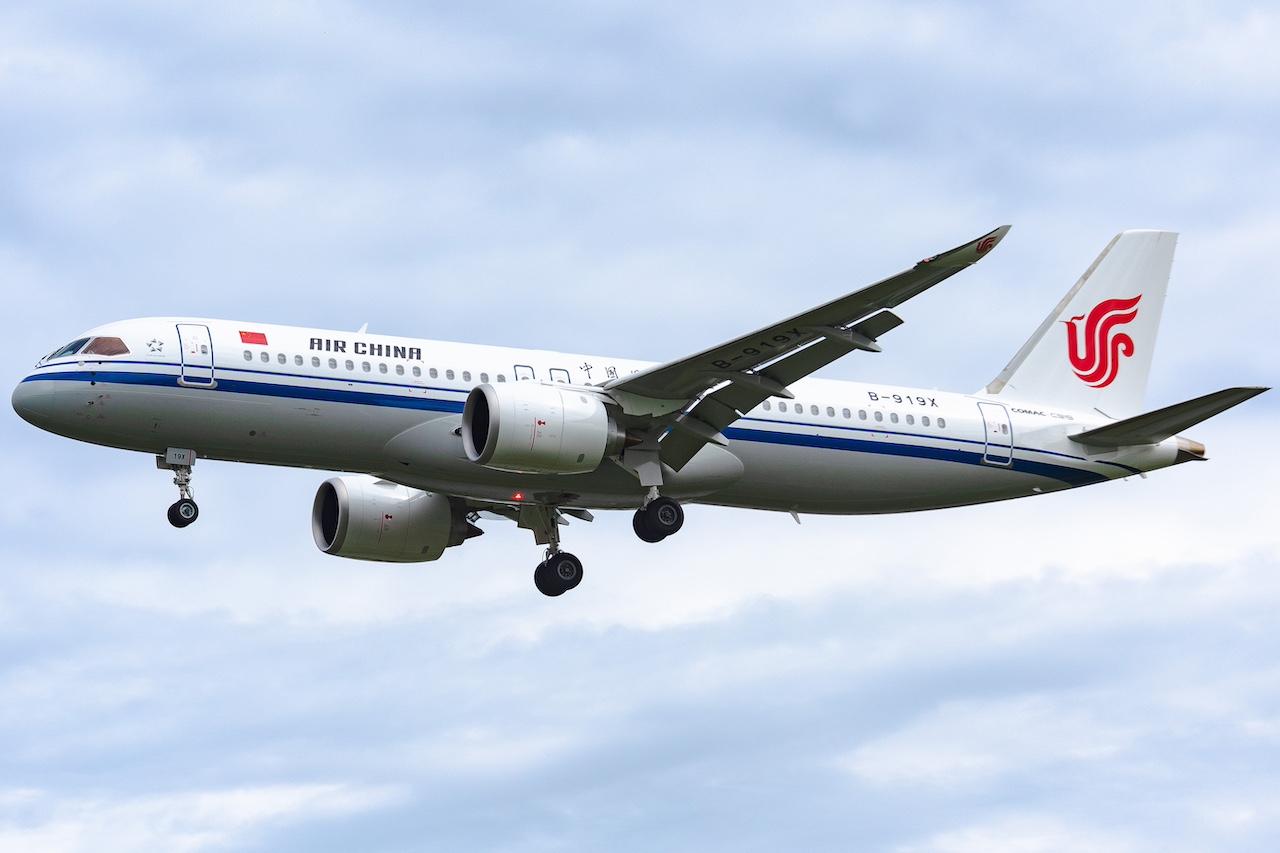



China’s home-grown COMAC C919 is poised to reach another landmark in its development, with the narrow-body jet set to operate its first scheduled international passenger service on 12 August. Air China will deploy the aircraft on daily flights between Beijing Capital International Airport and Ulaanbaatar, Mongolia, marking the first routine international route for an aircraft that Beijing hopes will one day challenge the long-standing dominance of Airbus and Boeing.
Although the C919 has already been flying regular services between Shanghai and Hong Kong, as well as between Beijing and Hong Kong, those flights are considered regional operations because Hong Kong is a Special Administrative Region of China. The Beijing-Ulaanbaatar service will therefore become the aircraft’s first scheduled passenger route beyond Chinese territory, representing another milestone in COMAC’s gradual expansion into international markets.
A new chapter for China’s aviation ambitions
Developed by the state-owned Commercial Aircraft Corporation of China (COMAC), the C919 is China’s first domestically designed narrow-body passenger jet built to international airworthiness standards and intended to compete directly with the Airbus A320 family and Boeing 737.
While the C919 programme itself dates back to the late 2000s, Chinese efforts to develop a domestic commercial aviation industry stretch back several decades. One of the earliest projects was the Y-10, a four-engine passenger jet that made its maiden flight in 1980 but was discontinued as China lacked the industrial capacity to bring it into large-scale production.
China subsequently pursued international partnerships. Shanghai Aviation Industrial Corporation worked with US manufacturer McDonnell Douglas to assemble and develop MD-82 and later MD-90 aircraft, but the cooperation ended following McDonnell Douglas’s merger with Boeing in the 1990s. Other proposed international projects, including cooperation with European partners, also failed to produce a lasting Chinese commercial aircraft programme.
These experiences helped shape Beijing’s determination to develop its own aviation capabilities. China first pursued the smaller ARJ21 regional jet, which rolled off the assembly line in 2007 and provided experience in aircraft development, testing and certification. The C919 project was subsequently approved as China sought to move into the much larger single-aisle aircraft market.
Rather than attempting to produce every component domestically, COMAC adopted the “main manufacturer-supplier” model widely used in the global aerospace industry. Under this approach, COMAC is responsible for the aircraft’s overall design and integration while sourcing a number of major systems from specialist suppliers in China and overseas.
The scale of the project has been considerable. According to C919 chief designer Wu Guanghui, more than 300,000 people from over 1,000 companies and organisations across China have been involved in its development.
The prototype rolled out in 2015 before completing its maiden flight in May 2017. The aircraft received its type certificate from the Civil Aviation Administration of China (CAAC) in September 2022 and entered commercial service with China Eastern Airlines in May 2023.
Travel Tomorrow has followed the C919’s development since its maiden delivery to China Eastern Airlines in December 2022, charting its gradual progression from domestic operations to cross-border services. Earlier this year, the aircraft began regular passenger services between Shanghai and Hong Kong, another important milestone that demonstrated its readiness for operations beyond mainland China. The upcoming flights to Mongolia now take that journey a step further by establishing the C919’s first fully international scheduled route.
BREAKING: 🇨🇳 China’s domestic C919-600 “Plateau” has taken to the skies, launching a direct challenge to Airbus’s A319neo monopoly in high-altitude aviation. pic.twitter.com/OJnkEHSAxq
— Megatron (@Megatron_ron) July 30, 2026
Daily flights to Mongolia
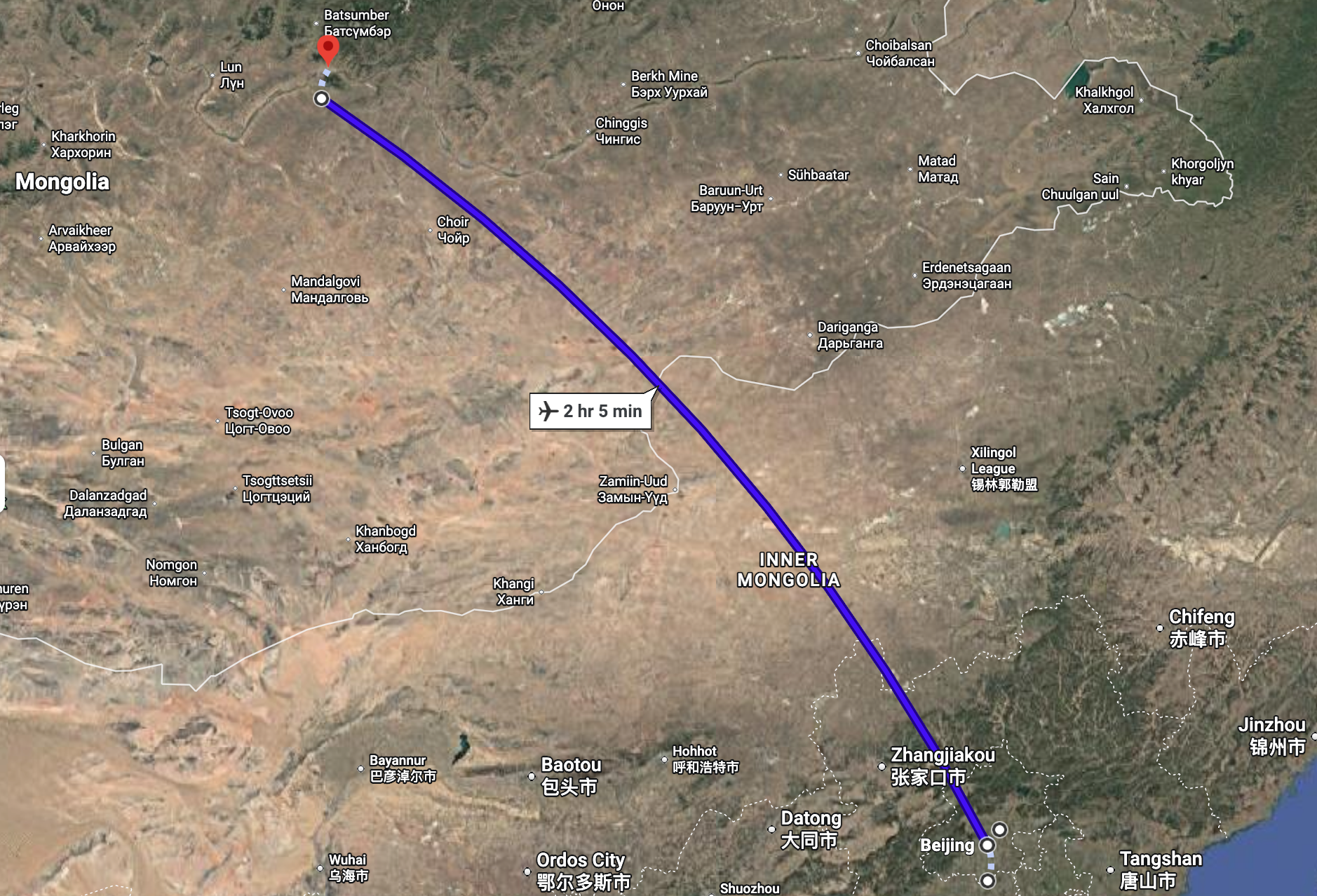
From 12 August, Air China will operate one daily return flight between Beijing and Ulaanbaatar using the C919.
Flight CA723 will depart Beijing Capital at 3:00 pm, arriving in the Mongolian capital at 5:15 pm after a journey of approximately two hours and 15 minutes. The return service, CA724, will leave Ulaanbaatar at 6:30 pm, landing back in Beijing at 8:35 pm.
The aircraft is configured with 158 seats, including eight in business class and 150 in economy, and will replace the Boeing 737 MAX 8 currently used on the route. Covering approximately 1,166 kilometres, the service is well suited to the C919’s design as a short- to medium-haul aircraft.
Air China currently operates a fleet of 12 C919s, making it one of the programme’s three launch operators alongside China Eastern Airlines and China Southern Airlines.
Challenging the Airbus-Boeing duopoly
The significance of the route extends well beyond the connection between China and Mongolia. It represents another step in Beijing’s long-term strategy to build a commercially successful aircraft manufacturer capable of competing with Airbus and Boeing, which have dominated the global market for large commercial aircraft for decades.
Earlier this year, Travel Tomorrow examined COMAC’s growing challenge to the Airbus-Boeing duopoly after Airbus CEO Guillaume Faury suggested the Chinese manufacturer could eventually transform the commercial aircraft market from a duopoly into a “potential triopoly”. While acknowledging the challenges involved in scaling production, Faury described COMAC as the most credible newcomer the industry has seen in years.
His remarks came as both Airbus and Boeing continue to face supply chain constraints that have delayed thousands of aircraft deliveries worldwide. Airlines across the globe have repeatedly expressed frustration at lengthy waiting times for new aircraft, creating an opportunity for alternative manufacturers to gain market share.
China, meanwhile, benefits from one of the world’s largest and fastest-growing domestic aviation markets, providing COMAC with a substantial customer base from which to develop production capacity and operational experience before expanding internationally.
Growing confidence in the C919
Since entering commercial service just over three years ago, the C919 has steadily expanded its network across mainland China. More than 42,000 commercial flights have now been completed, giving airlines and regulators valuable operational experience.
Around 40 aircraft have so far been delivered to Air China, China Eastern Airlines and China Southern Airlines, while the programme has accumulated more than 1,100 orders, primarily from Chinese airlines and leasing companies. Customers include Hainan Airlines, Sichuan Airlines, Tibet Airlines, Hebei Airlines, Lao Airlines and several Chinese lessors.
Interest is also beginning to emerge beyond China. Airlines including AirAsia, Garuda Indonesia and Kenya Airways have all expressed interest in the aircraft, although none has yet placed a firm order.
The C919 is powered by CFM International LEAP-1C engines and has a range of approximately 5,555 kilometres (3,000 nautical miles), making it suitable for many domestic and regional routes across Asia.
Certification remains the next major hurdle
Despite its growing success in China, COMAC still faces significant obstacles before it can compete directly with Airbus and Boeing on the global stage.
The aircraft has yet to receive certification from the European Union Aviation Safety Agency (EASA) or the US Federal Aviation Administration (FAA), approvals that would be essential for widespread international adoption. COMAC has repeatedly said obtaining overseas certification remains a long-term objective.
The aircraft also continues to rely heavily on Western technology. Its engines are supplied by CFM International, a joint venture between GE Aerospace and France’s Safran, while other critical systems come from companies including Honeywell. China is developing its own CJ-1000A engine as part of a broader effort to reduce reliance on foreign suppliers, although that programme has not yet reached commercial deployment.
At the same time, COMAC has continued to promote the C919 internationally through demonstration flights in countries including Vietnam, Malaysia and Indonesia, reflecting China’s ambition to expand first across Asia before targeting wider global markets.
More than another new route
The launch of the Beijing-Ulaanbaatar service may appear modest compared with long-haul international routes operated by Airbus A350s or Boeing 787s, but its symbolic importance is considerable.
For COMAC, the route represents the latest step in a carefully planned expansion from domestic operations to cross-border services and now to scheduled international flights. For China, it is further evidence of the country’s determination to build a globally competitive aerospace industry capable of reducing its dependence on Western manufacturers.
Whether the C919 ultimately becomes a genuine rival to the Airbus A320neo and Boeing 737 MAX will depend on its ability to increase production, secure international certification and win customers beyond China. But when Air China flight CA723 departs Beijing for Ulaanbaatar on 12 August, it will mark more than the launch of a new route. It will signal another milestone in China’s decades-long ambition to establish itself as a major force in global commercial aviation.