

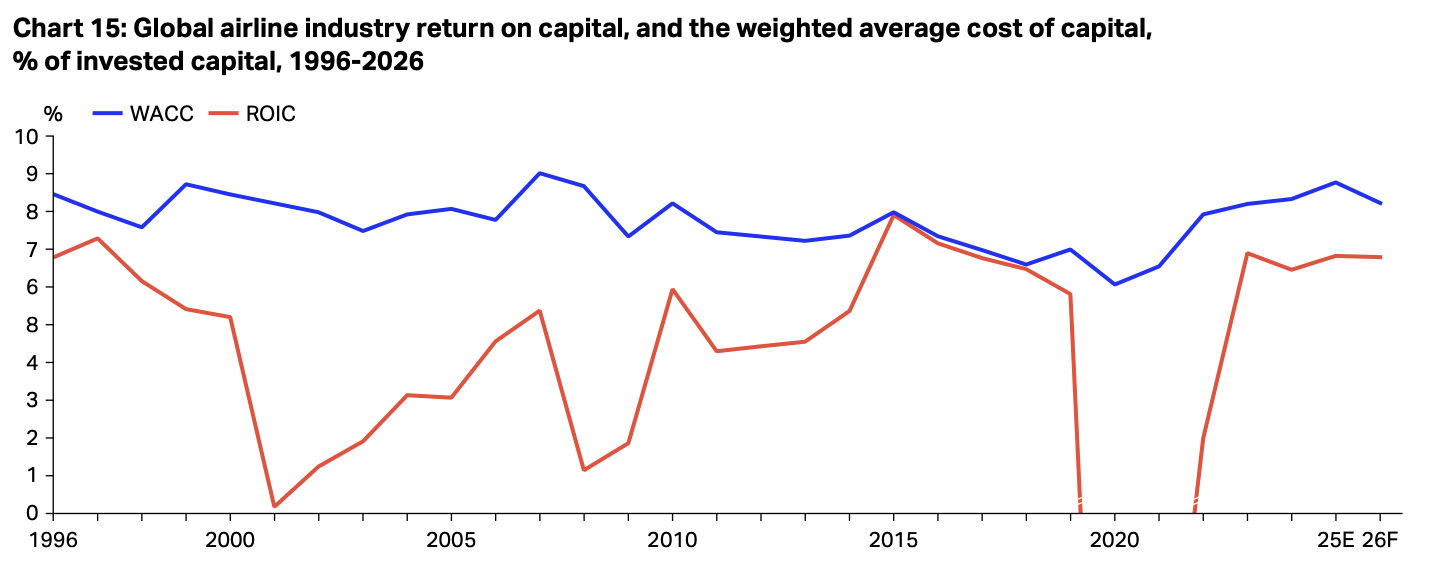
Airlines are expected to achieve record total net profits and exceed the previously predicted net operating margin for 2026, according to the latest financial outlook for global aviation from the International Air Transport Association (IATA). But the industry lobby group is at pains to emphasise that all is not as rosy as it seems for the sector, with net profit margins forecast not to rise year-on-year and return on invested capital (ROIC) lower than the weighted average cost of capital (WACC).
Total net profits at record high, but margins unchanged
On the plus side, the industry’s expected total net profit of $41 billion in 2026 (up from $39.5 billion in 2025) would indeed be a record, passenger numbers are expected to rise 4.4% to 5.2 billion in 2026, with load factors continuing to reach record highs and airlines expected to fill 83.8% of all seats over the year 2026. What’s more, cargo volumes are predicted to increase by 2.4% to hit 71.6 million tonnes.
However, the IATA report highlights that the sector’s net profit margin is predicted to be unchanged from 2025 at 3.9%, with net profit per passenger static, and cargo yields down 0.5%.
The financial outlook for the global ✈️ industry presented at #IATAGMD, show stabilization of profitability with 3.9% net margin expected in 2026, even as supply chain issues persist.
— IATA (@IATA) December 9, 2025
Details ➡️ https://t.co/zujsjibviB
Check out 👇 figures. pic.twitter.com/9ea9OVY9vn
“Impressive” resilience and stability?
It could be argued that the report has a strong whiff of expectation management and even downplay about it, with airlines keen to buck the perception that they are raking in billions during a period of global financial uncertainty and at a time when many countries are reviewing green policies and aviation taxes.
It is that very uncertainty that the IATA emphasises, noting that carriers continue to face “headwinds” in the words of Willie Walsh. Challenges include “rising costs from bottlenecks in the aerospace supply chain, geopolitical conflict, sluggish global trade, and growing regulatory burdens, the IATA Director General said in a statement. In his view, the data shows airlines as performing the “impressive” feat of having “successfully built shock-absorbing resilience into their businesses that is delivering stable profitability.”
🗣️ "In 2026, we expect an industry profit of $41 billion. Any large oil company can realize a similar profit in a single quarter, but this is for the entire industry for the entire year." IATA's Chief Economist. #IATAGMD presentation 👇 https://t.co/y9gBVngIeq pic.twitter.com/bVk4KSc4Rh
— IATA (@IATA) December 9, 2025
Cost of capital is an issue
Despite total industry revenues expected to reach $1.053 trillion in 2026 (up 4.5% on the $1.008 trillion expected revenues in 2025), 14% of which are made through ancillary products and other sources, for Walsh, the cost of capital versus earnings generated “remains an issue.” He points out that “margins are still a pittance considering the value that airlines create by connecting people and economies. They stand at the core of a value chain that underpins nearly 4% of the global economy and supports 87 million jobs. Yet Apple will earn more selling an iPhone cover than the $7.90 airlines will make transporting the average passenger.”
Supply chain issues, staff costs up, and regulatory burdens a risk
The supply chain is a constant refrain in the report, whether on the topic of aircraft, parts, fuel, or staff. Fuel efficiency gains will be up 1%, stymied by supply chain issues. While fuel costs are anticipated to decline slightly (by 0.3%) and fuel is expected to drop slightly as a proportion of total operating expenses, down from 26.8% in 2025 to 25.7% in 2026, the report points out that non-fuel costs are set to rise.
Staff costs are now “the largest cost component (28%) as wage growth continues to outpace inflation,” IATA says, complaining that having to rapidly restore staffing levels after COVID-19 lay-offs “amid very tight labor market conditions” has affected productivity.
Regulatory burdens are the other bugbear, with carbon-offsetting schemes a concern. “The cost of compliance with the Carbon Offsetting and Reduction Scheme for International Aviation (CORSIA) is expected to grow to $1.7 billion for 2026 (up from $1.3 billion for 2025),” IATA says. That’s an increase of over 30%.