
As we enter the second quarter of the 21st century, it is perhaps a good moment to think about what AI might mean for travel and tourism. There has been considerable speculation about what AI might mean for education, employment, and even for our understanding of what it means to be human.
As I write this, the UK Telegraph has just published an article headlined “How the ‘AI bubble’ could derail millions of retirement plans.” At the beginning of December, the Bank of England warned of a “sharp correction” in the value of major tech companies with growing fears of an artificial intelligence (AI) bubble. A repeat of the dotcom boom financial crash of 2000 is feared by many.
There is a great deal of hype about AI. Who has not been frustrated by the poor service provided by AI chatbots?
Research by the “European Broadcasting Union found that artificial intelligence assistants misrepresented news content in 45 percent of evaluated cases across languages and regions, highlighting persistent concerns about accuracy as AI adoption grows.” Accuracy ranged between 54% and 13%, and many models have high “hallucination rates”. If you have concerns about the model you are using, you can check it out here.
A colleague sent me a link to an article on Australia’s ABC channel: “Robots, AI and ‘smart tourism’ will change how we travel.” No interrogative. The article begins with an account by a PhD candidate at Griffith University of her recent trip to Shanghai.
“Mengni Fu checks in to her hotel room using her mobile phone from the backseat of a taxi. When she arrives at the hotel, she drops her luggage to one of the porter robots who delivers it to her room. She unlocks her room with a digital key on her mobile phone. Then she sits on the bed and asks the AI assistant to turn on the light, close the curtains and recommend a restaurant nearby.”
As I read this, I was reminded of the campaign run by the UK’s Voluntary Service Overseas in the late 1990s, a campaign which spurred the launch of the Responsible Tourism movement. Consumer demand for experiences has been, and is, an important driver of travel and tourism. The first experience of robots and AI will likely be memorable, but it is unlikely to be one that travellers and tourists will want to repeat.
As we asked in the VSO campaign: “A chance to get away, to meet new people. … Who will you meet? … Every travel brochure says: ‘meet our friendly local people, they are the warmth of our welcome’. But will you actually meet any?”
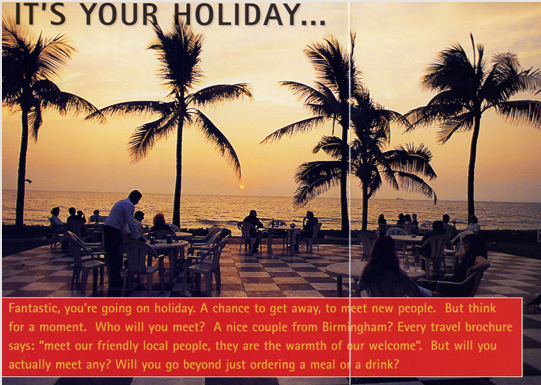
How warm will the robot’s welcome be?
New technology does have much to offer. “Smart tourism” is using AI and other technologies to manage flows, rebalance tourism and tackle overtourism. AI chatbots and large language models will likely encourage tourists to visit the most popular sites. Given the fashion for trophy photographs, perhaps the most useful AI would be an App that could take my photograph with the Sagrada Familia or the Piazza San Marco, in the background, without me having to bear the costs, time, energy and finance of travel.
If your interest in art stretches to wanting to have a free, long, close, uninterrupted view of a painting, so that you could see the brush strokes, take a look at Claude Monet’s work. I have recently enjoyed visiting the “digital twin” of St Peter’s Basilica, unveiled by the Vatican last year.