


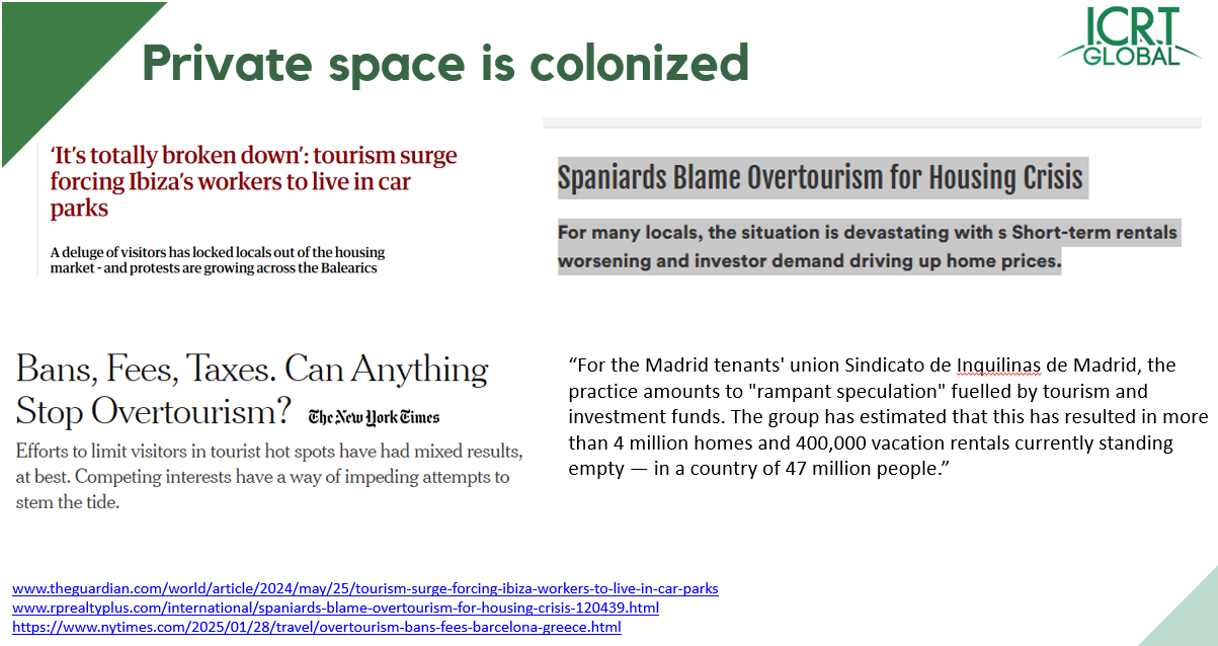
Research in 2024 revealed that 31% of travellers preferred to rent a house or apartment 50% preferring a hotel. Destinations were able to control the number of overnight tourists by using the planning system to regulate the number of available beds in hotels and hostels. Then came the unregulated growth in short-term rentals, efficient marketing on the internet and easier and cheaper access with the budget carriers.
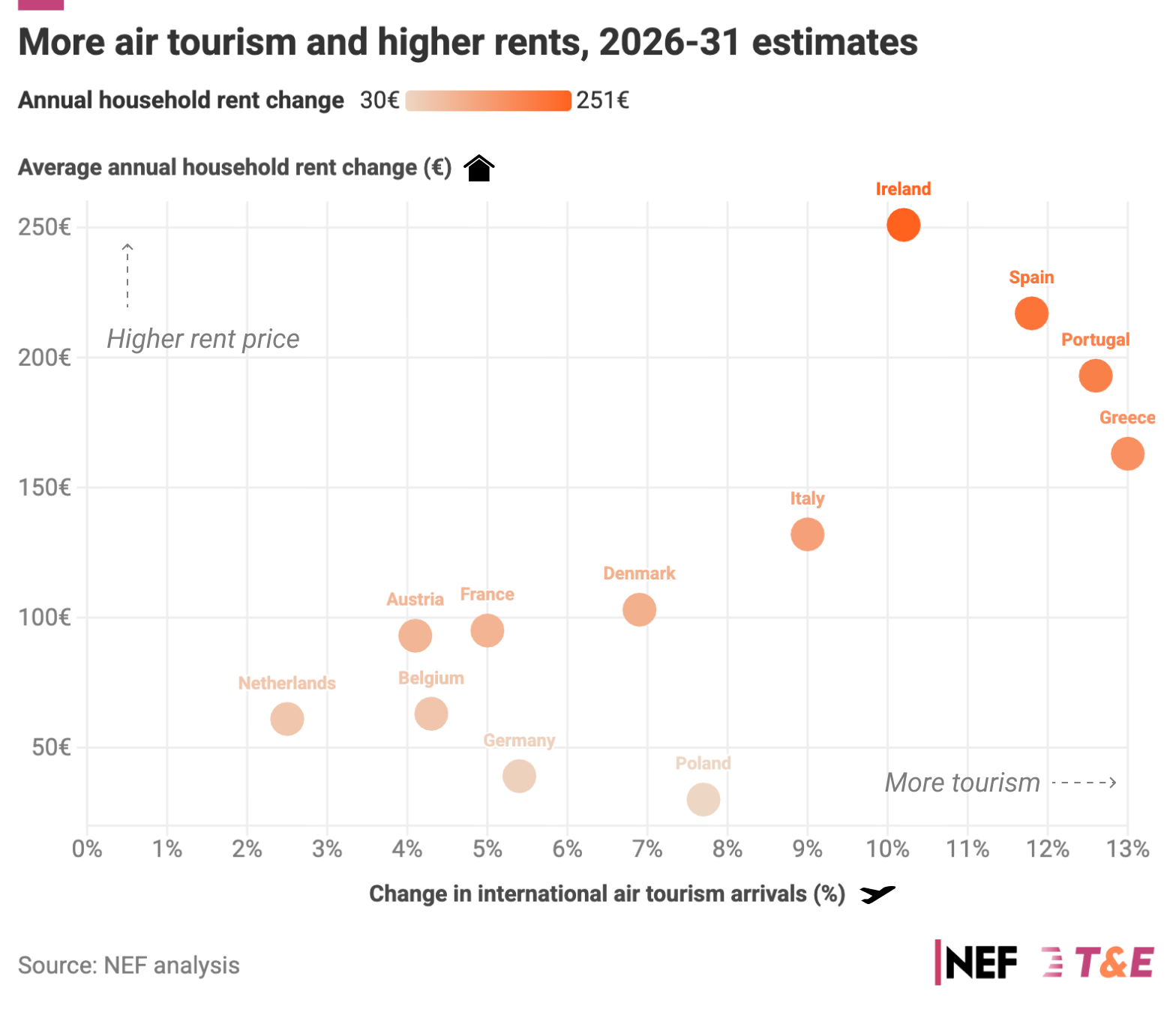
Transport & Environment commissioned the New Economics Foundation (NEF) to report on aviation’s contribution to fuelling unaffordable housing across Europe. NEF’s research “reveals that the average annual rents in five of Europe’s largest tourism-dependent economies are projected to rise by up to €250 per year over the next five years (2026-2031) as a consequence of incoming air tourism. These rises will primarily affect lower-income households, as income fails to keep pace with rental costs.” In short, more air tourism results in housing cost inflation. “In Europe, emissions from international tourist arrivals by air are projected to rise over 60% between 2016 and 2030.” As Transport & Environment point out, despite the growing concern over the impacts of tourism on local communities and the growing climate risks to the region, European governments continue to double down on aviation and tourism-driven growth – Spain has committed €12.9bn to airport investment, Athens is spending €1.3bn to boost capacity by 25%, and terminal expansions are underway in Lisbon.
Data Journalist, Thomas Hinton, has been looking at the evidence on the impact of tourism on rising rents and housing shortages. As he points out “when housing shortages, rising rents, and tourism accommodation are treated as one and the same problem, the policy discussion can quickly become blurred.” As so often when addressing overtourism, the local details matter. As Hinton points out “STRs may affect housing availability in specific neighbourhoods, but they are only one piece of a broader puzzle that includes zoning laws, construction permits, demographic shifts, urban concentration, and wider cost pressures.”
The issue is not whether STRs have an impact on housing for local people; they do. The challenge is to determine the scale of the tourism impact and whether or not “policies aimed at short-term rentals are proportionate, non-discriminatory, and aligned with EU-level rules designed to protect fair access to services across the internal market.” Research conducted by Eurocities Monitor in 2025 found 76% of mayors identify demand outpacing supply as the main driver of housing unaffordability in European cities; only 25% cited STRs as a cause. According to the European Commission’s Joint Research Centre, STRs represent around 1.2% of total housing. In Barcelona, short-term rentals make up 7.1% of local housing stock, compared to 2.8% in Paris and 1.9% in New York.
And we should remember that a quarter of Europeans cannot afford a week-long holiday.