

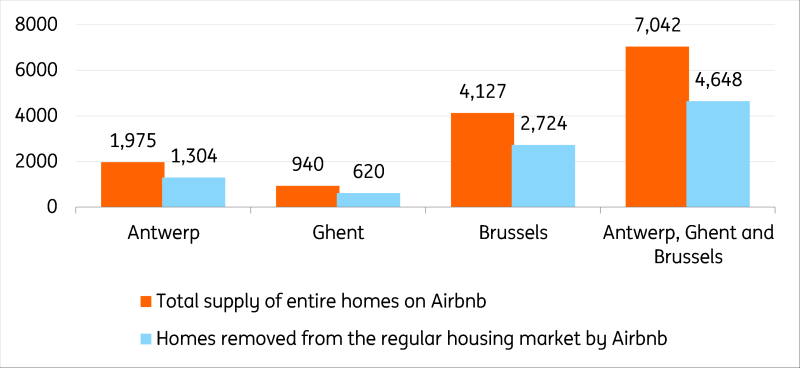
Thousands of homes across three of the largest cities in Belgium are no longer available on the regular housing market because they have been turned into short term rentals, a new study shows.
The research by ING bank reveals 5,000 properties in Brussels, Antwerp, and Ghent, representing 0.8% of the housing market in some of the most expensive cities for rent in the country, are being let out through accommodation giant, Airbnb, alone. What’s more, “this share is likely even higher if we include other platforms such as Booking.com and Expedia,” said Alissa Lefebre, economist at ING.
In 2024, around 1.23 million stays were booked via these platforms in Belgium, accounting for 12.3 million overnight stays, ING’s analysis found. In 2025, the 10-million overnight stay threshold had already been surpassed in the first three quarters of the year.
While the Flemish government in the north of Belgium has announced the introduction of stricter controls over short-term rentals, Lefebre argues such measures in isolation are not enough to improve the situation. Addressing the size and type of property available in the cities’ housing stock is also key, she said explaining that new building permits tend to focus disproportionately on single family dwellings. These have seen a year-on-year 17% uptick in planning grants, while permissions to build apartments are down 8% — a situation that does not align with demand. “The housing supply must respond better to changing demand,” Lefebre said, “among other things by encouraging and facilitating housing projects within smaller units.”
Other factors affecting people’s ability and confidence to find homes include how stable the investment climate is, the bank said. It is also important to make sure any new legislation on housing quality and energy performance do not lead to perverse effects on housing supply. ING cited rent caps as an example of a measure that has had a negative effect by reducing rental supply, dampening construction, and lowering market turnover.
Part of today’s problem has been poor compliance with regulatory attempts to deal with the impact of short-term rentals on the housing market. But new European rules in force since May 2026 aim to address this by requiring platforms to share data. A key next step, ING points out, is the “creation of a national registration system, which could bring an estimated 1,800 out of 4,650 homes back to the regular housing market.”
However, authorities must find ways to alleviate other “structural bottlenecks,” such as low construction activity, high costs, supply chain issues, and bankruptcies within the sector, ING argues.
The bank’s findings come against a backdrop of wider concerns about tourism’s impact on residents and its economic contribution to Belgian life. Brussels has repeatedly clashed with Airbnb over failures to provide fire safety certificates, criminal record checks, and breaches of urban planning stipulations over building use, as well as targeting property owners over unpaid taxes.
Ghent updated its “noise action plan” in early 2026, putting noise limits of 60 decibels on sensitive areas such as restaurant terraces, and 70 decibels for temporary peaks, with exceptions for major events. Going forward, the city’s canal tours will be required to switch to electric propulsion and to use headphones instead of loudspeakers.
And in summer 2025 the coastal destination of Ostend put forward plans for liveability bylaws to limit Airbnbs in some neighbourhoods and ban key boxes (which allow guests to collect keys without the owner needing to be present) in order to improve hosts’ accountability.