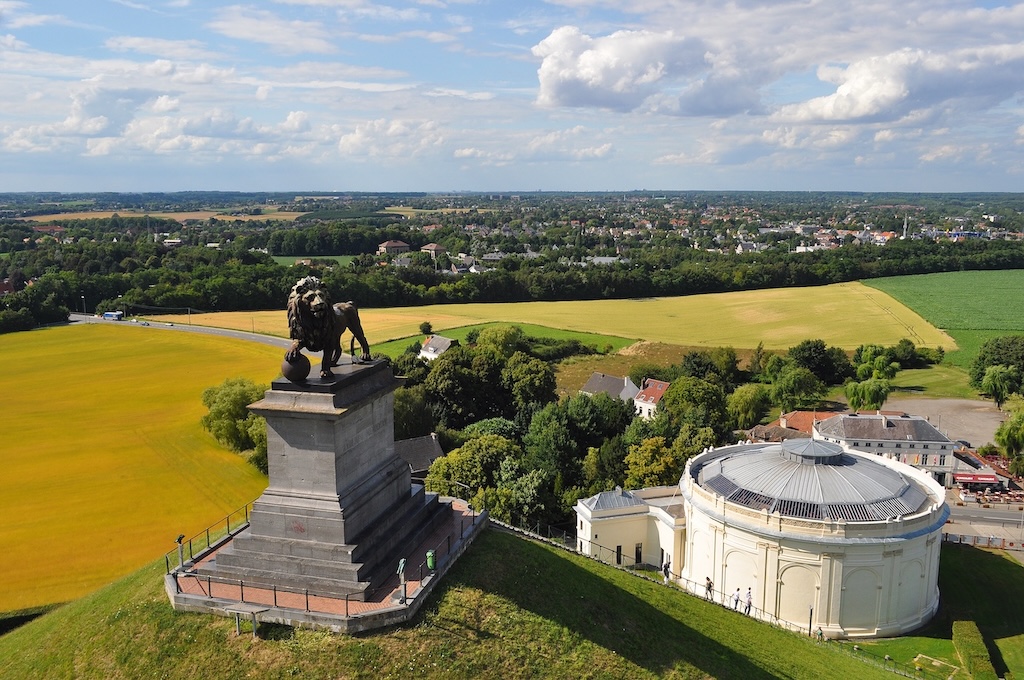



Ever since its completion in 1826, the Lion’s Mound has stood as a symbol for the end of the Napoleonic Wars. Now that the freshly renovated monument is celebrating its bicentenary, multiple events are allowing visitors to discover the Lion in a new light.
Since its inauguration in 1826, the Waterloo battlefield and the Lion’s Mound have become some of the best-known destinations in Wallonia. The Mound alone attracts some 175,000 visitors annually.
As a prominent site of historical and symbolic value, the imposing Lion of Waterloo (which is located in Braine-l’Alleud) was the start of a larger project on the grounds of the battlefield, which also includes the historical Hougoumont Farm and the Memorial 1815, a modern underground museum featuring immersive exhibitions. Every year, a number of events and historical weekends bring the history of the grounds alive.
In order to prepare the Lion’s Mound for its 200th anniversary, the monument underwent a series of major restoration works between the end of 2025 and May 2026. The works involved repairs to the long staircase to the top, including its steps, balustrade, and handrail. Stone and cast-iron elements were refurbished, as well as the statue of the lion itself. The works cost the Belgian federal government some €650,000, with funding contributed by the National Lottery.
The reopening of the Lion of Waterloo on 22 May 2026 also kicked off a year of celebrations, honouring the Lion’s bicentenary. Several events have been and will be organised in order to put the special occasion in the spotlight it deserves. We selected some unmissable happenings.
Iconic Lion, a photo exhibition
Until 31 December 2026, the Waterloo Battlefield Estate hosts Iconic Lion, an extensive photographic exhibition dedicated to the Lion’s Mound. The first part features the work of two professional photographers, Samuel Bouchoms and Jean-François Schmitz, and is on display at the underground museum Memorial 1815. Outdoors, the photo exhibition takes visitors on a journey past some of the battlefield’s most iconic locations. The selection of shots on show was captured by the public and gathered through a social media contest.
A festive and family-friendly weekend
For the time of a weekend, on 15 and 16 August 2026, the Waterloo Battlefield Estate will be organising a series of family-friendly activities on and around the Lion’s Mound. The programme includes a bouncy castle, games, a climbing wall, and a giant zip line launched from the top of the Lion’s Mound. Visitors will get to enjoy historical activities with the 1815 reenactors, including rifle and cannon firing demonstrations, and tickets (ranging from €0 to €27 per person) include a concert by the band Mister Cover on the evening of 15 August.
A show for the 200th anniversary of the Lion’s Mound
On 12 September 2026, the Lion’s Mound’s bicentenary will be celebrated through a grand show, narrated by Patrick Weber. Through a combination of storytelling, historical scenes, projections, and spectacular staging, the events that shaped the iconic site since 1826 will be brought back to life. The event is accessible to all (tickets cost €26 per person), and the experience will be elevated by a musical performance by students from Musica Mundi.
A little history
On 18 June 1815, a stretch of land located in what is now known as the towns of Braine-l’Alleud and Lasne (just south of Brussels) was the stage of a battle that went on to make history. On that day, the French Imperial Army under the command of Napoleon was met by two allied forces of the Seventh Coalition, led by the Duke of Wellington and Field Marshal Blücher.
The French were defeated; the Battle of Waterloo meant the end of Napoleon’s Hundred Days return from exile, and thereby the end of the Napoleonic Wars. A relative sense of peace came over Europe, but 40,000 men lost their lives on the battlefield, while many more were wounded. One of those men was the then Prince of Orange, William, the eldest son of King William I of the Netherlands. During the battle, the prince was hit in the shoulder by a musket ball and knocked from his horse as a result.
In 1823, King William I decided to build a monument to commemorate the victory of the Seventh Coalition and to remember the fallen soldiers. For the design, he commissioned his architect, Charles Vander Straeten, who planned the project in such a way as to position it on the spot where the Prince of Orange got hurt.
Over the next three years, the monument took shape. Some 290.486 cubic meters of earth were taken from the battlefield to shape the 40-meter-high mound, a move criticised by many at the time as it undeniably altered the original outlook of the location, chosen precisely because of its rolling landscape. The hill was crowned by a triumphant cast-iron lion – looking towards defeated France – designed by sculptor Jean-Louis van Geel, while 226 steps completed the project.
For more information about Wallonia and to plan your trip, see VISITWallonia.com, the official tourism website for Belgium’s southern region, offering inspiration on destinations, attractions, accommodation, outdoor activities, cultural heritage and local gastronomy.