


Many cinema goers feel like most pictures are longer than before. But is that really the case? Film industry analyst Stephen Follows took a look at the numbers and confirms what movie enthusiasts have suspected for a long time.
36,431 – that’s exactly how many movies Stephen Follows analysed before appearing on the podcast The Town, hosted by Matt Belloni. His goal was simple: to determine whether or not movies have actually gotten longer over the years, as many cinema enthusiasts feel like they have.
The outcome of his analysis is less straight-forward then one might expect. Since 1980, when simply looking at all films produced worldwide, not a lot has changed. Average movie length has fluctuated a little from one year to the other, but stayed within the 100 to 103-minute region.
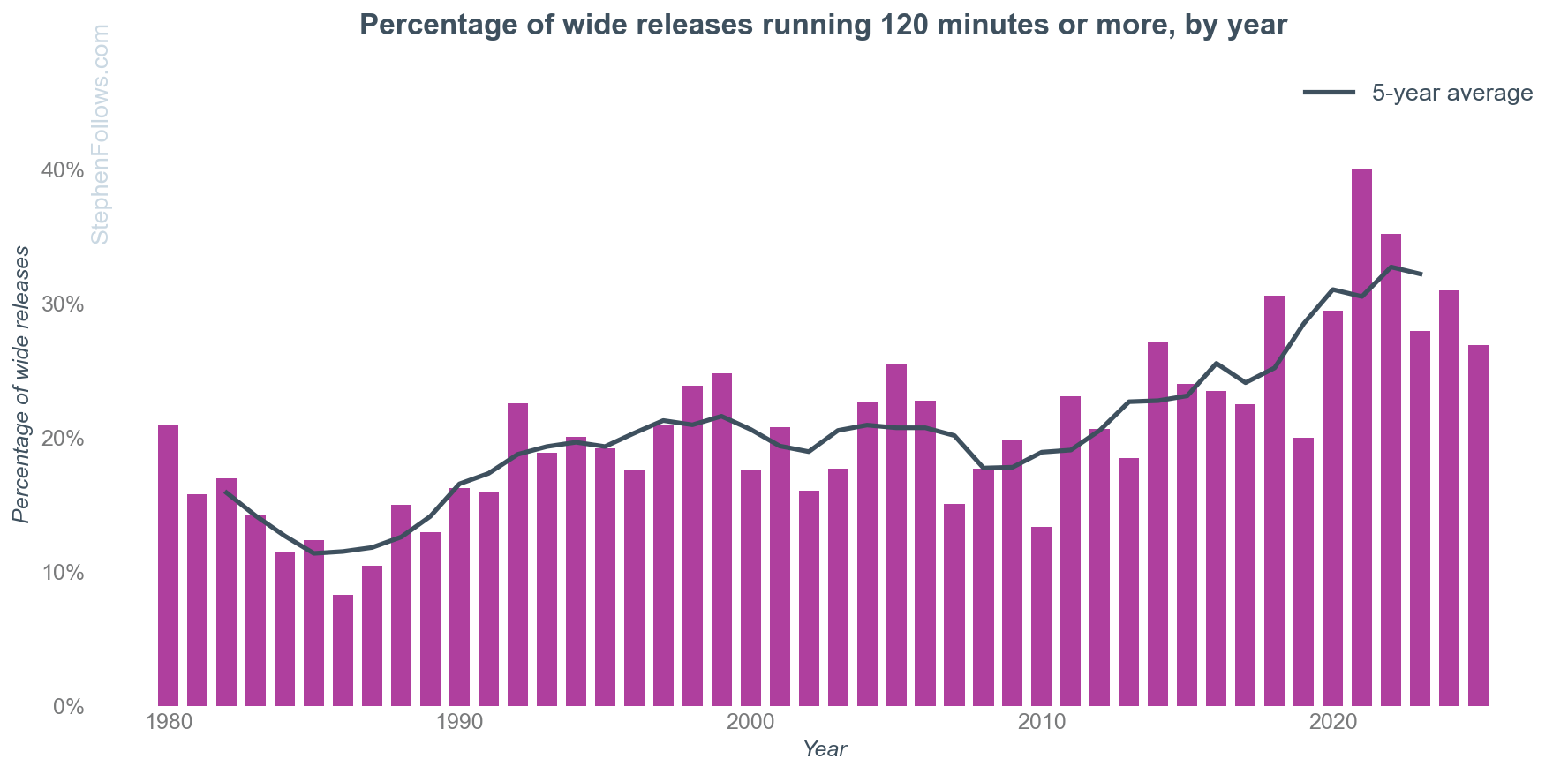
However, when looking at so-called theatrical releases – defined by Follow as movies that open in hundreds or thousands of cinemas across North America – things start to look different. In the early 2000s, those movies went on for 106 minutes on average, whereas by the 2020s that number had already risen to 114 minutes.
Moreover, while around 14% of wide releases ran over two hours in the 1980s, that percentage increases to 32% in the 2020s. And when looking at wide releases that ran under 90 minutes, the number shrank from 13% in the 1980s to 7% in the 2020s.
“The whole distribution has shifted upwards. While there are some outliers dragging the average up, it’s more the case that the entire middle ground has moved. The 105-to-119-minute film is now the most common runtime bracket for a wide release, and the two-hour-plus film is no longer unusual,” Stephen Follows writes.
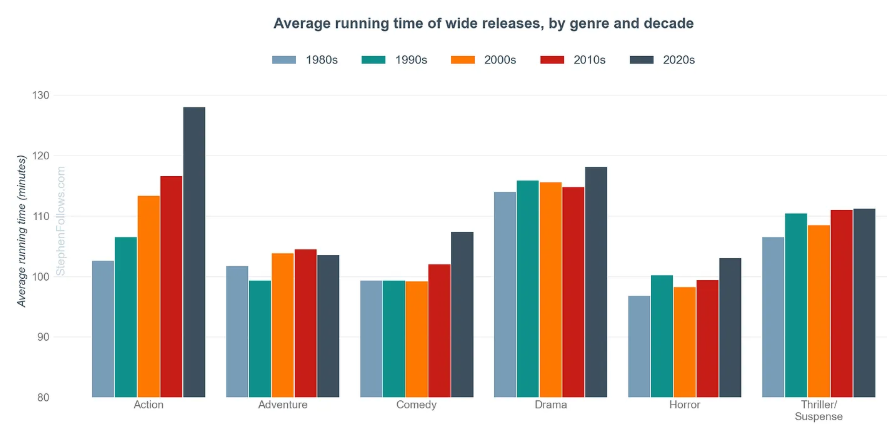
When looking at specific genres, action movies seem to be massively driving the average length increase, going from 103 minutes in the 1980s to 128 minutes in the 2020s. Making movies that go one for longer than three hours on end also seems to have become more popular over the years. Follows mentions The Batman (175 minutes), Oppenheimer (180), Avatar: The Way of Water (190), Killers of the Flower Moon (206), and The Brutalist (215) in particular.
Why, oh, why?
Only one question remains: why did movies get longer while mid-movie pauses have gone extinct? Audiences feel like they get more value for their money, as most cinemas don’t charge extra for longer movies, while studios get to turn their movie into a big event.
“My read on this is that a studio spending $200 million on a film wants every set piece on screen and for the audience to feel they got their money’s worth from a premium-priced cinema ticket. Cutting twenty minutes might make for a tighter film, but it doesn’t make for a bigger event,” Follows explains.
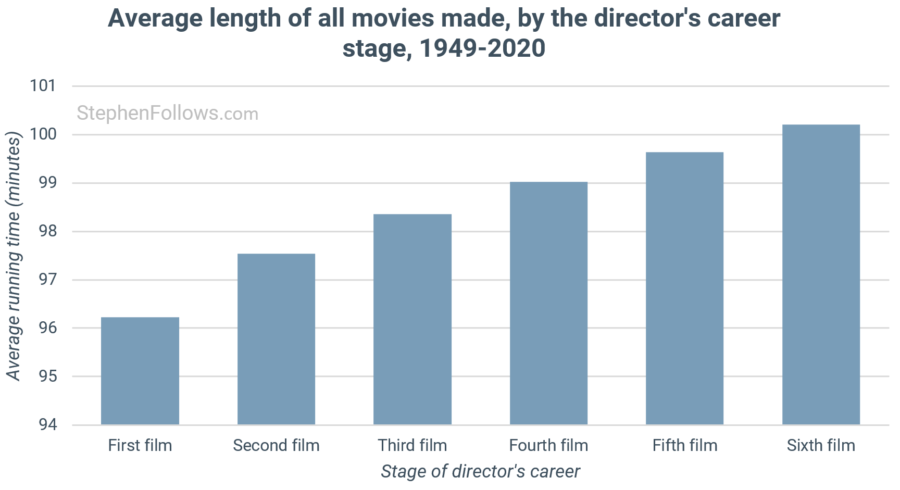
However, there are other explanations too. For example, digital projection has removed the impractical need to change film reels and streaming may have taken over the shorter movie market. In his analysis, Follows provides yet another few possible explanations with explanatory graphics for the fact that theatrical releases movies have, indeed, become longer.