


Cool roofs could save hundreds of lives during hot weather, scientists have found, providing more evidence that painting roofs a paler colour helps to reduce the urban heat island effect that sees built-up areas get hotter than greener spaces.
The effects of global warming mean that spells of extreme heat present a growing risk to public health, especially for vulnerable individuals who live in highly urbanised places. But the latest study by researchers from University College London (UCL) and the University of Exeter, found that light-coloured roofs installed across all of London’s skyline could have kept the UK capital 0.8°C cooler during the heatwave of 2018, preventing 249 fatalities. That’s 32% of the 786 heat-related deaths that happened in London in the unusually hot months (1.6°C higher than seasonal averages) of June, July and August that year.
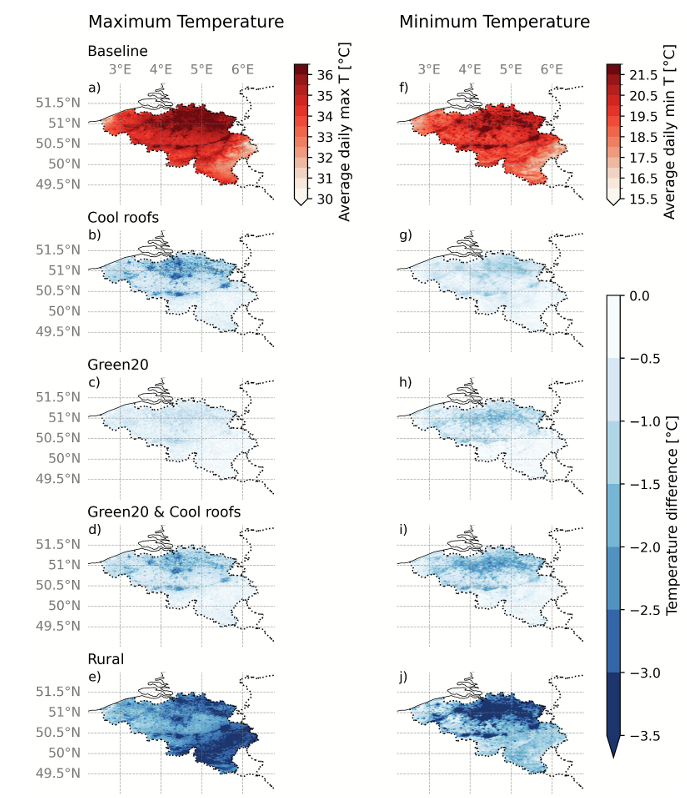
UCL published its findings in Environment International in partnership with Belgium’s Sciensano, VITO, and KULeuven. Belgium is one of the most densely built-up countries in Europe, and in the Belgian capital, up to a quarter of the heat-related deaths during the July 2019 heat wave could have been prevented with the implementation of cool roofs, it claims.
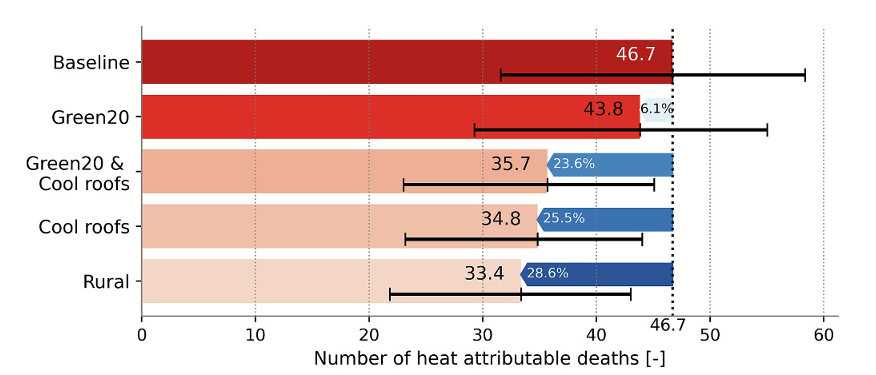
during the July 2019 heatwave in Brussels. © F. Serras et al.
“If widely adopted, cool roofs can significantly reduce the ground-level air temperature of a city,” explained the study’s lead author, Dr Charles Simpson from the UCL Bartlett School Environment, Energy & Resources, adding: “The resulting cooling effect across the city would save lives and improve the quality of life for residents throughout the urban area.”
White painted or lighter-coloured roofs, as often seen in the picture postcards of Greek islands and hot Mediterranean countries, work to cool neighbourhoods down because they absorb less of the sun’s radiant energy than traditional roofing materials in countries like the UK, where black bitumen, grey slate, and terracotta tiles are more frequently seen overhead.
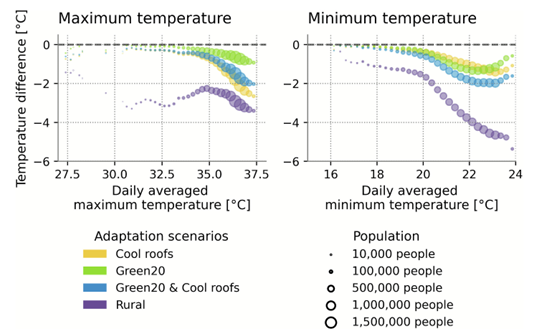
As cool roofs store and give off less heat, surrounding air temperatures remain cooler too. Implemented on a large scale, it’s possible to decrease outdoor temperatures, “especially during hot, cloudless summer days,” the researchers say, comparing it to “the difference between wearing a black T-shirt or a white T-shirt in the sun,’ according to KU Leuven researcher Fien Serras. “You stay cooler in the white T-shirt. The same principle applies to roofs, but with an impact on the whole city.”
The UCL and international team are recommending roofs that are intentionally made more reflective, for example, by installing white or light-coloured roof covering, by applying special coatings, or by using specific materials that reflect solar radiation. Having looked at the effect of adding greenery into urbanscapes, they also point out that more green spaces in combination with cool roofs proved important to lower nighttime temperatures—offering crucial recovery time for the human body when the temperature soars.