


Bathers and beachgoers on France’s Atlantic Coast and the Cantabrian Coast in Spain have been warned about physalia (also called portuguese man o’ war), sea creatures with dangerously venomous tentacles.
Lifeguards in the southern French departement of Pyrénées-Atlantiques, and city authorities in San Sebastian, Spain are advising against bathing on some regional beaches, using white flags to indicate the man o’ war’s presence and a red flag to prohibit swimming.
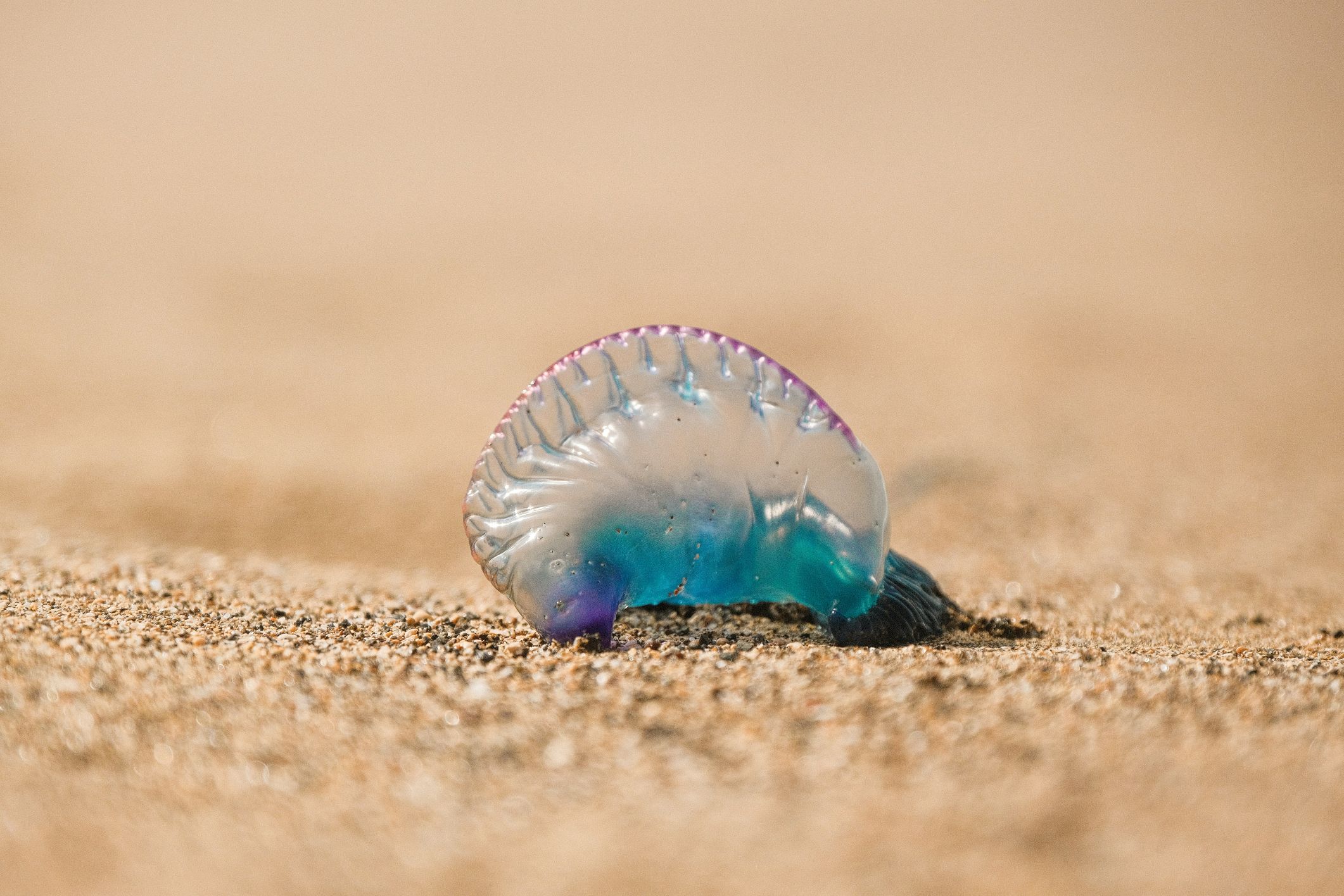
Not, as commonly thought, a jellyfish, but a siphonophore, the man o’war is recognisable on shorelines and in the sea as a transparent purplish balloon, with a pink-tinted head-dress and long violet-blue tentacles. Named for a supposed resemblance to an 18th century Portuguese warship, it is not in fact one single creature since it is a “colonial hydrozoan,” or a group of smaller “animals” that share food and act as one living unit. Their tentacles, which cause extremely painful burns to humans, can extend to 10 metres in length, with records hitting around 30 metres.
@.extremenature The Creature That Looks Like a Jellyfish — But Is Actually a Colony (Portuguese Man O’ War) It looks like a harmless jellyfish drifting on the ocean surface. It isn’t. The Portuguese man o’ war is a floating colony made of specialized bodies called zooids. Some keep it afloat. Some digest food. Others form tentacles that can extend more than 30 meters below the surface. Along those tentacles are thousands of microscopic harpoons loaded with venom. Most people only see the blue sail. They never see the weapon beneath it. Did you know this wasn’t actually a jellyfish? Follow for more from the depths. #OceanScience #MarineBiology #PortugueseManOWar #Educational #NatureDocumentary ♬ original sound – Extreme Nature
It is the partly the reach of the tentacles that makes the man o’ war rightly feared, since they can be spotted bobbing on the surface of the water some distance away yet still inflict agonising injury.
Authorities advise exiting the sea straight away and alerting a lifeguard but even that should be done carefully since the man o’ war’s capacity to wound continues even after the creature has died, been washed up on the sand, or its tentacles have been separated from the body.
Wounds usually appear as red whiplash marks where the venom has broken down local tissues in a process known as cytolysis. Authorities advise anyone who believes they have been injured by a Portuguese man o’ war to rinse any welts with seawater, or a mix of food vinegar and warm seawater at a 1:3 ratio.
A number of actions are no-nos since they risk releasing more venom. Fresh water and ice packs are to be avoided, as should rubbing or scratching the wound. Never touch the tentacles bare-handed, even to remove parts of them from a victim – a process that should be done with tweezers. Never rinse with urine (despite the advice in a popular episode of Friends), or apply any creams, or gels.
Medical attention should be sought if the discomfort does not subside. In the worst cases, victims may also experience headaches, high temperatures, muscle cramps, nausea, vomiting, respiratory difficulties, and cardiac problems, to which, again, a doctor or medic should be alerted.
The usually tropical man o’ war’s arrival on Basque and Cantabrian shores may be linked to warming sea currents amid a summer of multiple heatwaves that experts agree are worsened by climate change. Elsewhere the same phenomenon has cause mass coral bleachings, multiplied flesh-eating bacteria at European beaches, and supercharged sargassum blooms in the Caribbean in a series of environmental impacts that tell a tale of warming planet.