Hard coral in the Caribbean has declined by nearly half within the last five decades, according to a study by regional coordinators in the Global Coral Reef Monitoring Network (GCRMN) that shows reefs in the Caribbean have lost 48% of the hard coral they possessed in 1980.
The GCRMN Caribbean region boasts 24,230 km² of coral reefs, comprising 9.7% of the world’s coral reef extent. Hard coral is the living, hard, reef-building coral that scientists use to monitor reef health. It provides an essential habitat, supporting around one-third of all named marine species.
It also sustains humans. In the Caribbean, healthy coral is valued at $6.2 billion annually in fisheries and tourism benefits. What’s more, coral reefs act as a natural barrier against wave energy and storm surges, protecting coastal communities and ecosystems, in a region where, the study authors say, 47 million inhabitants lived within 20 km of a coral reef in the Caribbean in 2020.
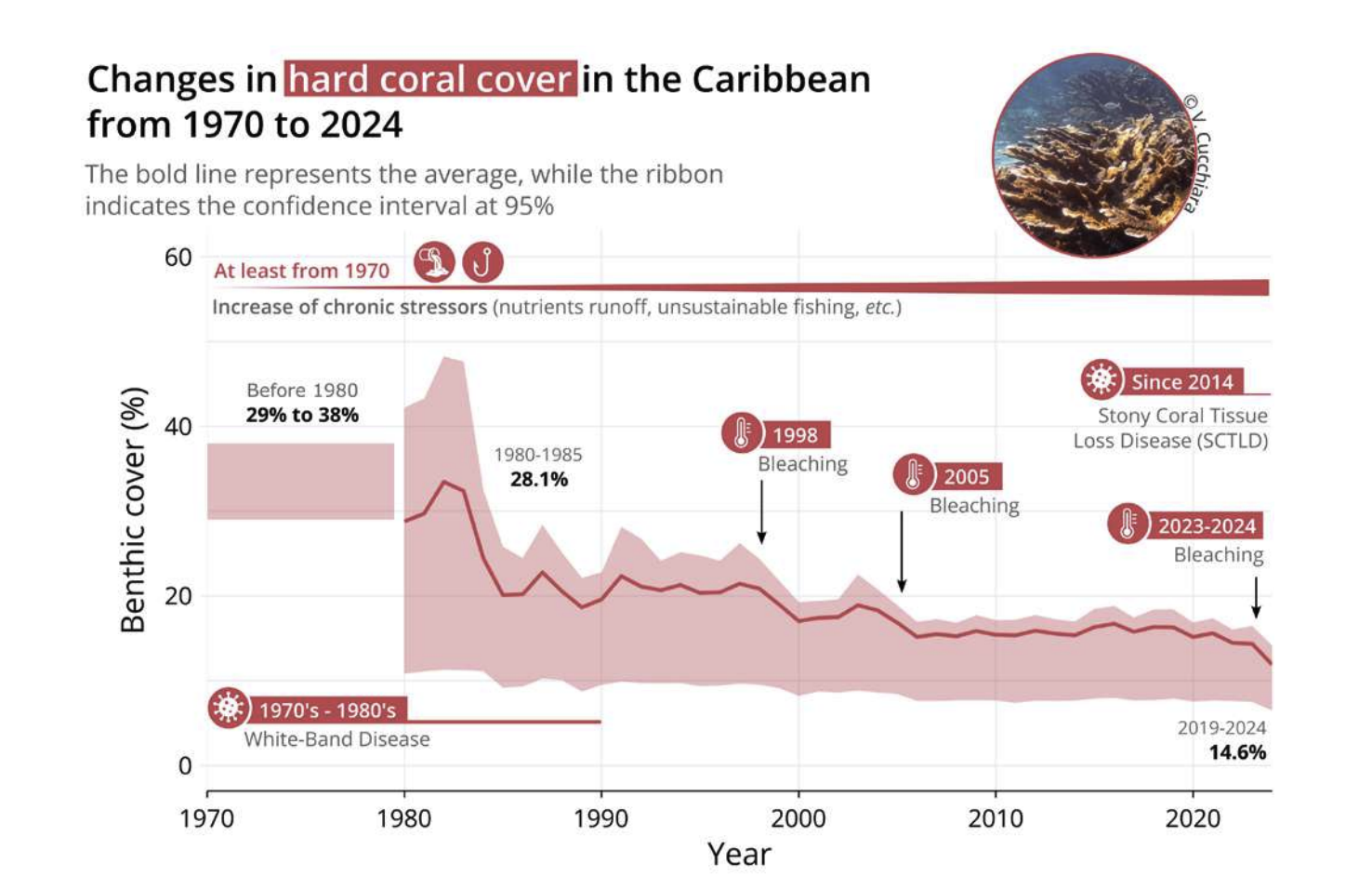
But hard coral around the Caribbean has decreased from 28.1% in 1980–1985 to 14.6% in 2019–2024, the researchers say, attributing the phenomenon to climate change and fossil fuel-driven global warming. Between 1985 and 2024, sea surface temperatures across Caribbean coral reefs increased by an average of 1.07°C, representing a warming rate of 0.27°C per decade. While all countries and territories in the region experienced this warming, the largest long-term increases were recorded in Mexican waters, Guatemala, and the Flower Garden Banks National Marine Sanctuary, where sea surface temperatures rose by about 1.4°C.
Meanwhile, marine heatwaves, where sea surface temperatures remain unusually high for prolonged periods, become more “frequent, intense, and longer lasting,” the researchers found. Events in 1987, 1998, 2005, 2010, 2015– 2017, 2020, and 2023–2024 have led to mass coral bleaching, a stress response that sees corals expel the vital algae living in their tissues, turn white, and risk starvation. The GCRMN’s Dr Jérémy Wicquart said in 2023-24, the region’s coral experienced “the most destructive thermal stress ever recorded.”

Climate change is also making hurricanes more violent, and hurricanes damage coral. From 1980 to 2024, the authors estimate 171 hurricanes passed within 100 km of coral reef systems, with “notable peaks” in 1995 (11 hurricanes), 2005 (15), and 2017 (10).

In a region where the coral falls under 44 jurisdictions, the authors are calling for an integrated approach to reef protection and financing, embedding policies into the United Nations Framework Convention on Climate Change (UNFCCC) and the Convention on Biological Diversity, as well as national strategies and adaptation plans.
They also want to see a reduction in local threats, from greenhouse gas emissions to trade in invasive species, more maintenance and monitoring, and a scaling up of coral restoration projects.