The global warming that comes from aircraft contrails could be reduced by actions as simple as changing “just a handful” of flight paths at certain times of year, new research shows.
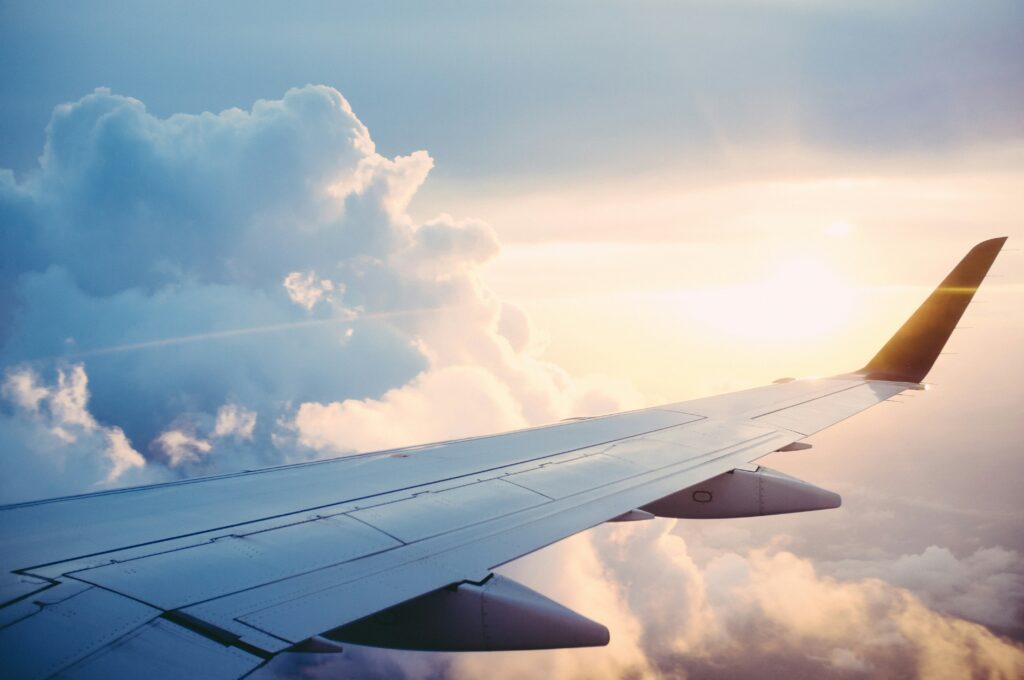
Contrails can be seen from below. They are the white lines left behind in the sky when planes fly through regions of cold, humid air. These aviation emissions linger in the atmosphere and form pollution clouds that blanket the Earth, trapping heat.
But an analysis by T&E (Transport & Environment) has found that the majority of contrail warming happens because of night flights in the autumn and winter months in specific places. Tiny adjustments to flight routes, or the way planes climb and descend, to help them bypass cold and humid areas, would “significantly reduce contrail formation,” T&E says.

In detail, in 2019, 75% of European contrail warming occurred between January and March, and from October to December. Late evening and night flights caused 40%. Combined, night flights in autumn and winter accounted for 25% of European contrail warming, from just 10% of air traffic. Therefore, T&E points out, adjusting a small number of flights would bring major climate benefits with minimal effects on air traffic.
“Contrails are a very concentrated problem. Fortunately, there are straightforward and affordable opportunities to scale up contrail avoidance in Europe. The science and the solutions are clear: by adjusting the paths of just a handful of flights, Europe could prevent years of avoidable global warming,” said Alexander Kunkel, Senior Analyst at T&E, in a statement.
When it comes to place, contrail concentration happens around specific locations. The study confirms that the North Atlantic has high contrail avoidance potential. The airspace above the North Atlantic is dominated by long-haul flights with high contrail warming but has low traffic density. In 2019, long-haul flights above five hours accounted for 40% of contrail warming while making up only 10% of European departures. This “high warming low traffic” scenario is an ideal candidate for tackling contrails, T&E says, noting that re-routing can be planned in advance using weather forecasting and before the flight takes off. This would reduce controller workload and ensure safe operations.
“The time to shift into the next gear on contrail action is now. By boosting research, supporting large-scale trials, and designing a policy framework, Europe can pave the way for the deployment of contrail avoidance in the next five to ten years,” Kunkel added.
At the European Union level, T&E says scaling up contrail avoidance would mean:
- including non-CO₂ effects and contrails in air traffic management (ATM) legislation.
- Maintaining the EU’s non-CO₂ monitoring scheme ensuring it covers extra-EEA flights, to further improve data and research on contrails.
- incentivising airlines and air traffic control centres to avoid contrails
- conducting large-scale airspace trials to develop better knowledge on contrail avoidance.