


August 2026 was the world’s joint hottest month ever recorded, tying with July 2023 as global temperatures climbed back above 1.5°C over pre-industrial levels, according to the Copernicus Climate Change Service (C3S).
The global average surface air temperature reached 16.96°C last month, which is 0.85°C above the 1991–2020 average. It made August the warmest August in the ERA5 dataset and the joint-warmest month across all calendar months along with July 2023.
Temperatures were 1.65°C above the estimated 1850–1900 pre-industrial average, marking the first month since November 2025 in which the global temperature anomaly exceeded 1.5°C.
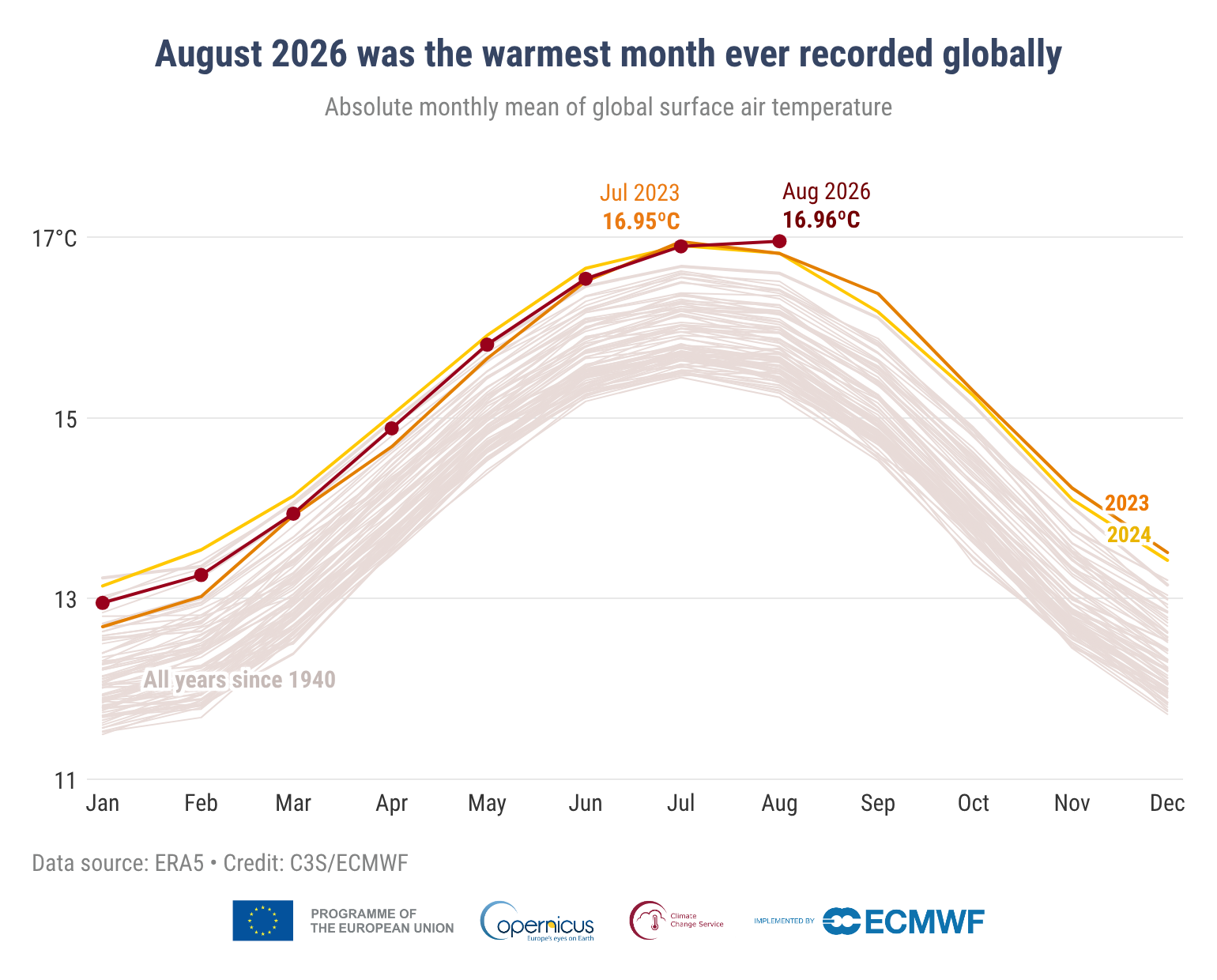
Under the 2015 Paris Agreement, countries committed to pursuing efforts to limit long-term global warming to 1.5°C above pre-industrial levels. A single month exceeding that threshold does not mean the long-term Paris Agreement target has been breached, which is measured over a longer period. The global average temperature for the 12 months from September 2025 to August 2026 was 1.48°C above pre-industrial levels.
“August 2026 was a remarkable month in the global climate record,” said Samantha Burgess, Strategic Lead for Climate at the European Centre for Medium-Range Weather Forecasts (ECMWF). “Combined with record global sea surface temperatures and the warmest summer on record for Western Europe, these observations show how climate change is driving extremes across both the atmosphere and the oceans.”
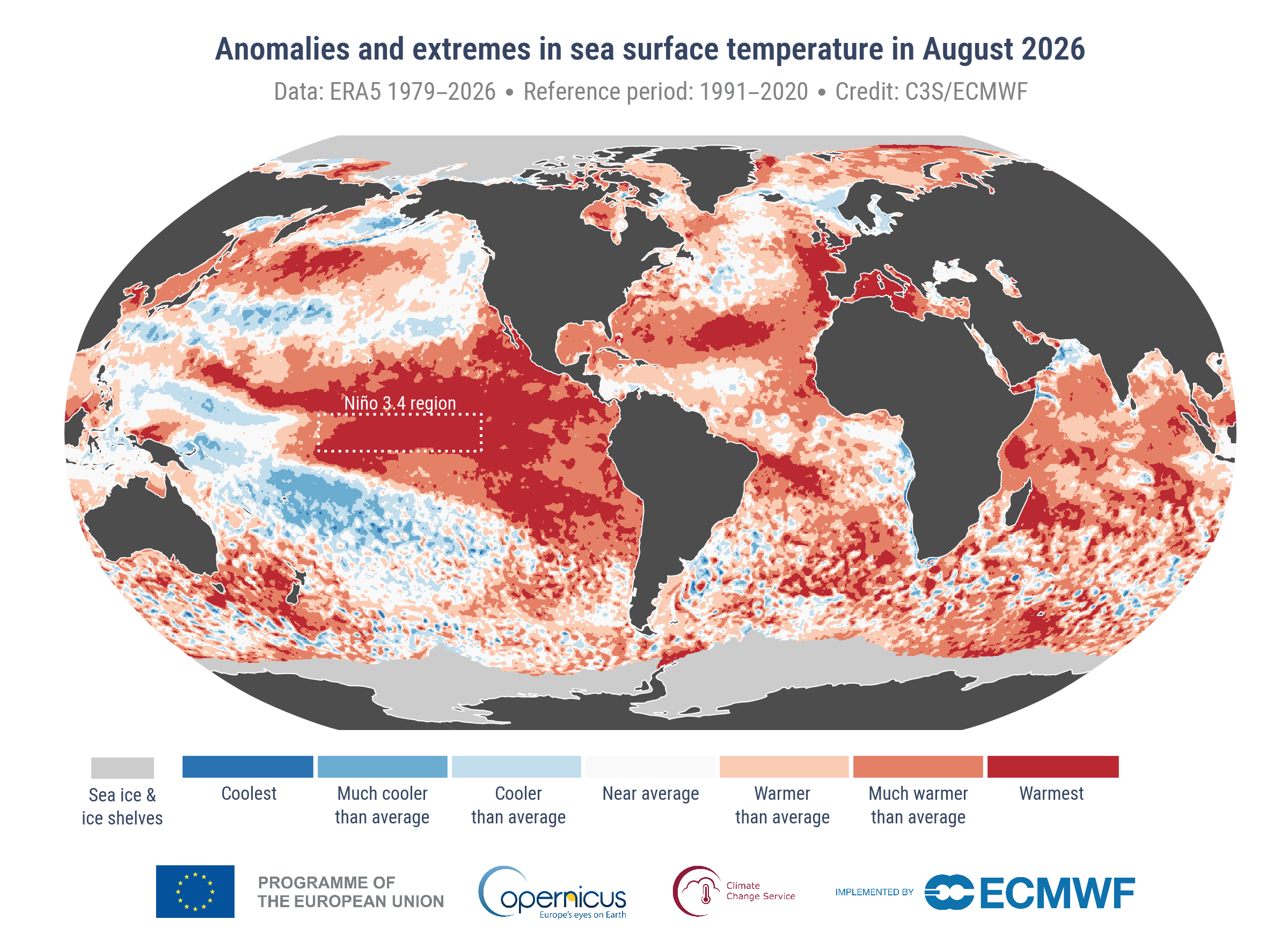
Ocean temperatures also reached record levels. The average sea surface temperature across extra-polar oceans, between 60°S and 60°N, stood at 21.07°C, the highest recorded for August and equal to the all-month record set in March 2024. Copernicus said the exceptional temperatures reflected global heating alongside rapidly developing El Niño conditions in the equatorial Pacific.
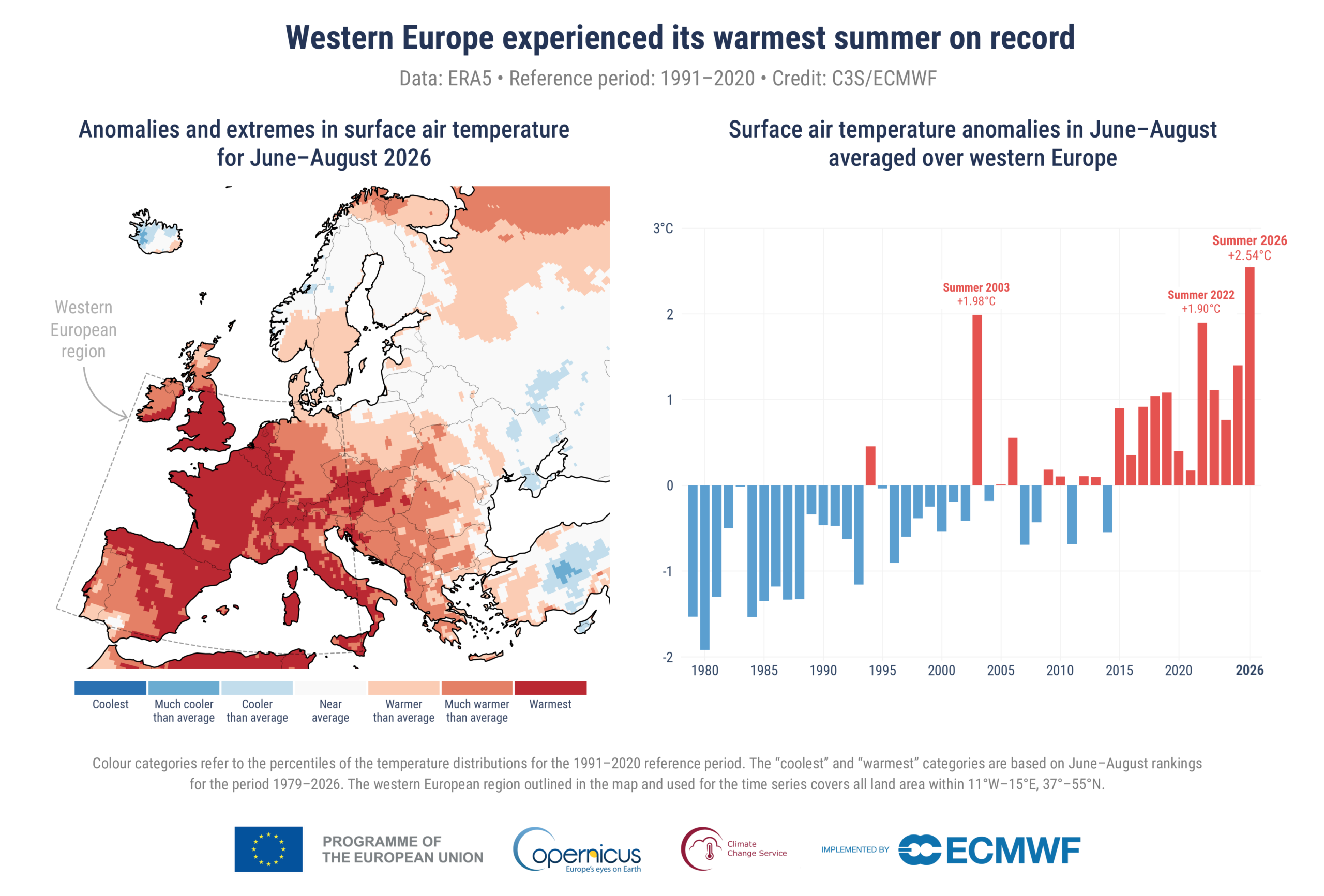
Europe also experienced unusually high temperatures. The average temperature over European land in August reached 20.26°C, 1.10°C above the 1991–2020 average, making it the continent’s fourth-warmest August on record.
Summer 2026 was the third warmest recorded across Europe as a whole, behind 2024 and 2022. Western Europe, however, experienced its hottest summer on record, surpassing the previous record set in 2003 after a succession of early, persistent and intense heatwaves.
Dry conditions also affected large parts of Europe during the summer, with exceptionally low soil moisture and widespread low river flows. By August, several major European rivers were experiencing unusually low water levels, with the Danube stranding cruise ships and disrupting tourism in Hungary. Rhine, Southern Bug and Dnieper also saw exceptionally low flows, while the Vistula, Glomma, Rhône, Seine and Po also reached exceptionally low levels before recovering slightly following late-August rainfall.
Meanwhile, extreme heat and wildfires have affected large parts of Europe. In France, the largest wildfire began on 22 July in Saumos, in the Gironde department, burning or damaging around 42,000 hectares. 220,000 people across 23 towns were evacuated, including tourists, while 240 residential homes were destroyed. Around 2,500 firefighters were deployed, with 84 injured. Overall, wildfires across the Gironde and Landes regions near Bordeaux forced around 260,000 people to flee their homes.
Wildfires in Spain are completely out of control. More than 300.000 people across Spain and France have been evacuated.
— France Safety Travel (@francesafetytra) July 26, 2026
Heroic firefighters are fighting day and night to prevent it from spreading further.
Thank you for your immense service. pic.twitter.com/EmH4t5JHq8
Spain also faced widespread wildfires throughout the summer, with more than 170,000 hectares of forest land affected since the beginning of 2026, compared with just 29,000 hectares in 2025. Around 76,000 people were evacuated nationwide, and a further 30,000 were confined to their homes as firefighters battled major blazes near Madrid, Ávila and Valencia. The Ávila fire alone burned around 25,000 hectares, making it one of the largest in Spain’s recent history, while a blaze near Madrid forced 116,000 people to evacuate.
In Greece, dozens of fires have burned around 6,000 hectares on Crete and Paros, while fires around the Gulf of Corinth forced evacuations from Porto Germeno and nearby villages, destroying some 10,000 hectares as well as homes and vehicles. Athens also faced evacuations of more than 1,000 people, including over 250 rescued by boat from beaches. At least 12,000 hectares of forest and agricultural land were burned, while two helicopter pilots were killed during a firefighting operation.
Globally, the June-to-August period was the joint warmest on record, matching 2024. From January to August, 2026 ranked as the second-warmest year on record so far, behind 2024 and ahead of 2023. Copernicus said El Niño conditions are expected to strengthen further in the coming months, potentially developing into one of the strongest events on record and increasing the likelihood of continued high global temperatures during the remainder of the year.