


If tourists are effectively temporary residents, should we expect them to contribute to the taxation necessary to fund the infrastructure required by their presence?
Tourism places additional pressure on local services, from transport and public facilities to sewage treatment and waste management. This raises a broader question about who should bear these costs and whether visitors, alongside residents, should contribute through taxes or levies to help fund the services and facilities needed to accommodate them.
There is an obvious link between tourism numbers and volumes of sewage produced, and where combined sewer systems carry both rainwater and sewage, there is an inevitable risk of stormwater discharge, including sewage, when there is heavy rainfall. Without stormwater discharge, sewage would likely back up and flood people’s homes, better that the sewage is dumped into lakes, rivers, and the sea than that it bubbles and spills out of the water closets.
Lake Windermere is England’s largest lake, just over 18 km long. It is a long and narrow ribbon lake, carved by glaciers, and it is up to 64 metres deep. It is a World Heritage Site within the Lake District National Park, an area of 2,362 square kilometres, attracting around 18 million tourists every year, 80% of the day-trippers, but roughly 29.15 million tourist days are spent in the park annually, counting anyone who spends more than three hours in the park. The resident population, according to the 2021 census, is a mere 38,993, in 17,800 households.
There has been mounting concern about the pollution of Lake Windermere. Algal blooms turn Lake Windermere green and starve the wildlife in the lake of oxygen.
A study funded by the UK Space Agency found a direct correlation between visitor numbers and algal blooms in Windermere. In the UK, water companies are legally permitted to discharge untreated sewage during periods of heavy pressure on the sewer network to prevent it from backing up into homes.
Research company Map Impact analysed mobile phone data to estimate the number of people in the Windermere area and compared it with levels of chlorophyll-a, an indicator of algal growth detected through satellite data. Researchers identified individual days when more than 300,000 people were present in the area, compared with a resident population of around 35,000, according to Map Impact’s research, highlighting the intense pressure tourism can place on the lake and its surrounding infrastructure.
However, visitor numbers are only part of the problem. Rising average temperatures linked to climate change create conditions that can encourage algal blooms, while fertiliser runoff from agriculture provides additional nutrients that support algae growth.
Sewage pollution has added to concerns over the lake’s water quality. Map Impact reported that raw sewage was discharged into Windermere for around 5,904 hours in 2022 — equivalent to 246 days, or roughly 67% of the year if the hours were counted continuously.
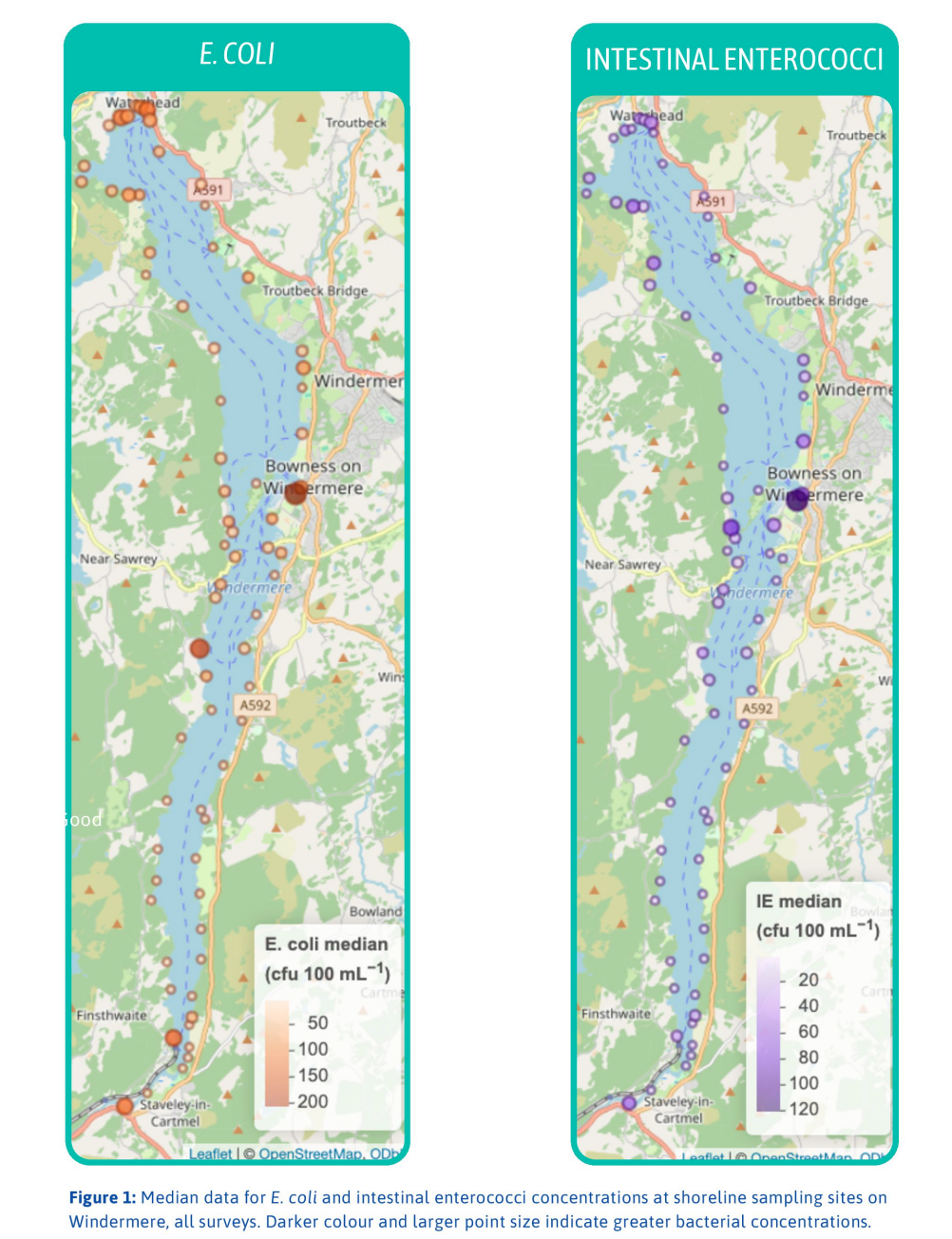
The Big Windermere Survey, published in August 2025, involved 350 citizen scientists taking more than 1,000 samples over two and a half years and revealed High levels of bacteria found in human faeces – Escherichia coli (E coli) and intestinal enterococci (IE) – indicating sewage pollution. They were highest in the summer months, but the analysis showed high levels throughout the year.
In October 2024, the BBC reported that United Utilities “repeatedly dumped millions of litres of raw sewage illegally into one of England’s most famous lakes over a three-year period. “Permit breaches should be reported to the Environment Agency, but United Utilities failed to do this for most of the discharges identified by the BBC between the start of 2021 and the end of 2023. … United Utilities failed to report at least 102 million litres of that pollution.”
Surfers Against Sewage has developed a Sewage Alert App which pulls together the UK’s live sewage discharge data from over 18,000 overflows. Their sewage alert app issues warnings specifically for designated bathing waters to inform water users when water quality is compromised and it may be unsafe to enter the water. We had heavy rain in Faversham, where I live, on Tuesday 8th September; untreated sewage was discharged for 5 hours and 16 minutes.
Stok Kangri, located just 15 km from Leh in the Ladakh region of northern India, is closed to tourist and military expeditions. The closure is an extreme example of the consequences of overtourism, after years of trekking placed growing pressure on the mountain’s fragile ecosystem and local water resources.
Abdul Qayoom, writing about the reasons behind the closure, describes how temporary bathrooms and toilet facilities near the base camp affected streams used by surrounding communities. “Urine and human waste often ended up mixing directly with the nearby streams,” he wrote, including waterways relied upon by villagers for drinking and irrigation.
Climate change added to the pressure. As water flows declined, the impact of waste became more severe, with Qayoom noting that “the same amount of toilet waste and pollution became far more concentrated in a smaller volume of water.” At the same time, climate-driven changes were placing additional stress on the glacier and its watershed.
Ultimately, it was the local community that pushed for action. The Stok village committee, working with the All Ladakh Tour Operators Association (ALTOA), supported stopping expeditions to give the mountain, its water resources and wildlife time to recover.
The decision was therefore not simply imposed by authorities, but driven by those living with the effects of growing tourism. As Qayoom writes, “It came from local people actively protecting their own home, their environment, and their future water supply” — making Stok Kangri a striking example of a community responding directly to the pressures of overtourism.