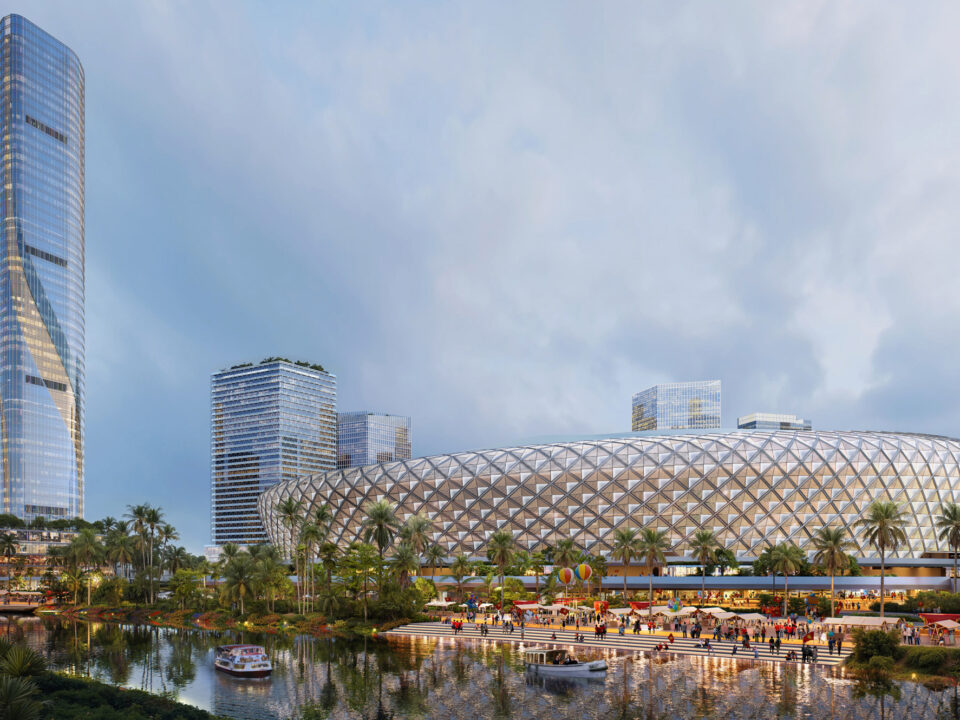
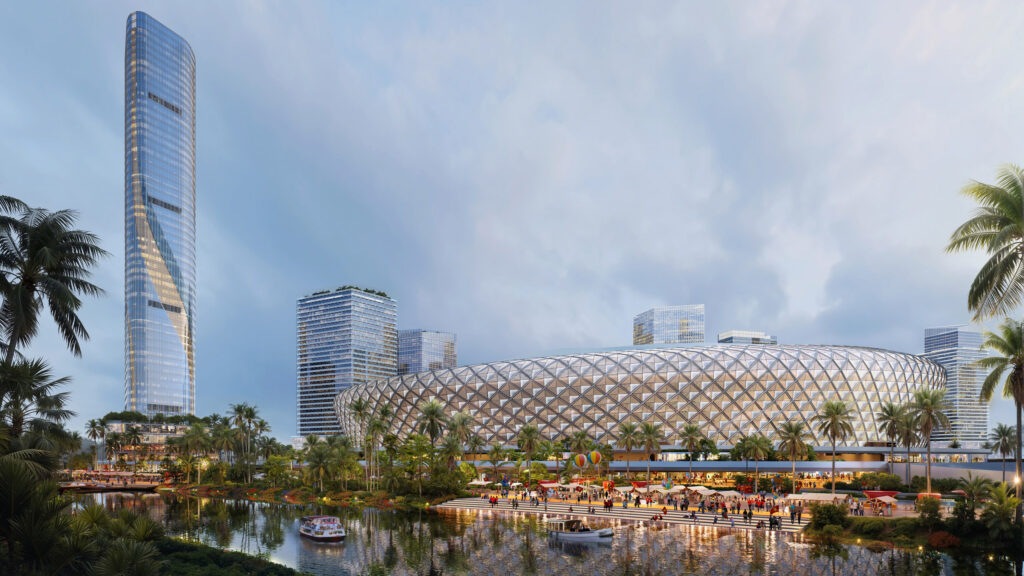
China inaugurated its newest architectural landmark, the Xi’an International Football Centre, on 8 October 2025, with an inaugural Asian Cup qualifying match. Designed by Zaha Hadid Architects (ZHA), the 60,000-seat stadium combines sculptural elegance, engineering precision, and environmental logic. A key part of China’s master plan to elevate its football profile.
The stadium matches that of most Chinese clubs in size – only the Guangdong Olympic Stadium, Beijing National Stadium and Hangzhou Sports Park are significantly bigger. However, what truly distinguishes the Xi’an complex is its design: a blend of functionality, fluid geometry and urban openness that embodies ZHA’s signature aesthetic.
Located in Xi’an’s Fengdong New District, a rapidly developing tech and education hub, the complex is set to drive the city’s broader transformation. Extending beyond sport, the venue incorporates training academies, community facilities, recreational areas and flexible cultural spaces for concerts and performances, as well as restaurants that are open year-round. It also connects directly to Metro Line 16. Its open façades are designed to blend with the surrounding urban landscape, embodying ZHA’s philosophy that architecture should “flow seamlessly with the movement it houses”.

At first glance, the structure resembles a huge metallic flower opening towards the sky. Digital modelling was used “to optimise proximity and views from all 60,000 seats, generating the most exciting atmosphere for football and ensuring an outstanding match experience for all players and spectators”. And at its centre, “the fluid forms of the roof shelter the saddle-shaped structure designed to maximise the availability of spectator seating at midfield”, explained ZHA.
The stadium features an ultra-lightweight cable-net roof system that supports a translucent membrane. This is designed to protect fans from the rain and sun while allowing natural light to nourish the turf below. The roof’s geometry also minimises the harsh winter winds that chill the city each year, reduces energy consumption, and promotes natural ventilation. In summer, wide overhangs and shaded terraces regulate the temperature to ensure comfort in Xi’an’s continental climate.

A broader vision for Chinese football
While some in China claim to have invented the game, cuju, the ancient form of football, is officially recognised by FIFA as one of its earliest ancestors – the country’s modern engagement with the sport is relatively recent. Overseas leagues were only first broadcast in the 1980s. By the 1990s and 2000s, China’s economic openness had drawn the attention of major international clubs keen to tap into the country’s enormous fan base, which today numbers nearly 290 million.
The Xi’an International Football Centre is part of Beijing’s 35-year national plan, launched in 2016, to turn China into a “first-class football superpower”. The programme involves integrating football into schools, expanding youth leagues and dramatically improving infrastructure. Early milestones include the establishment of the CFA U-21 League in 2021 and the first China Youth Football League in 2022. The long-term infrastructure goal is ambitious: to have one football pitch for every 10,000 citizens by 2030.

In October 2025, the Xi’an International Football Centre hosted the inaugural matches, including China’s U-23 team competing in the 2026 AFC Asian Cup qualifiers against Australia, Timor-Leste, and the Northern Mariana Islands. This marked a significant step forward for the nation’s footballing aspirations.