
What do Emmanuel Macron, Serena Williams, David Beckham, Antonio Banderas, Shakira, and Henry Kissinger have in common? Padel.
This “new” sport, which has experienced explosive growth in recent years, appears to appeal to a surprisingly broad audience. From politicians and elite athletes to global celebrities, the game has spread well beyond traditional sporting circles.
We all know at least one friend, colleague, or family member who has been swept up by this fast-paced “natural child of tennis and squash,” which can be played at any age and is easy to pick up.
What is it about padel?
In reality, the sport is not new at all. It was invented in 1969 in Mexico by Enrique Corcuera and his wife, Viviana, who were seeking entertainment at their new holiday home in Acapulco. With no space for a full-size tennis court, the bored couple started hitting a ball against the walls. Enrique, a tennis enthusiast, soon realised that his wife was enamoured with the makeshift game. According to legend, Viviana even threatened to leave him if he did not build her a proper court. “No padel court, no Viviana,” she reportedly declared.
Fortunately, they lived in a pre-smartphone era; had they been doomscrolling instead, padel might never have been invented.
And so, Enrique complied, building the first enclosed cement padel court: 20 metres long and 10 metres wide, it was designed to prevent balls from being lost. According to Viviana, there were initially barely any rules at all, except those that her husband adjusted whenever he was about to lose. The former Miss Argentina drafted the first set of rules as a birthday present for him.
Padel is inherently social, played with solid, stringless rackets, and always in doubles. It is also cross-generational: grandparents can play with their grandchildren, and beginners can quickly get to grips with it.
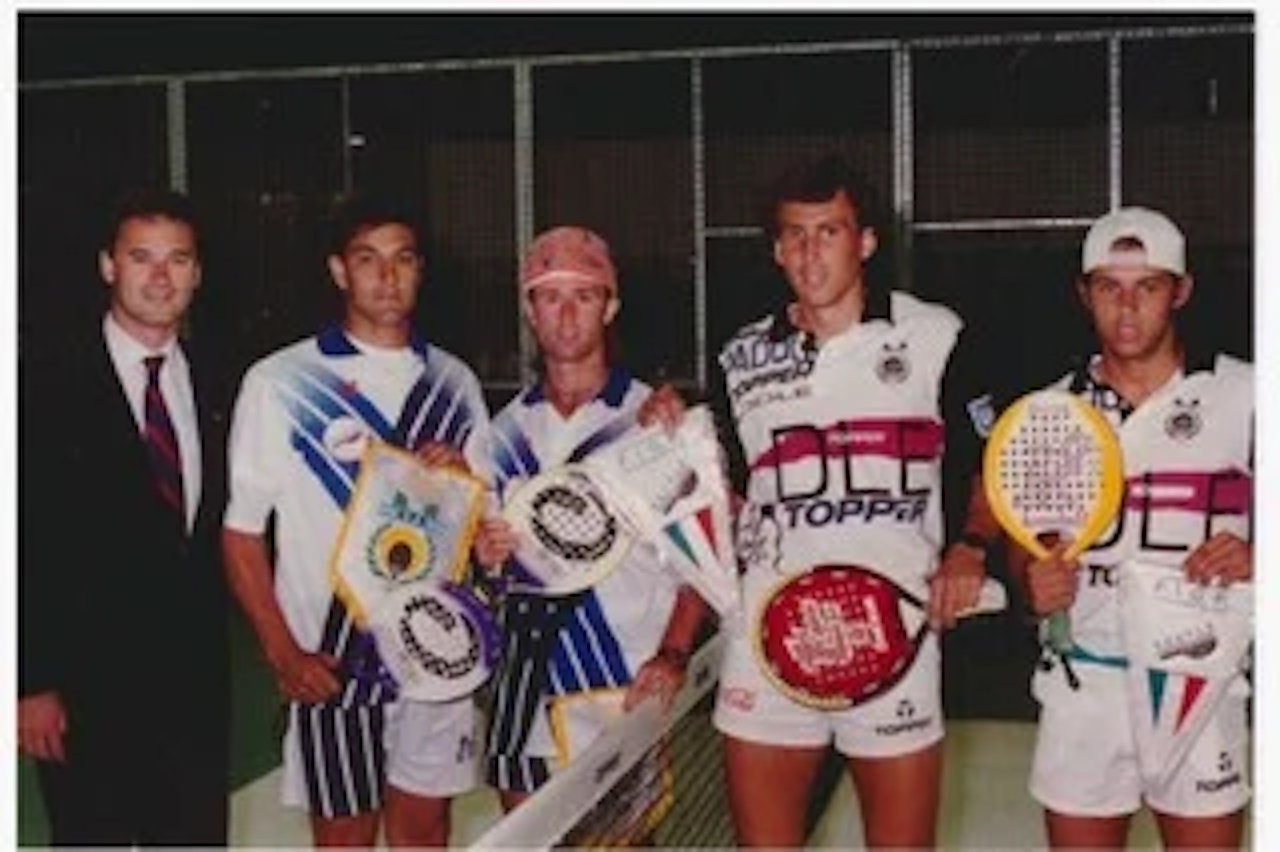
As the International Padel Federation (FIP), founded in 1991, puts it: “Padel is a sport for all, regardless of gender, age, or skill levels. Talent and entertainment have no limits.”
Kissinger already played it in the early days in Acapulco; the game did not cross the Atlantic until the mid-’70s, when Prince Alfonso of Hohenlohe, a friend of Corcuera’s, built the first European courts in Marbella. From there, the sport spread rapidly through Spain, Argentina, Uruguay, and Chile, eventually reaching France, the US, and Canada throughout the ’80s and ’90s. The first official competition was held in Buenos Aires in 1988, when the formal rules were fully standardised.
Today, padel is widely regarded as the world’s fastest-growing sport. According to the Lawn Tennis Association, there are more than 400,000 players in England alone, and tens of millions of people now play padel across more than 130 countries.
This growth has even reshaped sports tourism. Luciano Cestari, founder of LC Tennis & Padel Holidays in the UK, told Travel Tomorrow that interest has decisively shifted towards padel. In 2021, his programmes were split 50/50 between tennis and padel. However, by 2026, nine out of ten of his packages will be padel-focused. Already operating in the UK, Portugal, and Menorca, Cestari, who “followed the birth of the sport in his native Argentina,” plans to expand to Italy next year.