


A divine new museum dedicated to one of the planet’s most majestic mammals is about to emerge on the wild coast of northern Norway, offering encounters with whales through science, art, sound, and live encounters with the real thing.
The Whale will open in June 2027 in Andenes, located some 300 kilometres north of the Arctic Circle. Though one should not judge a book by its cover, judging by the first images, the building alone may be the reason to make the journey.
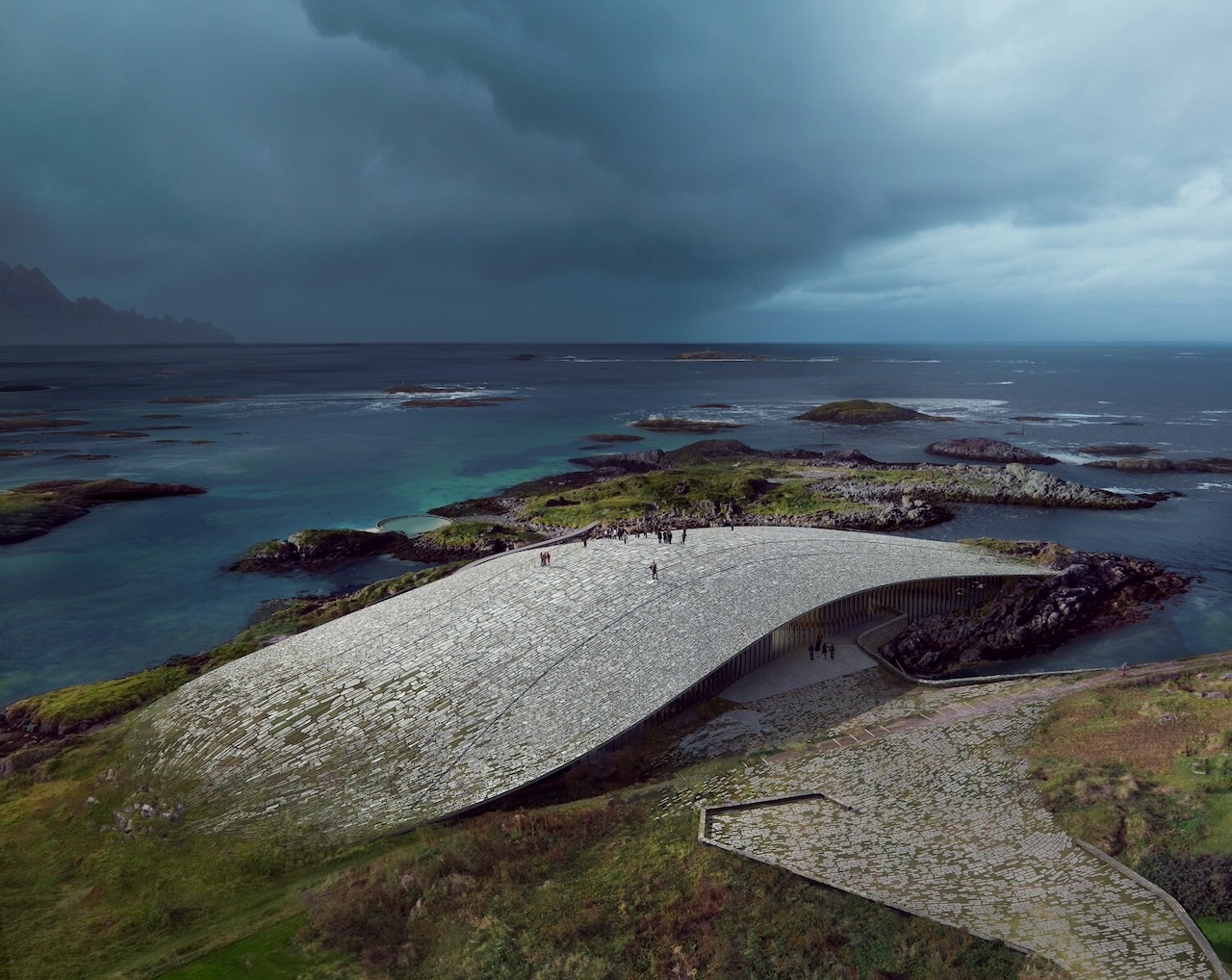
Designed by Danish architect Dorte Mandrup, there is something immensely calming about the building. Rising naturally from the rocky shoreline, it resembles a whale emerging from the sea: monumental yet fluid; seemingly moving even when standing still; belonging to the coastline rather than being an addition to it.
Despite its size, it almost disappears into its surroundings; its colours, materials, and sweeping lines echo the sea and the surrounding landscape. It is chameleon-like, commanding the horizon yet blending in.
The vast concrete roof, which is open to the public and covered with natural local stone, can be walked across to enjoy panoramic views of the ocean, mountains and Andenes lighthouse.
At ground level, a curved glass wall softens the boundary between inside and outside, reflecting the sea so perfectly that the building appears to merge with it.
Mandrup describes the structure as looking as though “ a giant with a razor-sharp knife had loosened the skin of the Earth’s crust and carved out a hollow beneath to reveal another world”.
This hollow contains life-size wooden sculptures of killer whales breaking the surface, as well as a Species Gallery which brings together all 90 modern-day whale species and traces 50 million years of evolution.
Another room dissects the animal bone by bone, including the “strange masses and blobs”, while the Horizon Room shows the world’s oceans as one connected body of water by flipping the globe on its head.
At the heart of the museum, a full-scale whale sculpture and the Library of Relations explore humanity’s long and complex relationship with whales, highlighting their surprising similarities in terms of communication, cooperation, and care.
The Soundscape is a dimly lit, multisensory space that recreates the depths of the ocean, filled with whale song frequencies. As previously reported, there may be more to those sounds than meets the ear.
A study from the University of the Sunshine Coast in Australia found that listening to whale song can generate a sense of awe and connectedness with nature. This can, in turn, increase people’s intentions to behave in a more environmentally conscious way.
In the present case, I would argue the mere view of the museum has that effect.
Andenes was not chosen at random. Its location on the edge of the continental shelf means it is one of the few places where whales can be seen all year round.
Whale-watching excursions from Andenes last between three and four hours and cost around €155, with sperm whales among the species commonly encountered in the summer while humpbacks are seen in winter, but also dolphins.
Packages, from general admission to bundles with hotel stays and whale safaris, go on sale this autumn.