

The difference in behavioural expectations from country to country has always inspired outrage and amusement, whether it’s respecting the queue in the UK, knowing how many cheek kisses to give in different parts of France, how loudly to speak in public in Spain, or taking photos of your dinner plate in a restaurant, anywhere. With etiquette influencers on the rise, and embarrassing instances of “bad behaviour” easily spread around the world online in minutes these days, the stakes of getting it wrong can be high. But new research by online learning platform Preply may help.
The platform took public data and a survey of 1,600 people across 27 European nations, and has compiled some surprising guidance.
When to arrive?
The debates start even before anyone has met up, and uncertainty is becoming more prevalent. Asking the internet whether it’s best to arrive on time, early, or late has become more common over the last year, Preply said, with searches on the topic up 66%.
In 23 out of 27 countries, arriving on time is seen as best. Perhaps bucking national stereotypes about relaxed manners, Greek people think being punctual is important. But in Czechia, France, Germany, and Poland, a majority seem to think being merely “on time” is already late and arriving early is preferable.
Greetings
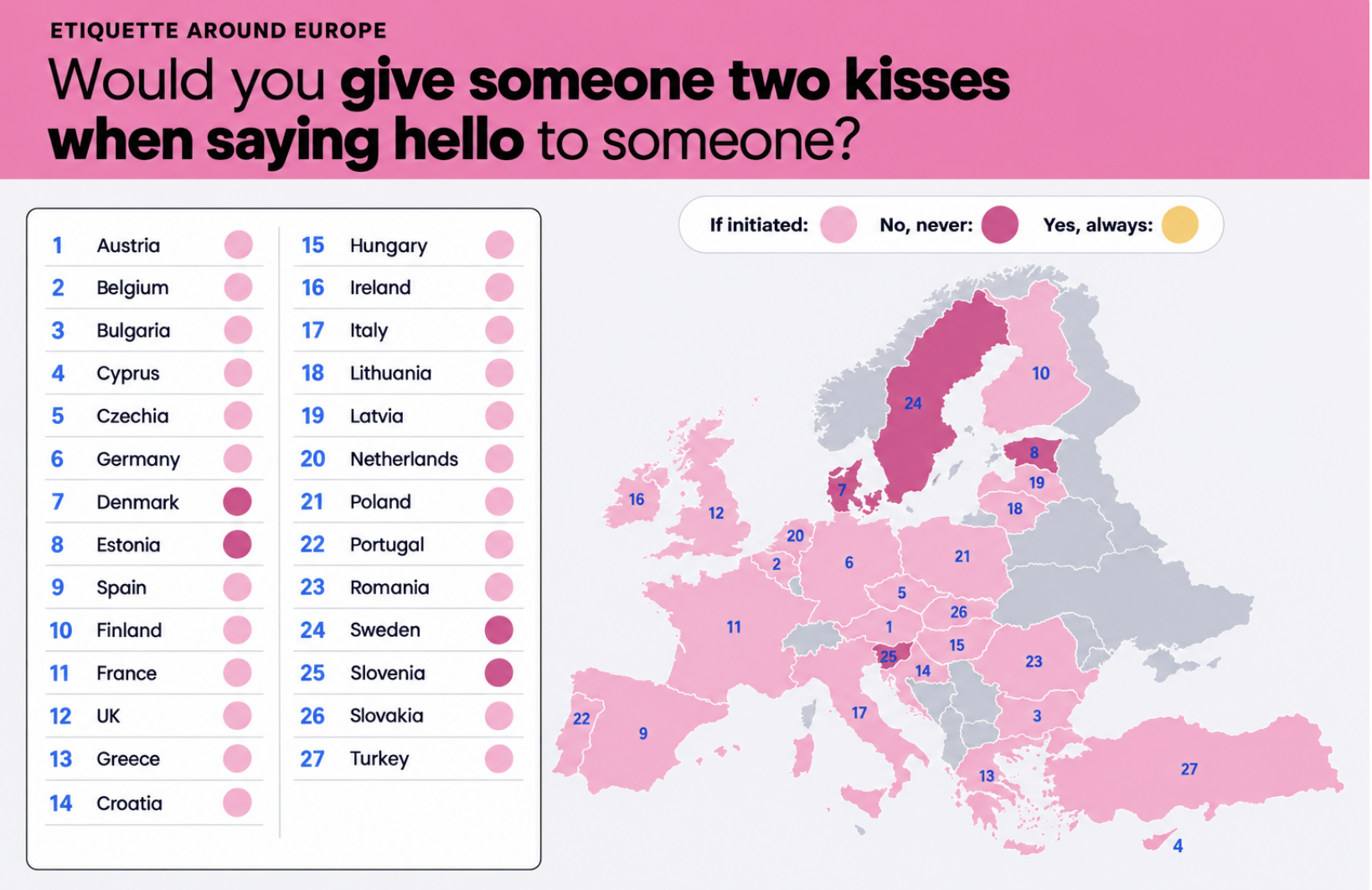
Forget the stereotypes again. In the vast majority of European countries (23 out of 27), initiating two cheek kisses is unusual. Most people (85%) said they would wait to see what the other person did. And in Denmark, Estonia, and Sweden, greeting someone with two kisses is seen as an outright no-no, perhaps in line with some people’s idea of “cold” northern countries. But Slovenians, in south-central Europe, also said they go as far as refusing to kiss as a greeting.
Visiting someone’s home
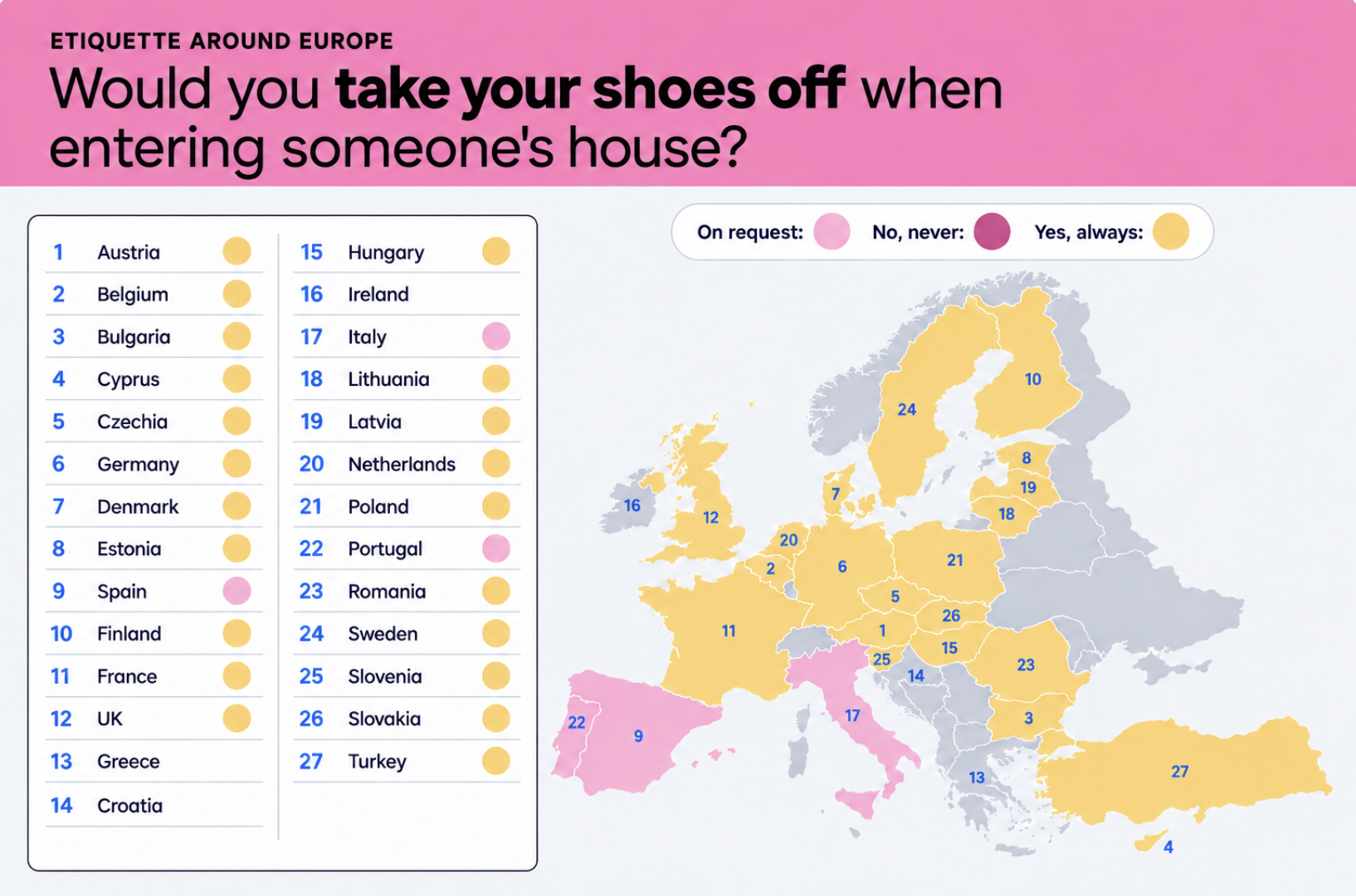
In Sweden, as seen above, one keeps one’s lips to oneself, but also leaves one’s shoes on the doorstep. A unanimous 100% of Swedish respondents said you must take off your shoes when entering someone’s home. It turns out that’s not so unusual. The majority of people in every European country except Italy, Portugal, and Spain (where tiles rather than delicate wooden floors or carpets prevail) agreed that outdoor shoes should not be worn inside. So, just make sure you’ve cleaned and darned your socks and clipped your toenails!
Taking a house gift is also seen as the done thing by more than half of Preply’s respondents, while a third of people, especially in Austria, the UK and Spain, said they might take a gift for a special occasion. But watch out! Taking a gift to someone’s house in Finland might be seen as over the top. The majority of Finns said they would never bring a house gift for their host.
At the table
Eating up all the food put in front of you is seen as polite everywhere in Europe, though more men (82%) said they would finish their meal to show they appreciated their host’s effort, compared to just 75% of women, more of whom thought it showed a little decorum not to scrape the plate clean.

Takeaways
This all may seem intimidating and no help at all for people suffering social anxiety. But the takeaway message, for Madeline Enos, language trends expert at Preply, in correspondence with USA TODAY, is that perfect behaviour is less important than being seen to make an effort to fit in. “Good travel etiquette doesn’t require memorizing every rule,” she says. “It’s about having good situational awareness, reading the room, and recognizing that what’s considered polite in one culture might be different in another.”