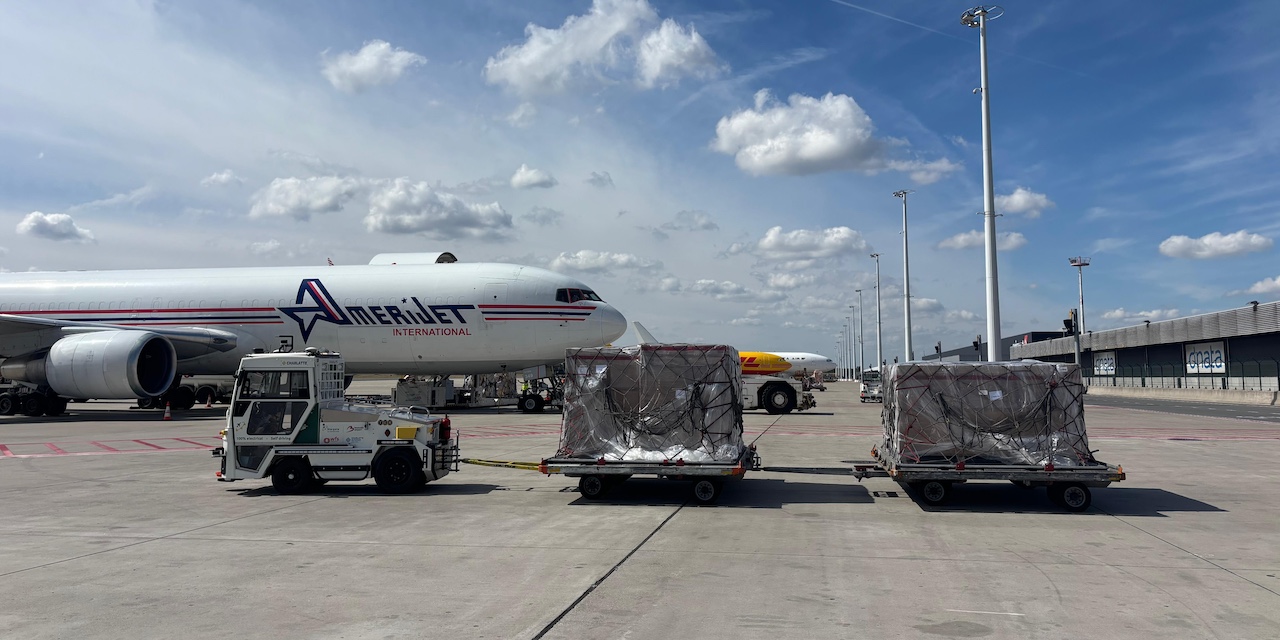



Trials of electric tow tractors for cargo are taking place at Brussels Airport, with the aim of exploring ways to make operations more efficient and sustainable, while maintaining safety as “the absolute priority,” the airport said in a press release.
The tow tractor is an autonomous vehicle that, during the trial period, will transport cargo trailers along four predefined routes in the cargo zone between warehouses and aprons. It uses satellite navigation systems and laser sensors to perceive its surroundings and identify any obstacles.
Taking place under strictly controlled conditions and only during off-peak hours, the project is focusing on how the technology integrates with airport cargo operations. It will seek to tailor future developments to the airport’s environment and conditions, as well as assessing what would be required to scale up the technology. Efficiency gains, safety improvements and greener operations, all while “supporting teams in their daily work”, are the ultimate goals, the hub’s statement said.
Part of the European Stargate programme
The autonomous tow tractor is not the first deployment of self-driving vehicles at the Belgian airport under the European Stargate programme, which brings together a consortium of 22 partners under the aviation hub’s leadership to work on a range of decarbonisation projects, including on-site electric vehicles, green energy generation and sharing with local neighbourhoods, and improving multimodal transport access to the airport.
There was a successful airside trial of a 100% self-driving electric shuttle in 2025, as well as a test project involving an autonomous shuttle that travels from the terminal to a staff car park.
Safety remains the priority
Commenting on the latest pilot, Arnaud Faust, CEO of Brussels Airport, said: “We continue to explore innovative and sustainable solutions that can tangibly strengthen cargo operations.”
Faust added: “The aviation and logistics sectors are evolving rapidly. Thanks to this project, we can gain valuable insights into the potential of autonomous technologies, and into what they can deliver in terms of efficiency and sustainability, while people remain key to operations and the highest safety standards are maintained.”
The pilot is a collaboration between the airport, WFS Cargo and Charlatte Autonom with Navya Mobility, whose CEO, Jean-Claude Bailly, echoed Faust’s words on safety. He highlighted the participants’ expertise in “autonomous mobility solutions within complex and demanding airport environments” and emphasised that “safety and reliability are paramount in the design of our products, whose technology enables fully autonomous operation, without an operator on board, when regulatory conditions allow.”
In another environmental initiative now in its fourth year, the airport is currently calling for projects to support local initiatives that benefit both people and nature. The Brussels Airport Fund is inviting applicants to submit their ideas by 16 September 2026 for a chance to receive financial support of up to €10,000 for their green projects.