


Spanish authorities have launched a major safety operation as hundreds of thousands of tourists gather to witness Wednesday’s total solar eclipse, warning that the surge in visitors to rural areas could increase the risk of wildfires amid extreme heat and exceptionally dry conditions.
The eclipse on 12 August will cross northern and eastern Spain along a band stretching from A Coruña in Galicia to Mallorca, making the country one of the best places in Europe to experience totality. Up to six million people could gather along the eclipse path, while around 460,000 international tourists are expected to have travelled to Spain specifically for the astronomical event.
The influx is also expected to put significant pressure on Spain’s roads, with around 1.5 million additional car journeys anticipated. Authorities are urging travellers to avoid unnecessary journeys and not to stop on roads or hard shoulders to observe the eclipse, particularly where vehicles could obstruct access for emergency services.
Extreme wildfire danger across Spain
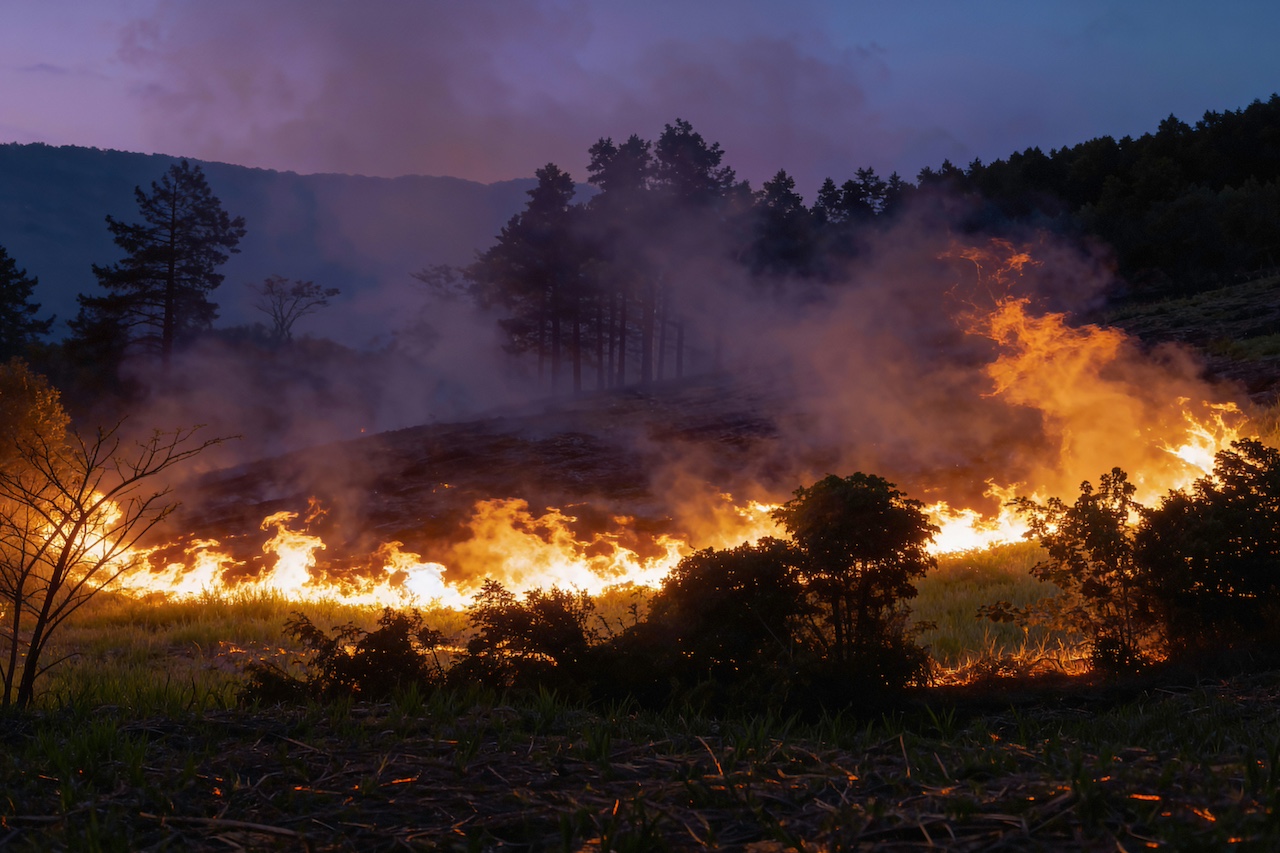
The warnings come after weeks of extreme temperatures and destructive wildfires across the country. Around 200,000 hectares have already burned in Spain this year, approximately six times the area recorded at the same point in 2025. Fires have recently been active in several parts of the country, including Huelva, Segovia and Huesca.
Conditions have been exacerbated by an exceptionally hot and dry summer. July was mainland Spain’s joint-hottest July since records began in 1961 and its driest on record, with just 4.3 mm of rain, equivalent to around 26% of normal precipitation for the month.
A large proportion of Spain is under weather alerts for Wednesday, with temperatures expected to reach as high as 40°C in some areas. Spain’s national weather agency AEMET has also warned of very high or extreme forest fire danger across much of the Iberian Peninsula and the Balearic Islands.
“The vegetation is extraordinarily dry and the smallest spark or carelessness could lead to devastating forest fires,” Environment Minister Sara Aagesen warned during a visit to Niebla, the site of a recent fire.
Aagesen urged people heading into natural areas to exercise the utmost caution, particularly around forests and places with low humidity and large amounts of dry vegetation.
Authorities are particularly concerned about potential ignition sources such as discarded cigarettes, barbecues, fireworks and vehicles parked over dry vegetation. Drivers have been warned that hot components underneath vehicles could potentially start a fire when parked on dry grass.
“We’ve had an extremely tough summer in Spain, with yet another series of major forest fires. That’s why we must restrict any kind of activity that could generate a spark,” Virginia Barcones, Secretary-General for Civil Protection and Emergencies at Spain’s Interior Ministry, told Reuters.
660 official observation points
Spain is treating the eclipse as a nationwide security operation, with more than 660 official viewing sites identified across the country and around 35,000 officers expected to be involved in managing crowds and protecting vulnerable areas. A national control centre in Madrid will coordinate surveillance and emergency operations.
Heavy traffic is another concern, particularly because congestion in rural areas could prevent firefighters and other emergency services from reaching incidents quickly.
Some regional authorities have gone further by restricting access to vulnerable areas. In Valencia, natural parks have been closed and access to rural footpaths restricted. Camping and activities involving fire have also been suspended in high-risk areas, while barbecues and fireworks are prohibited.
Some planned eclipse gatherings elsewhere in Spain have been cancelled altogether because of the fire risk.
Eclipse triggers astrotourism boom
Despite the warnings, the eclipse has triggered a major tourism boom across the path of totality. Accommodation in small towns and villages has been booked for months, while demand for campsites, motorhomes and rural accommodation has surged. Around 70% of Spain’s caravan fleet has reportedly already been reserved for the event.
Hotel prices have also risen sharply in some of the main viewing destinations. A Coruña has recorded particularly strong demand, while Mallorca, Santiago de Compostela and Bilbao have also experienced significant increases as travellers compete for accommodation within or close to the path of totality.
The phenomenon is particularly significant for Spain, where mainland observers have not experienced a total solar eclipse for more than a century. Totality will be visible within a band running across the north of the country and towards the Mediterranean, with the eclipse visible from destinations including A Coruña, Bilbao, Zaragoza and the Balearic Islands.
The influx had been anticipated months in advance, with Spain already preparing for a major eclipse tourism surge as accommodation and viewing locations along the path of totality attracted growing demand.
NASA has selected the tiny village of Villalibado in north-western Spain as one of its observation bases, installing four high-powered telescopes next to its Romanesque church to livestream the eclipse to millions of viewers worldwide.
Eye and equipment safety warnings
Wildfires and traffic are not the only safety concerns surrounding the event. Spanish hospitals are also preparing for possible eye injuries caused by people looking directly at the Sun without adequate protection. Six brands of eclipse glasses have been withdrawn after being deemed unsafe by Spanish consumer organisation FACUA.
As well as wildfire concerns, authorities have warned eclipse watchers to protect their eyesight by using certified solar viewing glasses. Smartphones and cameras can also be vulnerable when pointed directly at the Sun, making the use of appropriate protection important for anyone planning to photograph the eclipse.
The warnings come as Europe prepares for its most significant solar eclipse in decades, with large numbers of travellers heading to Spain and Iceland to experience totality and others across the continent able to see a partial eclipse.
For visitors heading into Spain’s countryside, authorities are stressing another precaution: avoiding anything that could produce a spark. With extremely dry landscapes, temperatures approaching 40°C and hundreds of thousands of additional visitors converging on rural viewing locations, officials are hoping the country’s unprecedented eclipse tourism boom does not add to an already severe wildfire season.