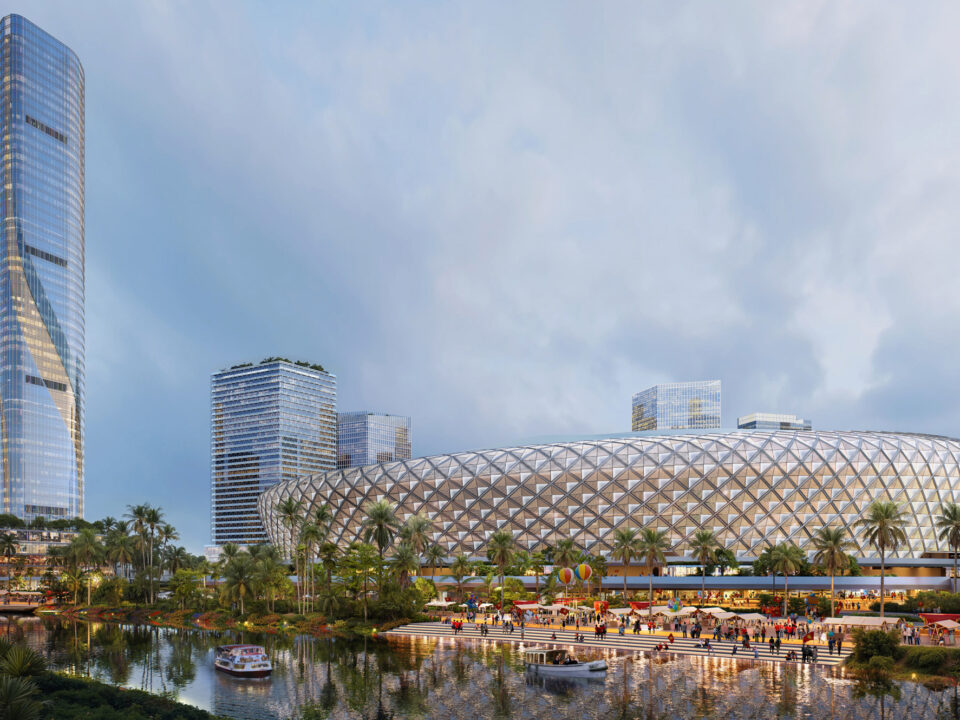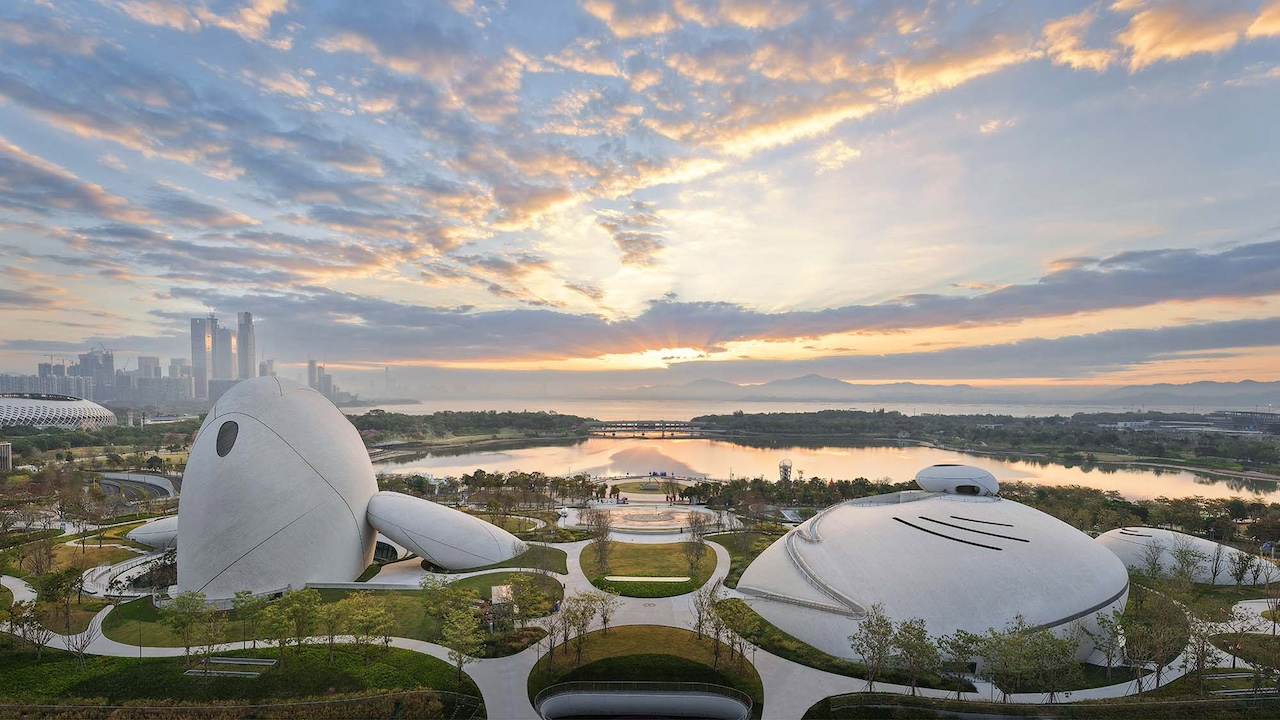



A new architectural trend is emerging, driven by a desire to bring buildings back to nature, with mixed results depending on execution. The latest example is MAD Architects’ Shenzhen Bay Culture Square, a design museum and public park where gigantic white pebbles appear to have been thrown onto the shore.
Led by Ma Yansong, Dang Qun and Yosuke Hayano, the design draws on the classical Chinese allusion Shui Luo Shi Chu, meaning roughly “the water recedes and the rocks emerge”. Work began in 2018, and eight years later, the 188,000-square-metre complex is complete and open to the public.
Occupying a roughly 51,000-square-metre waterfront site in Houhai, in Shenzhen’s Nanshan District, it houses the Creative Design Pavilion and Shenzhen Science and Technology Life Hall, alongside galleries, educational spaces, a design library and a multifunctional theatre.
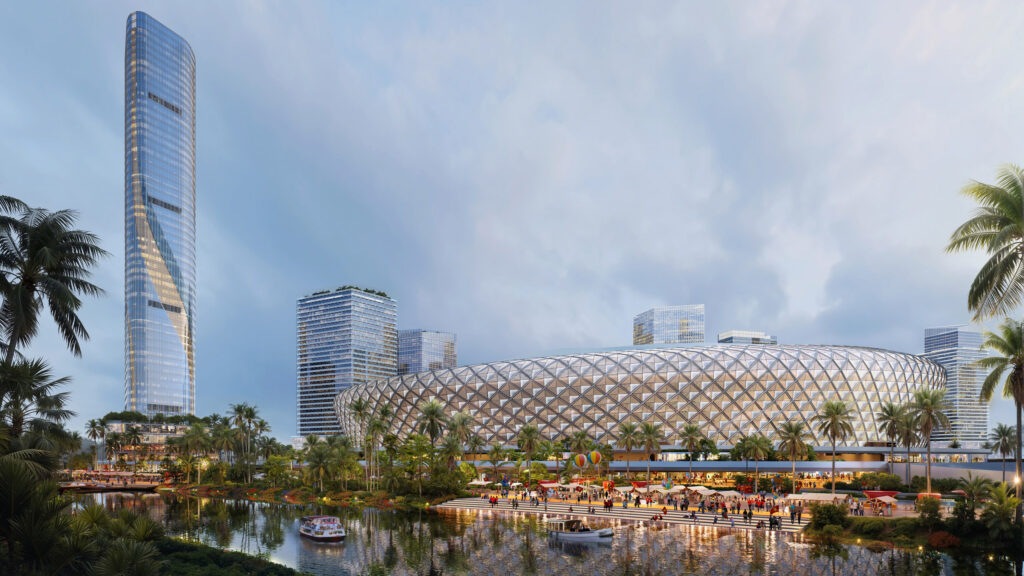
The structures, which locals have nicknamed “AirPods”, for their resemblance to Apple’s earbuds, offer a clear visual dissonance with the forest of skyscrapers behind them, precisely the point as the world’s seventh most populous city strives to stand out from other “super cities”.
“Much of my work is guided by a simple question: can public space be more open and equal?” Ma Yansong told Dezeen. “[…] This site was entirely reclaimed from the sea. How can our design turn ancient nature into people’s imagination of the future, and make a large cultural building feel intimate, in service of human experience?”
Ma Yansong says he wanted to create a “surreal atmosphere” in which visitors could enter into dialogue with ancient times and the future, adding: “Architecture should be integrated into nature and become a landscape that can be experienced.”
The result allows city dwellers to escape the hustle and bustle of urban life without actually leaving it, offering them a place to rest, think, and reconnect with nature. Shenzhen Bay Culture Square sits between Houhai and the waterfront landscape of Talent Park, its planted roofs extending the park across the museum itself.
Joggers, children, birdwatchers and photographers are revelling in the space, conceived by MAD to allow visitors to “step outside everyday perception into a larger imagination of nature and time”.
The complex comprises two clusters of halls, north and south. Above them, an undulating green roof rises and falls like a natural valley, with paths winding between lawns, trees and planted slopes towards viewpoints over Shenzhen Bay. The pavilions progressively decrease in height from city to shore, partly to avoid blocking the migratory birds that travel the East Asian-Australasian Flyway each year.
Much of the complex is tucked beneath this topography, freeing the surface for pedestrians, with a road along the eastern edge sunk underground and a footbridge connecting the roof park to the surrounding city.
“By placing the building volumes beneath the landscape, the project leaves the ground to nature, creating an open waterfront park where people can freely walk, explore, and linger,” said MAD.
Below this pastoral roofscape, the galleries are spare and almost cavernous, with ribbed concrete exposed overhead and lighting and services absorbed into the ceiling. A ring-shaped atrium connects the underground galleries and draws daylight in.
At the water’s edge, the line between architecture and nature deliberately blurs. Planted exclusively with native species, the landscape gradually descends towards the adjacent wetland without a hard boundary. A shallow pool doubles as an open-air theatre, with nearby platforms hosting markets, exhibitions, festivals and concerts.
Shenzhen recently welcomed another new museum tracing 4.6 billion years of Earth’s history, while MAD’s other recent projects include a bulbous science museum in Haikou and a curving headquarters in Shenzhen.