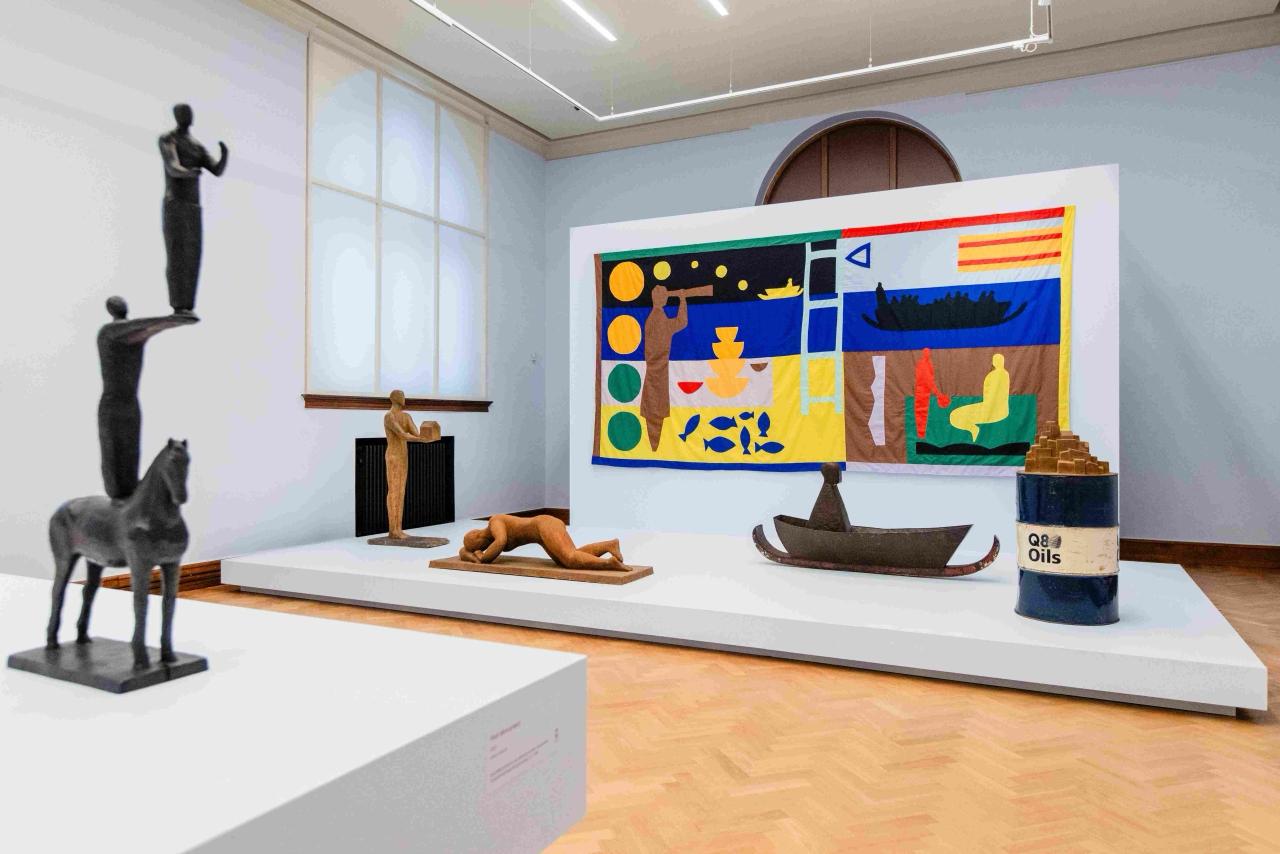


Philip Aguirre y Otegui’s retrospective at Antwerp’s Royal Museum of Fine Arts (KMSKA) transports visitors from the moment they enter, sweeping them through time and space, moving between continents, historical periods and events, and sometimes entirely different worlds.
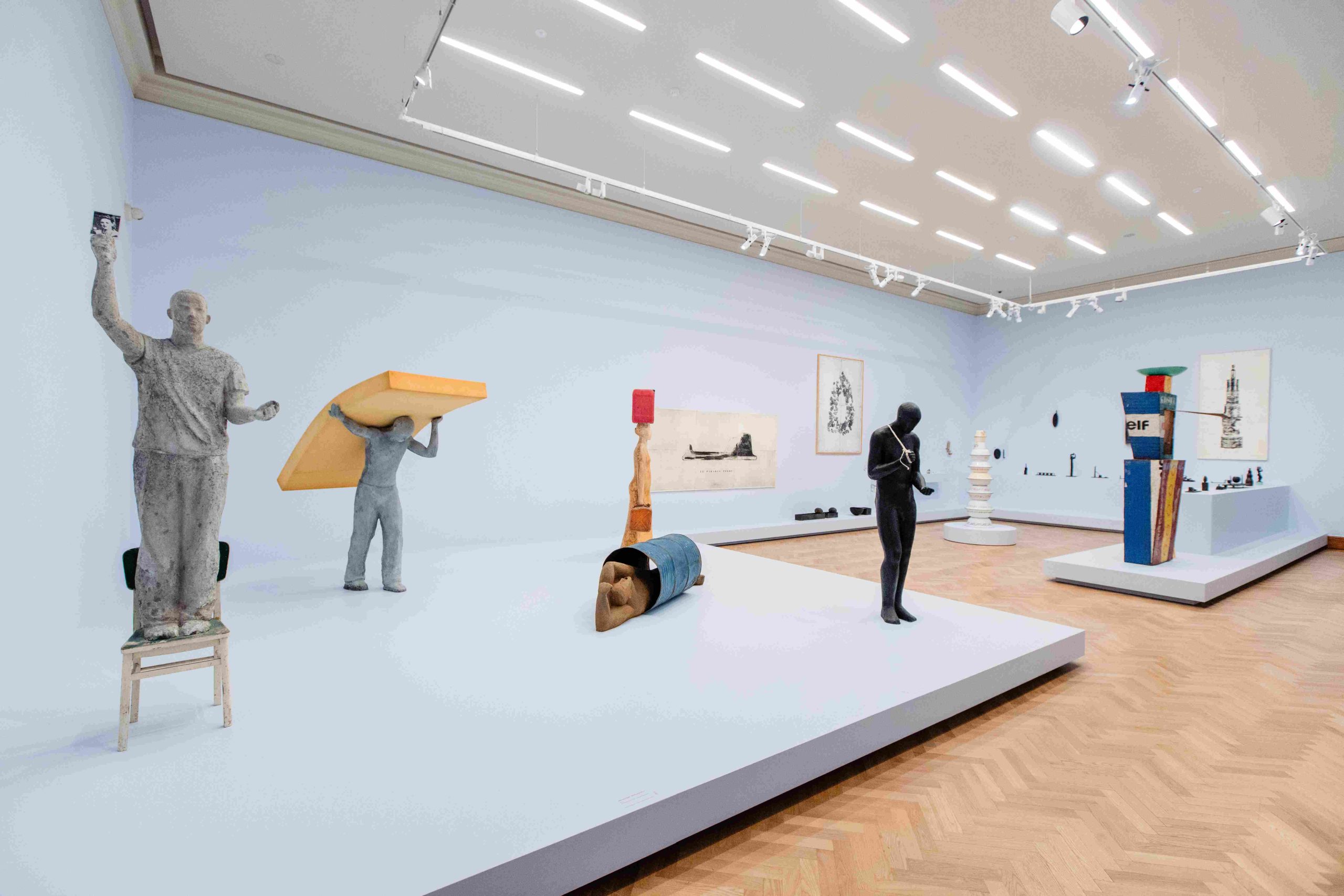
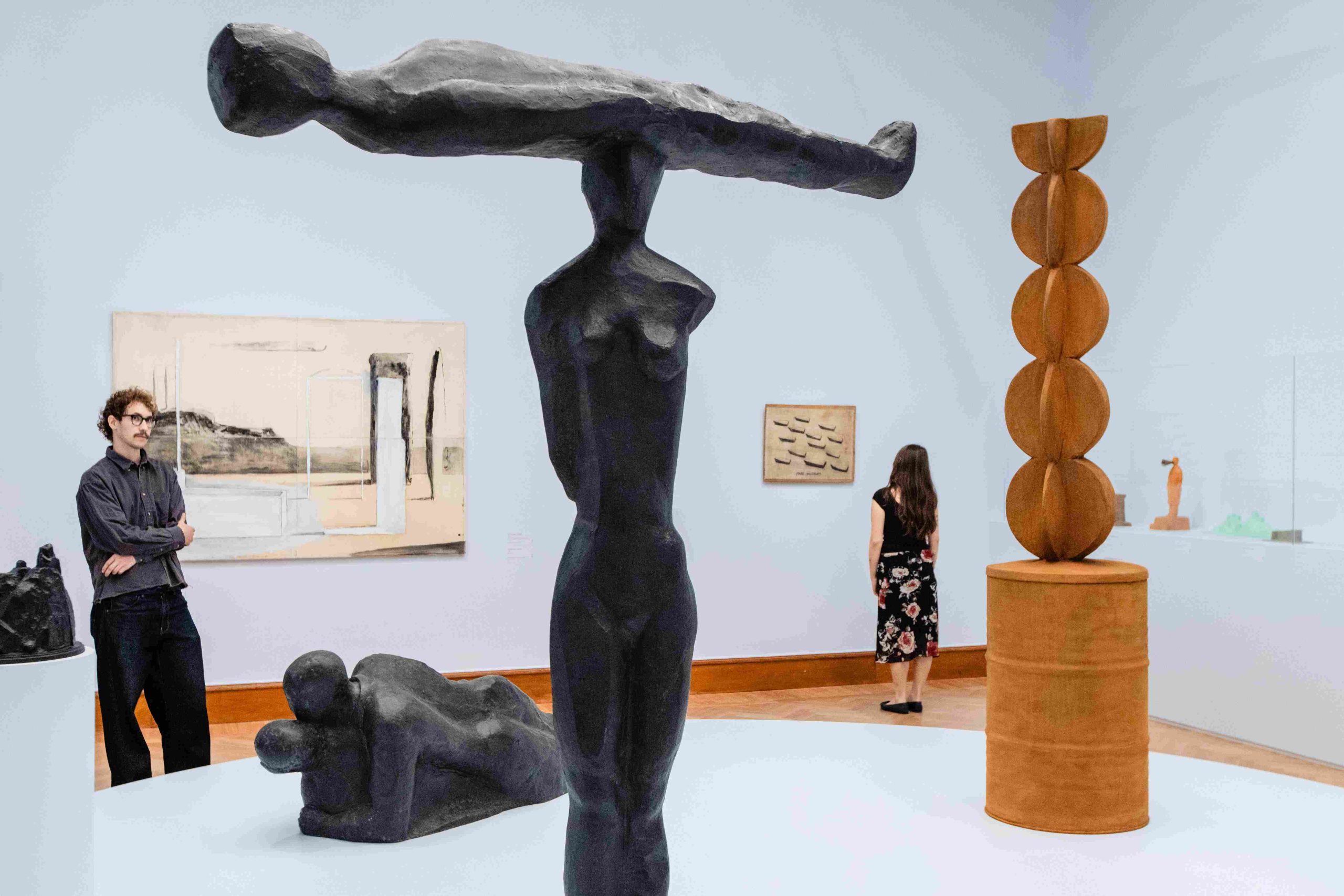
Life-sized sculptures stand alongside intimate drawings, small bronzes, and everyday objects that have been transformed into works of art. While the diversity of forms and materials is striking, the human figure remains central.
The artist’s work has been shaped by his family history. Aguirre has Basque roots through his father, Juan Martín, who fled the Spanish Civil War as a boy and found refuge in Belgium, where he would settle and raise a family.
Moving swiftly between Europe, Africa and Latin America, through migration, war, encounters and family, visitors enter the universe of the Belgian artist, born in 1961. Travel can be voluntary or forced, individual or collective. His oeuvre speaks of exile and migration, but also of friendship, love and community. Some leave, others arrive, and the artist, a traveller himself, pays homage to the countries and cultures he portrays.
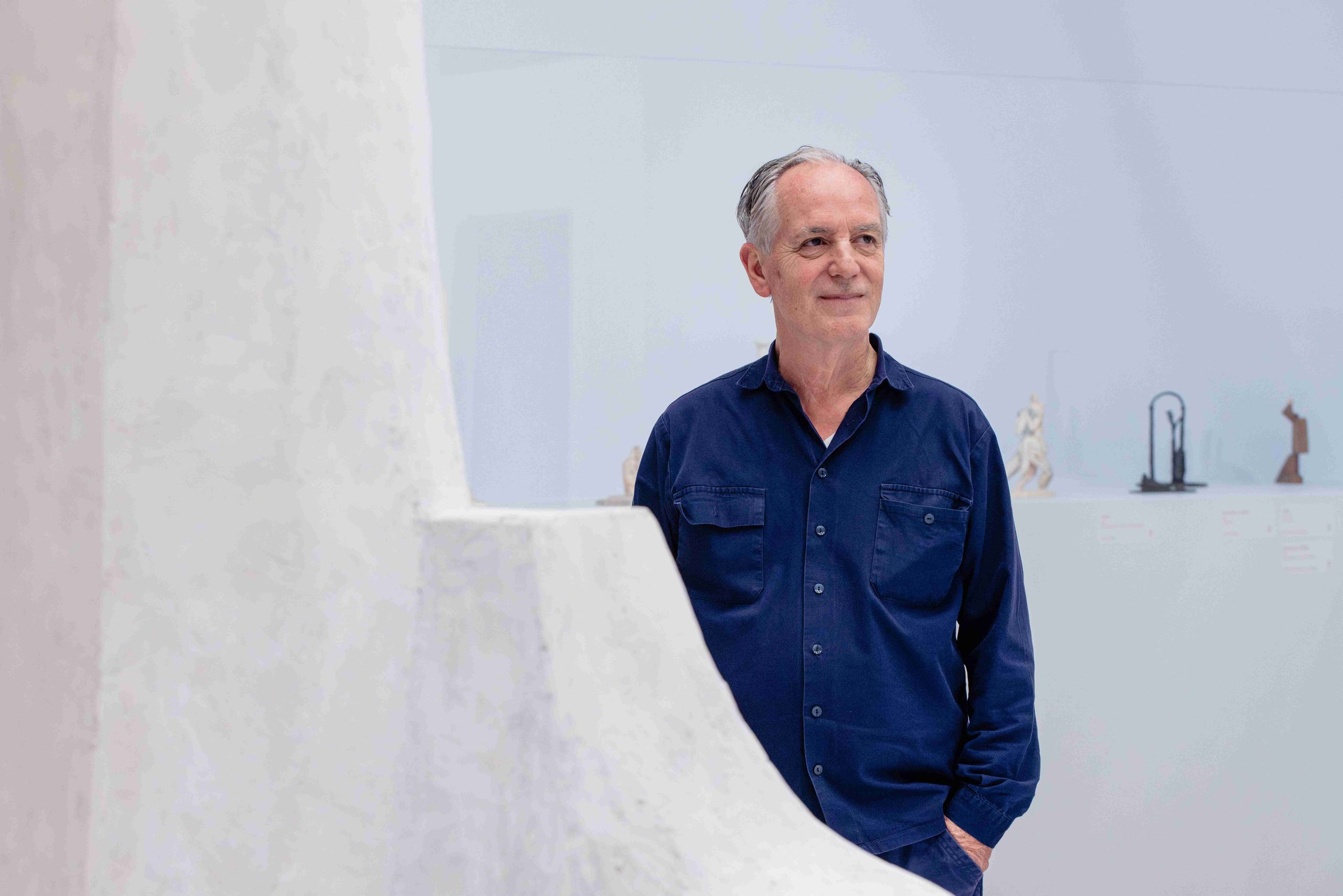
Although politics is almost omnipresent in Aguirre’s work, it is subtle and rarely confrontational. It emerges through bodies, gestures and situations, sometimes almost by implication, leaving visitors free to decide what they wish to focus on: the politics, aesthetics or humour.
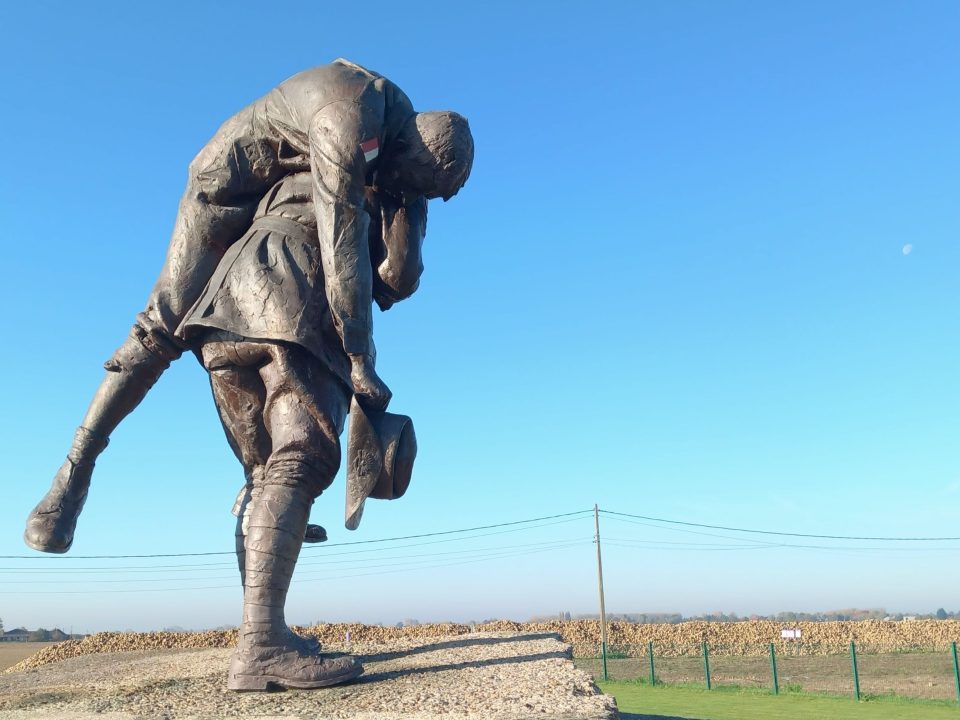
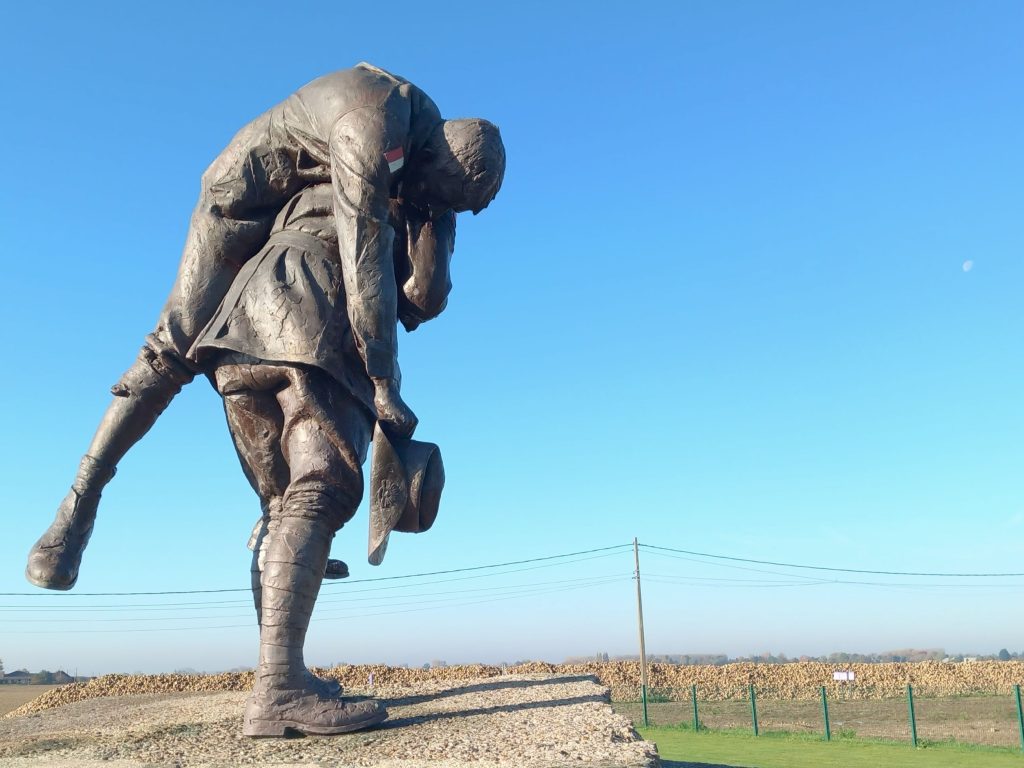
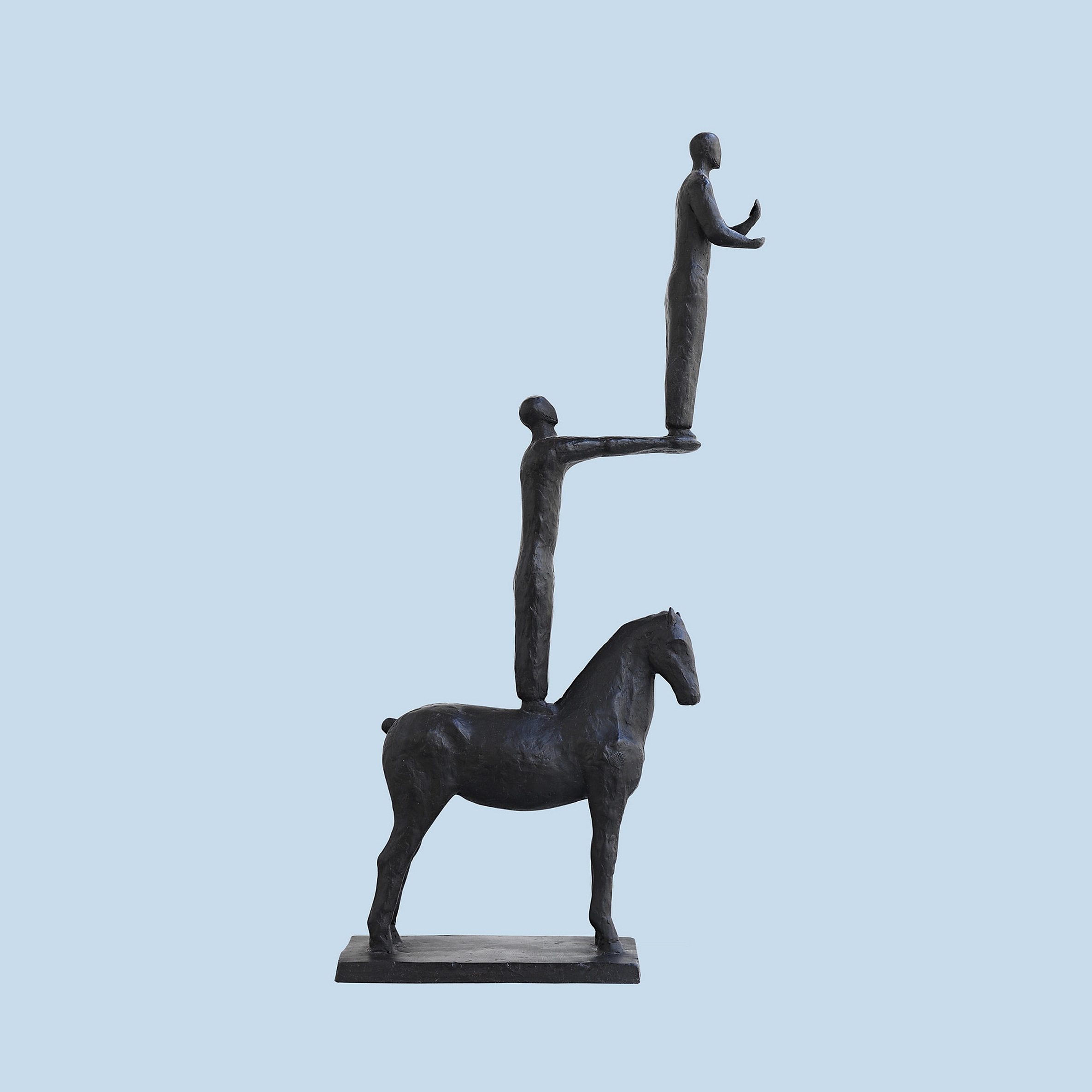
Two works illustrate this particularly well: Algeciras acoge (2007) and Petit Monument (2010). The former could be mistaken for two lovers embracing but was inspired from the photo of a Spanish policeman comforting a migrant who had arrived on the shore by boat. The latter may appear to be a circus acrobatic performance, but acts as a metaphor for the power, authority and military glory traditionally associated with equestrian monuments. An eight-metre-high version of Petit Monument is to be installed permanently in front of the KMSKA.
This major retrospective is as much a journey through his work as a form of introspection.
Travel Tomorrow met the artist to discuss his lifelong passion for travel, and how the places he has visited and the people he has met have influenced his work, outlook on life, artistic freedom, and the values he inherited from his parents and is now passing on to his own children.
The first journeys
When asked about his most memorable childhood holidays, Aguirre recalls family trips to the Basque Country, when driving from Belgium to Spain was an adventure in itself.
“Our first trip was to Spain, to the Basque Country,” he says. “But there were no motorways. I think the motorway only went as far as Orleans, and after that it was all national roads. It took us three days to reach the Basque Country.”
His parents made the most of the journey, stopping to explore cultural landmarks along the way.
“We visited the Louvre, the châteaux of the Loire Valley, Bordeaux… It’s not that my parents were particularly into art. They were cultured, yes, but not part of the art world. They wanted to show their children these things. It was part of our education – compulsory, even.”
He remains grateful for those early experiences.
“I don’t think my parents ever imagined that one of their children would become an artist. They simply thought exposing us to art and culture was part of a normal education. I’m glad they showed us all those things.”
Journeys of a football
When we spoke, Aguirre had just returned from Venice, where he is participating in the Biennale, and where he travelled en famille. Following in his parents’ footsteps, he made sure to combine cultural discoveries and exhibition visits with time for the children to enjoy themselves.
“I made [my sons] visit exhibitions for a few hours every day, and afterwards they played football in the squares of Venice.”
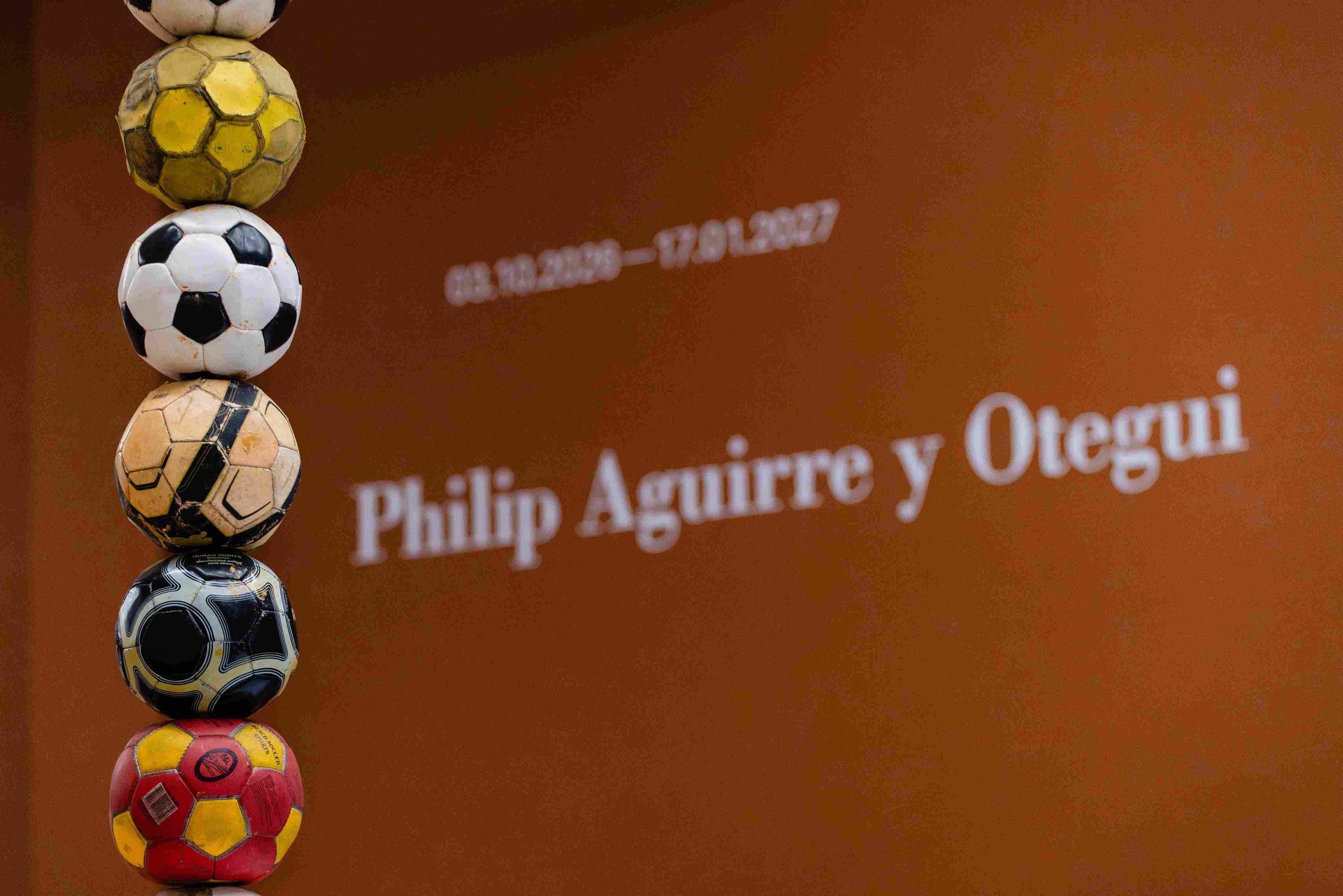
Football has long been a recurring theme in Aguirre’s work, as illustrated by the “football totem” that greets visitors at the KMSKA. For him, however, it goes far beyond the game itself.
“I like football, but I’m not a fanatic. I use it as a metaphor for what is happening in the world. Football is very political. Very, very political.”
“It is also a beautiful sport, and I use what is beautiful about it”, he adds.
To illustrate his point, Aguirre turns to an earlier work, African Dream (2004), not exhibited at the KMSKA. Based on photographs of Pelé’s famous bicycle kick, it shows a golden footballer frozen mid-move.
“I called it African Dream because people talk about the ‘American Dream’. But for a long time in Africa, football was the only way to leave the country or get a visa. That’s why I made it gold.”
Forced journeys
Displacement, whether for political or economic reasons, is a recurring theme in Aguirre’s work. It draws attention to people who might otherwise go unnoticed.
At the KMSKA, several life-sized sculptures, clustered together just above eye level, evoke hardship and uncertainty. There is a woman balancing a red jerrycan on her head and holding two more in her hands, a man with a mattress on his back, another with empty bottles tied to his shoulders, and a third lying in an old oil drum.
Senegal has long been a source of inspiration for Aguirre, particularly its traditional fishing pirogues, which are also used by migrants attempting the dangerous crossing to the Canary Islands.
In 2008, he collaborated with boatbuilders from M’Bour and curator Koyo Kouoh to create Gaalgui, a monumental upright pirogue which was presented at the 2009 Beaufort Triennial on the Belgian coast to raise awareness of these migrants.
Almost two decades later, the subject returns to the Venice Biennale in an edition conceived by Kouoh before her untimely death in May 2025. Presented at the Arsenale, Gaalgui Shelter draws on the same Senegalese boats and incorporates elements of a shelter, a lookout point, and a lighthouse. Entirely sky blue, it speaks of departure as much as protection.
Aguirre’s work can play a practical role in the communities he visits. In Douala, Cameroon, for example, his Théâtre Source transformed a natural water source into an amphitheatre, providing better access to water and creating a communal space that now hosts performances, weddings and baptisms. A large photograph of the site, with children playing on its steps, covers a wall in the first room at the KMSKA, facing the Fallen Dictator (2005).
“I walk around, I look”
For Aguirre, discovering a country may begin with an interest in a particular artistic tradition or an unexpected encounter. When asked whether he is first drawn to the people or the places and things around him, he says that it depends.
“In Portugal, for example, I chose to go because I knew about the tradition of ceramics and tiles. I wanted to learn about it, and that’s how I got to know the Portuguese people. But in Senegal, it was really the people I met who opened doors for me and introduced me to crafts and new possibilities.”
He starts by observing, though.
“I walk around, I look, I try to capture and understand what is happening: the colours, the shapes, the materials, all of that.”
These discoveries find their way into his work through the techniques and materials he encounters, learns to use or combines with his own creations, from Portuguese azulejos to Senegalese craftsmanship and, more recently, textiles.
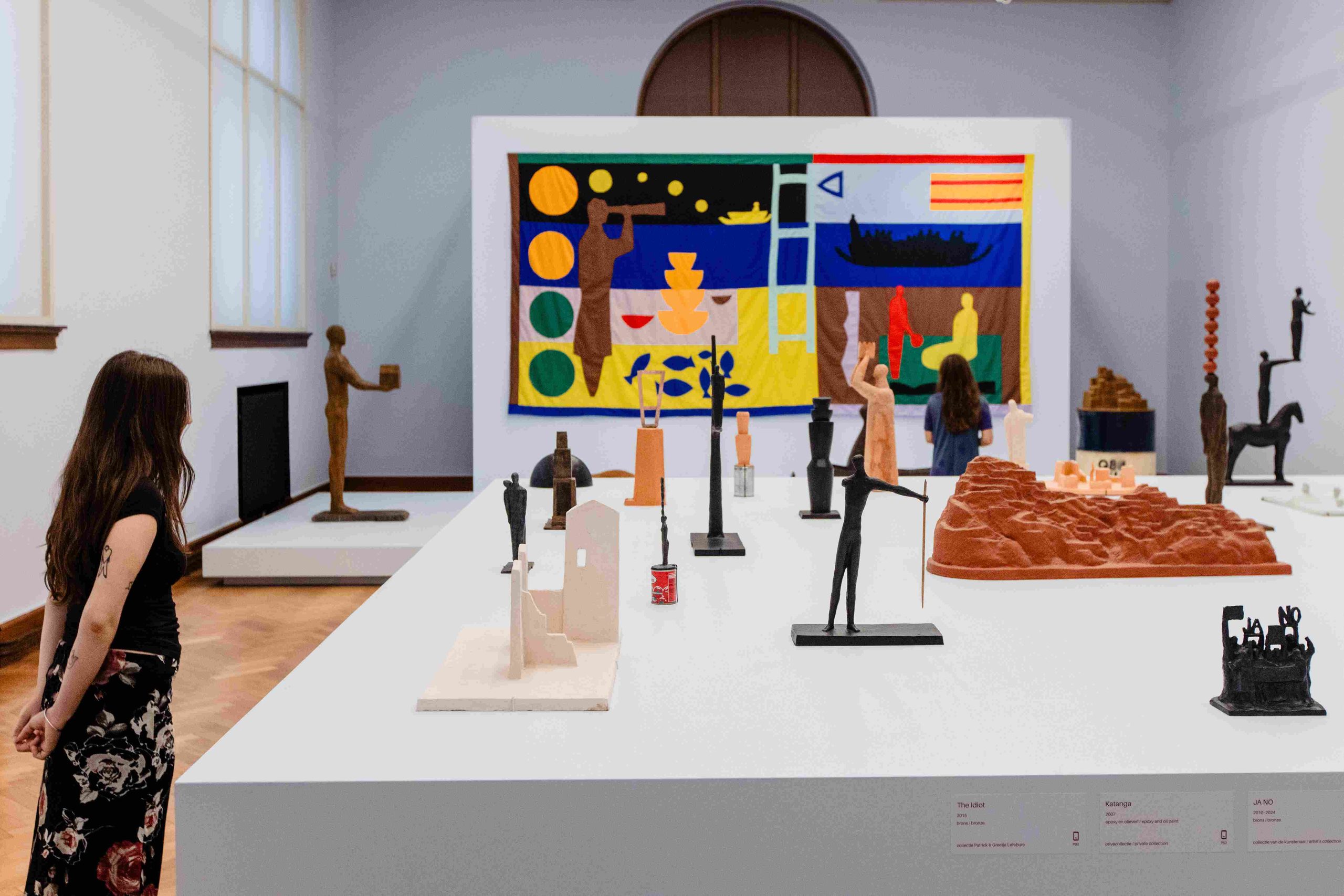
The latter came about almost by chance, in 2022, when Lamine Tounkara, a Senegalese tailor and friend, was struggling to find work. Rather than simply offering financial assistance, Aguirre proposed a collaboration that could provide work and open up new opportunities.
“So, I asked him, ‘Could you create something for me?’”
Aguirre painted watercolours, and Tounkara translated them into fabric. “We understood each other very well. It’s the sort of chance opportunity I absolutely love.”
This collaboration opened up a new field of artistic creation for Aguirre. Two of the resulting colourful patchworks now adorn the walls of the KMSKA exhibition, one in the first room and the other, Hommage à un ami, on the last.
Journeys without borders
Aguirre’s work transcends geographical boundaries as well as the divisions between disciplines, materials, styles, and traditions.
He has championed this freedom since his student days, when he found himself at odds with the prevailing ideas about contemporary art.
“When I was a student, there were these ‘popes of art’, the great curators. Everything was very dogmatic, conceptual or minimalist. They would tell me, ‘You’re a romantic’. And I’d reply, ‘So be it, but I’m going to be free and do what I want. I don’t need dogmas’.”
For him, art should remain a space where one is free to think.
“Art defines itself, so I have to reinvent myself every day.”
He also refuses to be confined to a recognisable style, even if it disappoints some of his admirers.
“I hate it when art becomes a product, something you can recognise from 200 metres away. It becomes a machine, a production line. I don’t think artists should just keep churning out the same thing.”
Beauty and poetry, however, remain constants in his work.
“When I finished my studies, the word ‘beauty’ was forbidden in art criticism. I found that so idiotic. I have always used words like ‘beauty’ and ‘poetry’, those very human words which I think we all need.”
He mentions an artistic ideal inherited from ancient Greece: art should be good, beautiful, and true. He says he heard the same principle expressed by a sculptor in an old film shot in a Congolese village.
“A work must be well made, with respect. It must speak about values, and for me, that’s essential”, he adds.
Journeys between cultures
For Aguirre, this freedom also translates into a taste for mixing cultures, unexpected associations and humour.
He prefers to describe himself as a chronicler rather than a politically engaged artist.
“They always say ‘engaged artist’, blah blah blah, activist, but that’s not true. ‘Chronicler’, now that’s a word I like. Humour is a weapon you can use. I always try to incorporate several layers of meaning into every piece of work.”
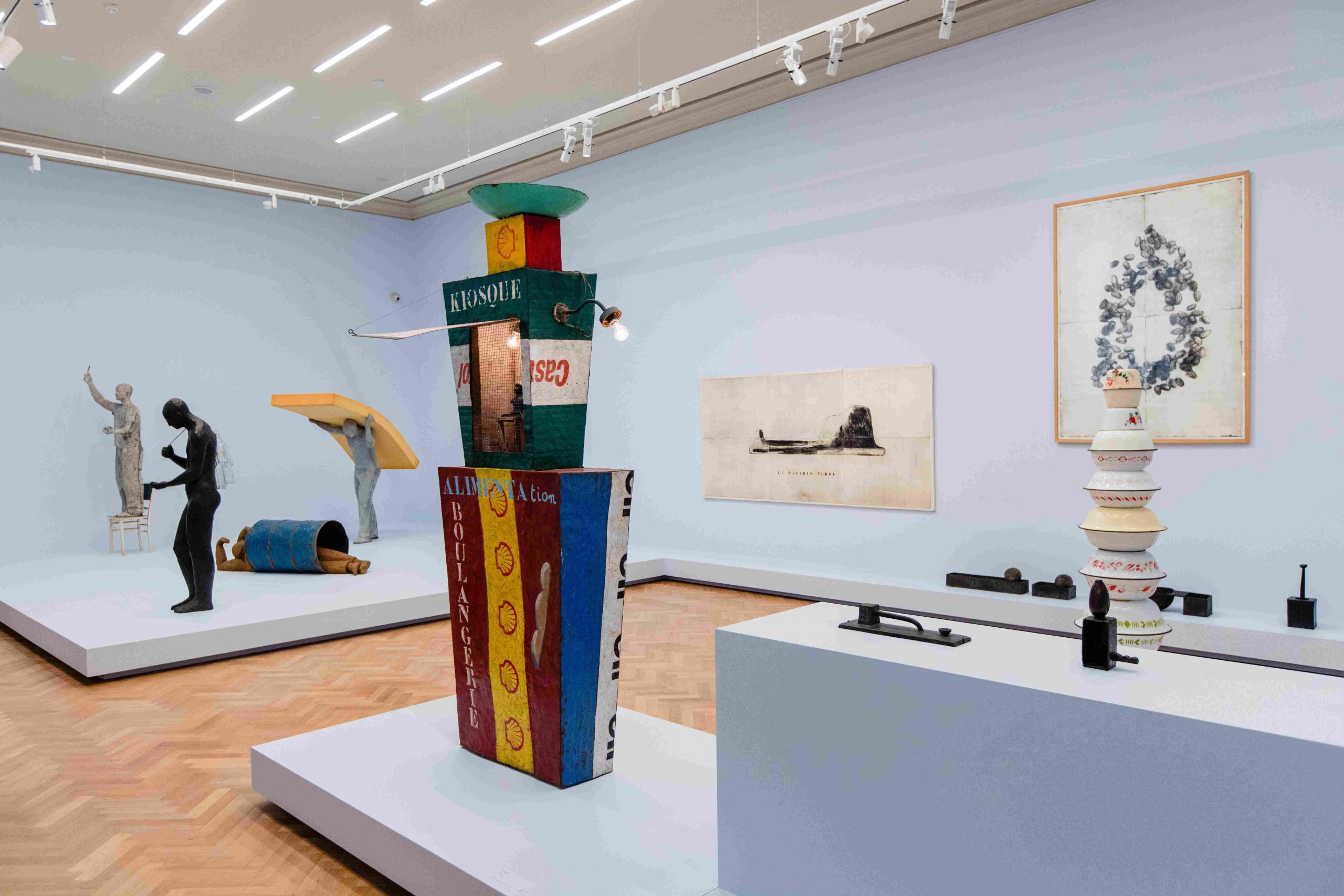
As an example, he cites a small Senegalese shop that he created: a tall, painted metal kiosk stencilled with “Alimentation” and “Boulangerie”, covered in Shell logos and with a lit window at the top. Inside, he placed a tongue-in-cheek self-portrait: a Venezuelan figurine known as El Negro Felipe.
“It’s a little voodoo sculpture from Venezuela. It’s a Black man and his name is Felipe. El Negro Felipe. So I thought, ‘Aha, I’ll put him in my African shop’. It’s all about playing with words, shapes, colours, and meanings. It’s eclectic, yet the visual language is clear. Yes, I mix a lot”.
That taste for mixing things is also evident in his collages, which he has been making since the 1990s, drawing inspiration from Pop Art and Andy Warhol.
“I’ve always made a lot of collages, using food packaging, sardine tins, tuna tins, cigarette packets and all sorts of things. There’s a lot of colour. You can see a bit of Pop Art coming through in my work.”
Forty years of journeys
The Antwerp retrospective brings together more than forty years of Aguirre’s work, from his earliest student creations to his most recent pieces. Looking back over that journey has sometimes been confronting and emotional, he says.
However, what struck him most was the continuity of his themes.
“What I see is that, over the course of more than forty years, there are a few ideas that keep recurring. And that’s normal.”
He recalls reading the autobiographies of the French writers François Mauriac and André Gide as a student.
“Towards the end of their lives, they would say, ‘Here I am, still working on the same idea I had when I was eighteen or twenty, still trying to develop it and find better ways to express it.’”
He now recognises something similar in his own artistic journey.
“My work has evolved, and I’ve discovered new ways of creating. But I’ve also placed some of my most recent works alongside those from my student days in the first room, because I can still see the connection between them.”
Travel has been part of his life since childhood and has since become an integral part of his artistic practice.
As he tells visitors on his guided tours, “First came travel, simply because I love travelling. Then I found a way to integrate travel it into my work and give it meaning.”
His next destinations? Senegal, where he regularly returns to see friends and collaborators, and Colombia.