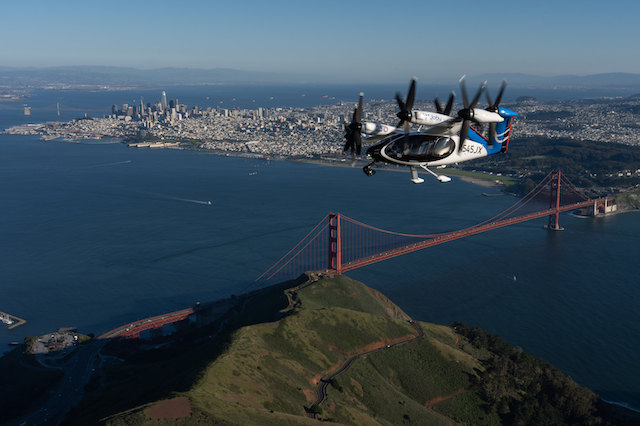



Joby Aviation recently flew its electric air taxi over the San Francisco Bay Area, showcasing how future urban air travel might work. The flight passed landmarks like the Golden Gate Bridge and the Marin Headlands, demonstrating that electric air taxis are not just a futuristic idea, but closer to real-world operation.
Designed to carry up to four passengers, these aircraft are quiet and produce no direct emissions, offering an alternative to road travel in heavy traffic. With six tilting propellers and fixed wings, the aircraft can take off vertically like a helicopter and then fly forward at speeds near 200 mph (320km/h), much faster than cars in city traffic.
This demonstration marked the start of Joby’s 2026 “Electric Skies Tour,” a series of flights in several U.S. cities intended to introduce people to the technology. The tour builds on extensive testing, with the company logging more than 50,000 miles (around 80,500 km) in test flights, showing that the technology is maturing. “By providing clean, quiet service with minimal infrastructure investment we are making flight an everyday reality for the community,” said JoeBen Bevirt, founder and CEO of Joby.
Joby is also part of the U.S. government’s eVTOL Integration Pilot Program (eIPP), a pilot initiative backed by the White House that allows electric aircraft to begin limited operations in selected regions. Joby will fly in states including Arizona, Florida, New York, and Texas as part of this program, aiming to build experience with safety, regulation, and public acceptance. Such pilot programs are crucial as current air traffic rules were not written with electric air taxis in mind, and regulators need real-world data to update them. Other companies like Archer Aviation and Beta Technologies are also participating in similar programs, showing that the industry is moving toward broader testing and eventual certification.
The push for air taxis is not just happening in the U.S. In Dubai, Joby and Uber have partnered to bring electric air taxis to the city’s skies by the end of 2026. Riders will be able to book flights directly through the Uber app, linking ground travel with aerial legs for faster journeys. Up to four people and their luggage can fly in these aircraft, which use vertical take-off and landing technology to use small rooftop or airport “vertiports.” Four vertiports are planned across the city, including at Dubai International Airport and the Dubai Mall, creating a network that could ease congestion in this fast‑growing urban landscape.
The growing interest in air taxis reflects broader trends in urban air mobility (UAM), a concept where electric aircraft connect parts of a city or region faster than cars and buses. Experts expect this market to grow significantly in the coming decades as cities struggle with traffic congestion, pollution, and stretched infrastructure. Air taxis are seen as one solution to these challenges because they use electric engines, which are cleaner and quieter than traditional combustion engines, and can bypass ground traffic entirely. Still, there are hurdles: building enough landing and take-off spots, training pilots and technicians, and creating new air traffic rules that keep these flights safe alongside other aircraft.
The development of air taxis also highlights economic and regulatory challenges. Electric aircraft are expensive and require complex certification by aviation authorities before they can carry paying passengers. In the U.S., lawmakers are even discussing bills to simplify the certification process to help new aviation technologies reach the market sooner. At the same time, companies are competing over technology, patents, and design as the industry evolves. This competition drives innovation but also adds pressure for safety and reliability, which regulators and the public both demand.
Joby’s recent flight, along with its nationwide tour, underscores the growing momentum behind urban air mobility. As cities expand and congestion intensifies, electric air taxis are emerging as a potential new transport layer, capable of linking neighbourhoods, airports, and city centres in minutes rather than hours. If companies can overcome regulatory and infrastructure challenges, the air taxi concept may soon become part of everyday life.