


Airlines have so far failed to pass on recent savings on fuel prices to customers amid travel demand that remains unusually high and a tightly consolidating aviation market, new reporting shows.
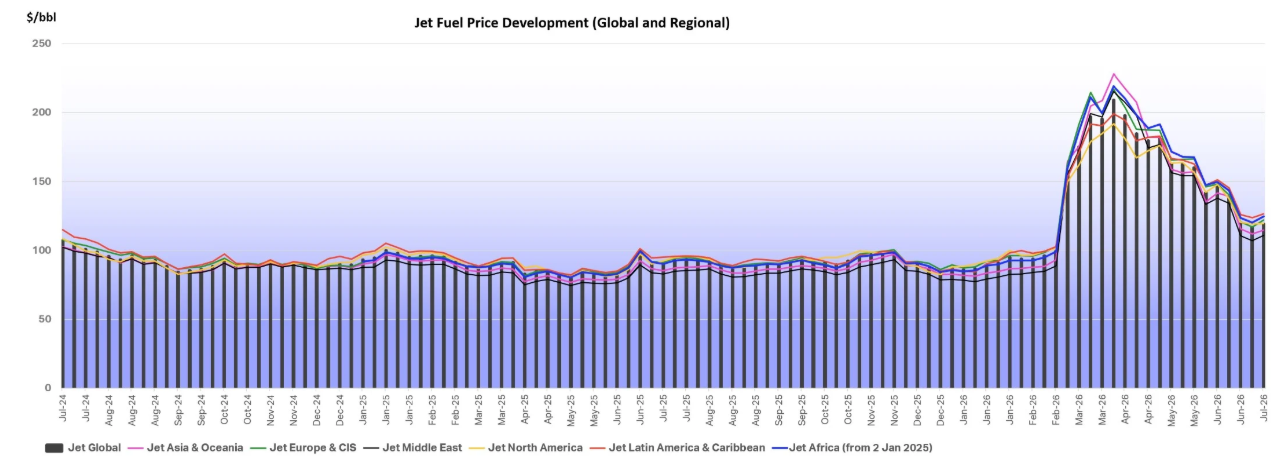
The Wall Street Journal reports that fuel prices have now dropped 40% since April, when the fuel supply chain was in crisis due to the blockade of the Strait of Hormuz that ensued after US-Israel attacks on Iran in February 2026.
Those frantic energy markets saw airlines putting up ticket prices eight times to cover the cost of fuel, meaning fares were up nearly $100 year-on-year by May. But even though fuel costs have fallen again, almost by half, fare prices are not aligned. Investment firm Raymond James says average domestic fares booked a week in advance now cost over 34% more compared to June last year.
It’s a situation predicted by Southwest Airlines CEO Bob Jordan in May. He told investors he was “bullish that the industry will retain a much higher percent of the fare increases than would be typical.” Jordan pointed out that carrier control over the marketplace and pricing has been bolstered by the demise of budget airline Spirit.
Jordan is not the only cynical one. American also admitted it would benefit from the bankruptcy, having lost a key competitor. “For American, let’s face it—we competed with Spirit across the board,” American CEO Robert Isom said in May. He noted “across-the-board improvement in all those places that we compete directly,” when the budget rival started slashing its services. And Scott Kirby, CEO of United Airlines, also noted the unusual lack of “elasticity” in ticket pricing, blaming a demand environment that is “pretty strong.”
If US travel demand remains that powerful, analysts do not expect the fuel savings to be passed on any time soon. The question is, how long can the high demand last? An Ipsos survey in May showed 56% of respondents were “extremely or very concerned” about rising airline costs, meaning caution could start to infiltrate buying habits.
“The real test is what happens after Labor Day [in early September] when leisure demand tapers and airlines adjust fall capacity for a lower-fuel environment,” said Conor Cunningham, an analyst at Melius Research. He foresees a return to “fare sales and discounting” only if demand softens.
Yet in Europe, consumer travel sentiment is positive despite geopolitical concerns, with over 80% of Mastercard survey respondents saying they were planning to travel over the next six months—well beyond America’s Labor Day.