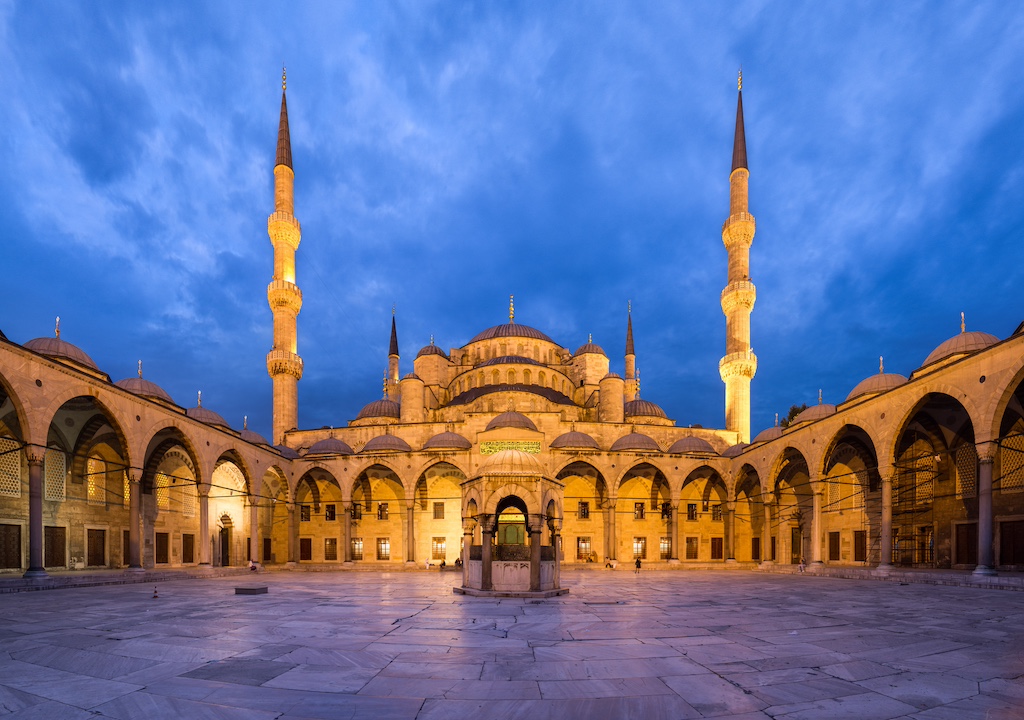



Few landmarks capture the spirit of Istanbul quite like the Blue Mosque. Rising above the historic Sultanahmet district with its elegant domes and soaring minarets, the 17th-century masterpiece remains one of Türkiye’s most visited attractions and an active place of worship welcoming thousands of visitors every day.
Its official name is the Sultan Ahmed Mosque, after the young Ottoman ruler who commissioned it, but its popular nickname comes from the dazzling blue Iznik tiles that decorate its vast interior. More than 20,000 handcrafted tiles, combined with hundreds of windows that fill the prayer hall with natural light, create the tranquil blue glow that has become synonymous with the mosque.

Standing on Istanbul’s historic peninsula opposite Hagia Sophia, the mosque occupies one of the city’s most significant locations. The surrounding area was once the political and ceremonial heart of both the Byzantine and Ottoman empires, home to the ancient Hippodrome and close to Topkapi Palace. Sultan Ahmed designed the mosque as the centrepiece of a much larger complex that included a theological school, charitable kitchens, shops, a hospital, and his own mausoleum.
What truly sets the Blue Mosque apart, however, are its six slender minarets.
When construction began in 1609, Sultan Ahmed I was 19 years old. The Ottoman Empire was still one of the world’s great powers, but the young ruler had not achieved the military victories that traditionally justified the construction of an imperial mosque on such a grand scale. Even before the building was completed in 1616, its ambitious design was attracting attention.

The greatest controversy was about the number of minarets. Ottoman imperial mosques typically featured up to four, but Sultan Ahmed ordered six, giving his new mosque a silhouette unlike any other in the empire.
The decision caused widespread criticism because the Great Mosque of Mecca, Islam’s holiest sanctuary, also had six minarets at the time. Many believed the new mosque appeared to place itself on the same level as the sacred site, and critics accused the young sultan of excessive ambition.
According to long-standing Ottoman tradition, the controversy was resolved when Sultan Ahmed financed the construction of a seventh minaret at the mosque in Mecca, restoring its unique status while allowing Istanbul’s new imperial mosque to retain its six distinctive towers.

Beyond the debate, the Blue Mosque represented the height of classical Ottoman architecture. Designed by Sedefkâr Mehmed Ağa, a pupil of the legendary architect Mimar Sinan, it blended Byzantine engineering influences with Ottoman design, taking inspiration from nearby Hagia Sophia while creating an identity all its own. Its cascading domes, spacious courtyard, and harmonious proportions have defined Istanbul’s skyline for more than four centuries.
Following an extensive six-year restoration completed in 2023, the Blue Mosque continues to welcome worshippers and visitors alike, and is open to guests from 8am to 7pm, completely free. Tourist entry pauses five times daily though, for about 90 minutes for prayers. Silence should be maintained and men must cover shoulders and knees, while women, also require a head covering (scarves are supplied if needed).
Inside, visitors can admire intricate floral motifs, stained-glass windows, and enormous chandeliers that were once illuminated by oil lamps. Some still display ostrich eggs, traditionally believed to discourage spiders from weaving webs around the lights.
Sultan Ahmed I died in 1617 at just 27 years of age, only a year after his great mosque was completed. Although his reign was brief, the monument he left behind has endured as one of the world’s finest examples of Ottoman architecture. The mosque’s six minarets, once the subject of fierce debate, are now among Istanbul’s most recognizable landmarks and a lasting symbol of the city’s rich religious, cultural and architectural heritage.