


Air travel demand will more than double by 2050, according to a new forecast by the International Air Transport Association (IATA), with the fastest growth in the Asia-Pacific and Africa regions.
The IATA’s Long‑Term Demand Projections (LTDP) take population, employment, flight frequency, and aircraft size data at the country level and consider real GDP (Gross Domestic Product) per capita, adjusted for PPP (Purchasing Power Parity), as a main growth driver. The resulting projections echo figures from European aircraft manufacturer Airbus in its forecast for 2023 to 2042 (GMF23), which predicted that demand would double over the next 20 years.
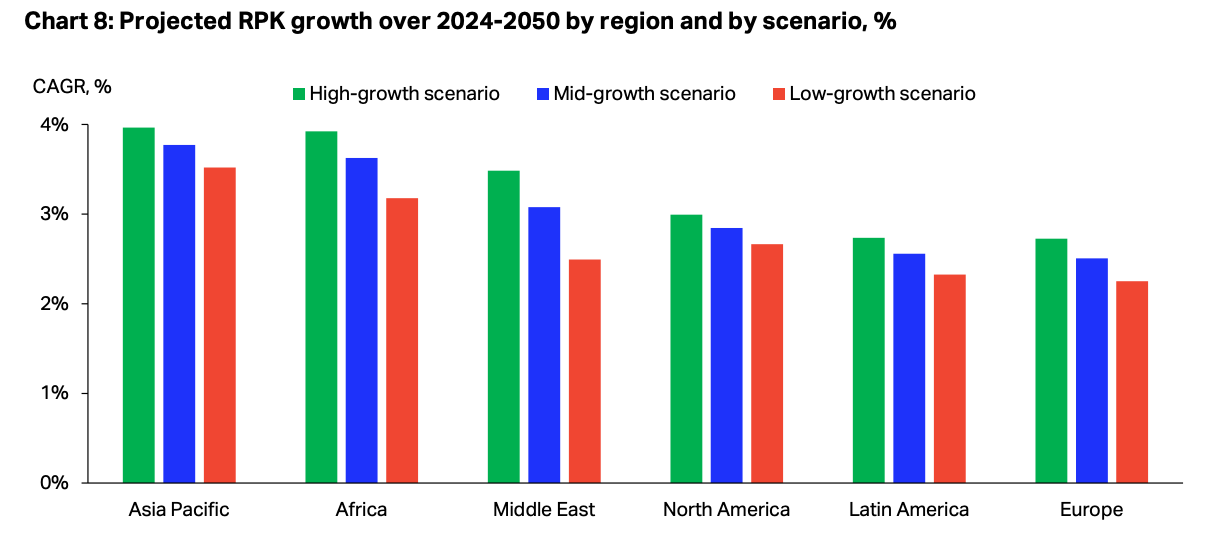
Did you know global air travel demand, measured by Revenue Passenger Kilometers, is expected to grow by 2.9%-3.3% per year from 2024 to 2050?
— IATA (@IATA) March 21, 2026
The #WeeklyChart and the long-term relationship between global economic growth and air travel demand growth 👉 https://t.co/W5KXePhmkJ pic.twitter.com/ACg4x0km42
The IATA indicators identify the fastest‑growing markets as intra‑Africa (4.9%), Africa–Asia‑Pacific (4.5%), Asia‑Pacific–Middle East (3.9%), intra‑Asia‑Pacific (3.9%), and Africa–North America (3.8%), where the pace of growth highlights “the importance of investment in aviation infrastructure and regulatory frameworks in developing regions,” the report said. It also noted additional factors that can boost growth above average, such as: “demographics, market maturity, economic development, and connectivity potential.”
Tying in with that analysis, Boeing has already issued similar 20-year forecasts predicting the biggest growth in passenger traffic numbers in South Asia (7.4% increase), Southeast Asia (7.2%), and Africa (6.4%). With a commercial aircraft fleet set to more than double by 2043, China is playing a huge driving role.
By contrast with those fastest-growing markets, several Europe‑centered markets are shown to be among the slowest in the report. Commenting on the projections in a statement, Willie Walsh, IATA’s Director General, said: “The outlook for air travel is positive. People want to travel and, under all our modeled scenarios, the demand to fly is expected to more than double by mid-century. That is good news for global economic and social development because aviation growth will catalyze opportunities, including jobs, around the world.”
Walsh went on to call for “policy frameworks to support key success enablers such as efficient infrastructure development, market access facilitation, regulatory harmonization, and an effective clean energy transition.”
Two long-term trends emerge from the IATA projections. The first is that even under the highest growth scenario, COVID caused a “structural shift in global aviation demand” that is not expected to be repaired or go back to pre-pandemic norms. The second is that overall, the travel market is moderating over time, with compound annual growth rates (CAGR) dropping from 6.1% in 1972 to 4.5% by 2024. Framing this as a “gradual moderation,” IATA argued it “reflects market maturity rather than weakening demand, as absolute passenger numbers continue to rise significantly.”