

Get ready to be dazzled: Brussels is doing its spring clean, with no bench, litter bin or road sign being left untouched.
In preparation for the summer season, the City of Brussels has initiated an extensive clean-up campaign to refresh the capital. Over the next 10 days, public workers and cleaning crews will fan out across the centre to scrub bollards, cycle racks, drinking fountains, lampposts, flower boxes, kiosks, and even public toilets – though one might hope those receive attention a little more regularly.
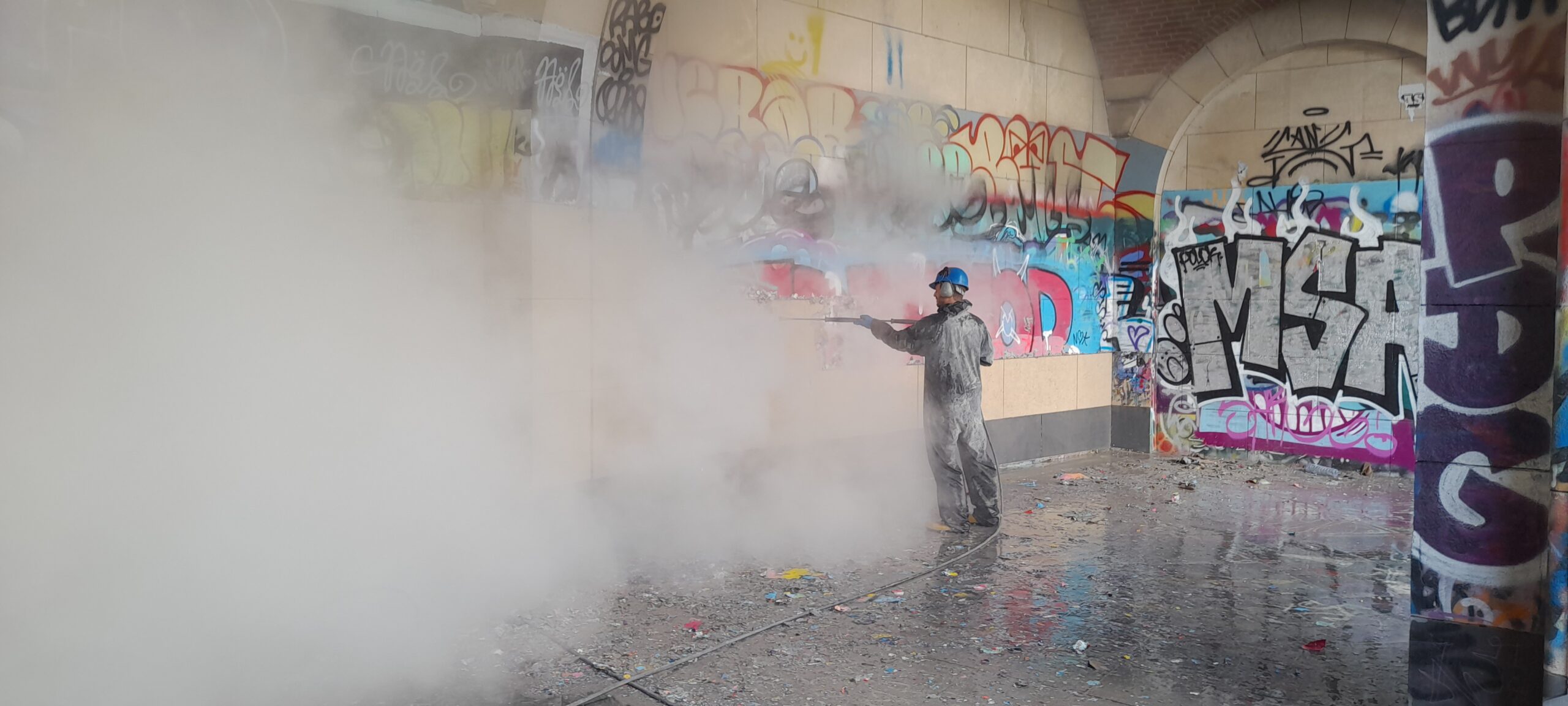
Nothing is being overlooked in the campaign initiated by Anas Ben Abdelmoumen (PS), Brussels councilman for Public Cleanliness. Street furniture, walls, stickers and graffiti are all in the firing line of the city’s recently acquired superheated water and steam-cleaning machines.
For lovers of street art and photography, this may be the moment to rush out and capture that mural or tagged doorway you spotted the other day, before it disappears beneath clouds of industrial steam.
“We have noticed that simply sweeping or removing dirt is not enough”, Ben Abdelmoumen’s spokesperson, Andreas De Kerpel, told the Brussels Times. “Steam cleaning is a very effective technique for removing tags and stickers, which is why the city has invested in new steam-cleaning machines. Summer is coming, and more people will be visiting the city centre. Naturally, it needs to look tidy.”
De Kerpel acknowledged that the current state of many benches, which are covered in tags and stickers, creates a sense of neglect and sometimes even a feeling of insecurity. However, he insisted that the goal was not simply to erase graffiti, but rather to refresh the entire cityscape by “cleaning everything with steam and superheated water so that it looks like new again”. He also emphasised in his interview with the paper that the operation was intended to encourage residents to show greater respect for public spaces and street furniture by sending a clear signal.
Graffiti, dismissed by some as vandalism and defended by others as street art, seems to be a primary target of the campaign.
However, many artists might see the clean-up as providing a new blank canvas waiting to be claimed. Part of its appeal lies precisely in its impermanence, reflecting the moods, trends and frustrations of the moment rather than turning it into a frozen open-air museum piece.
The works have already begun, and, according to the Brussels Times, the first results are already visible along the central pedestrian areas.
The entire operation is expected to cost at least €40,000 and is being carried out in partnership with an external company as part of a pilot project.
“The idea is to organise this kind of action regularly, several times a year,” explained De Kerpel.
If the results are convincing, the campaign could return later this year. Otherwise, Brussels residents and tourists alike will have to continue navigating a city where the graffiti sometimes reflects their political mood and sometimes does not.