


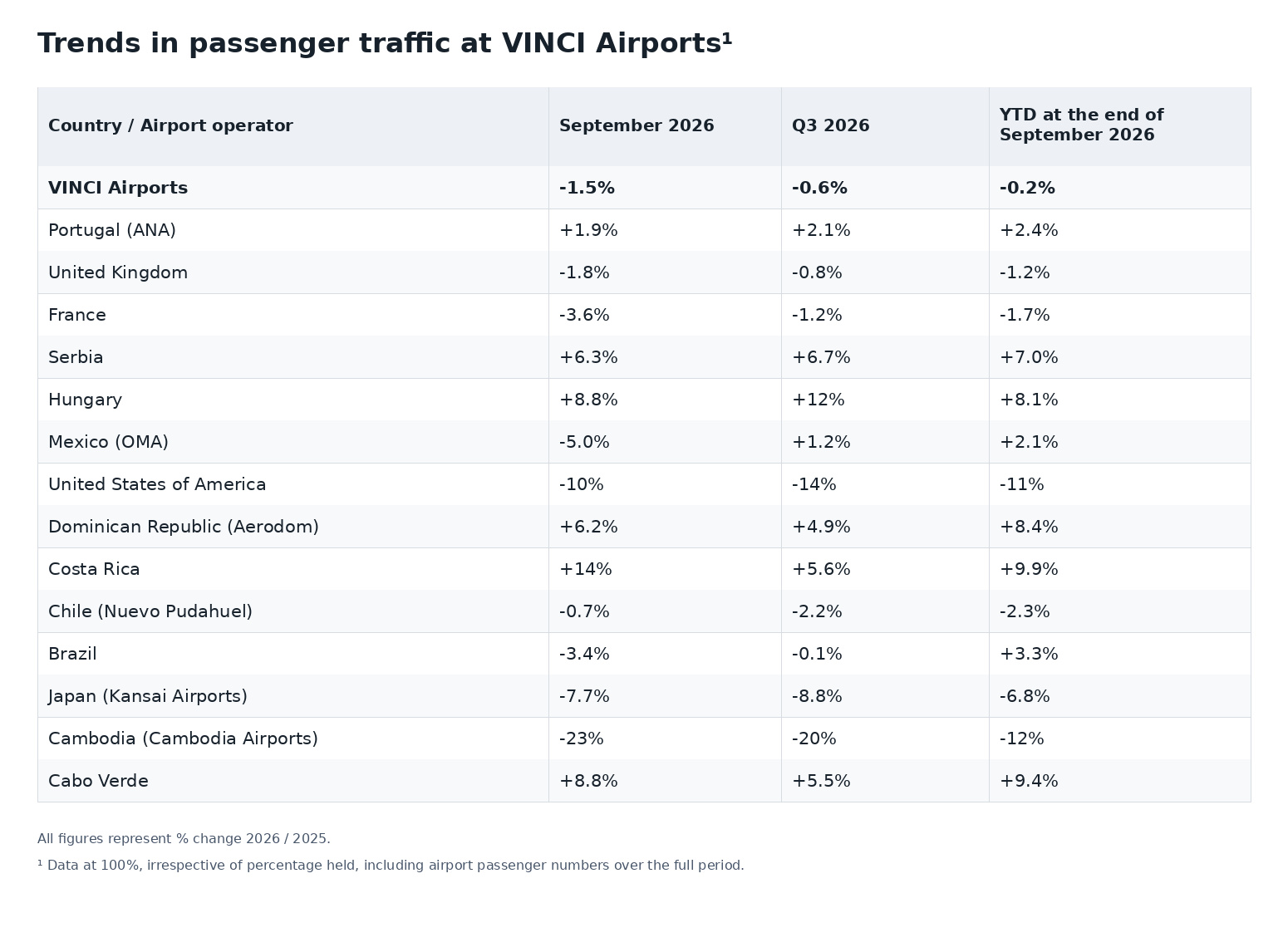
A quarterly review of VINCI Airports’ traffic numbers has revealed a slight decrease in numbers. During the third quarter of 2026, the private airport operator welcomes 93.5 million passengers, down 0.6% compared to 2025.
VINCI Airports, the leading private airport operator in the world, managing the development and operation of more than 70 airports located in 14 countries, has experienced a slight decrease in passenger traffic. According to the company, geopolitical disruptions in Asia and high kerosene prices continued to impact traffic at certain airports.
However, the negative effect on the passenger numbers was almost entirely offset by a strong momentum of numerous platforms in Europe and Latin America, highlighting “the network’s sound geographic diversification and its resilience to cyclical shocks”.
Strong numbers
VINCI Airports’ data show that several airports in its network continued their growth trajectory over the course of 2026.
In Europe, Budapest’s airport recorded very high passenger traffic during the summer period (up 12% when compared with the third quarter of 2025). The increase was caused by an expanded flight offer by Wizz Air and Ryanair to Southern Europe. Meanwhile, Belgrade airport confirmed its dynamism and role as a regional hub, with strong performance on routes to Western Europe.
At Edinburgh airport, traffic growth during the third quarter of 2026 was driven by increased capacity from airlines such as Ryanair, easyJet, and Jet2, particularly to Mediterranean destinations. In Portugal, too, strong performance continued: Porto and Faro stood out, with significant increases in passenger numbers this quarter (up by 7.1% and 3.7% compared to 2025).
Moreover, in the Cabo Verde archipelago, airports recorded a notable increase in traffic which was driven by the strengthening of connections with Europe, in particular through new routes operated by easyJet and TAP.
In Mexico, traffic growth was driven during the third quarter pf 2026 by strong domestic flights between regional airports. Meanwhile, Salvador Bahia airport in Brazil confirmed its rise as a regional hub following investments by the airline GOL. In the Caribbean, Dominican Republic airports saw significant growth thanks to connections with Spain, other islands in the region, and Latin America.
Industry difficulties
However, geopolitical disruptions also continued to impact traffic at some airports across VINCI Airports’ network.
In Asia, tensions between China and Japan again weighed on the trends of Japanese airports in the network (down 8.8% compared with 2025). Cambodia, too, recorded a decline in traffic, linked to decreased demand from China and Thailand.
In Chile, Santiago Airport saw its traffic contract, mainly due to unfavourable fuel price trends and flight adjustments for the Southern hemisphere’s winter season.
Finally, the decline in traffic at London Gatwick continued but eased over the third quarter (down 2.9%). According to VINCI Airports, the trend reflects the continued effects of the restructuring of the medium-haul offering of low-cost carriers, partially offset by strong results during the summer, particularly to Spain, and by the five new aircraft based by the company Jet2.