

Japan has launched a Mars mission set to bring back moon material that could illuminate the dawn of the solar system and how the two satellites orbiting one of Earth’s nearest neighbours were formed. If successful, the Martian Moons eXploration (MMX) rover will become the first ever spacecraft to land on a Martian moon and collect and return moon samples to Earth for analysis—but space enthusiasts will have to wait until 2031 for that moment.
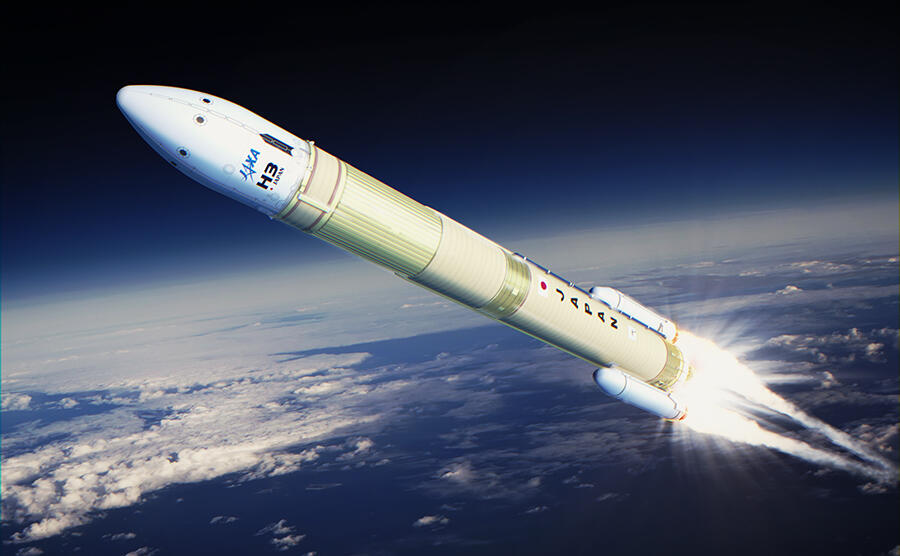
The Martian Moons eXploration (MMX) spacecraft blasted off from Tanegashima Space Centre in Minamitane, Kagoshima Prefecture, on 20 October 2026, at around 4:41 am local time, powered by an H3 rocket and with thousands watching online.
Japan’s Aerospace Exploration Agency (JAXA) is behind the $578-million (over €514.31 million) mission to better understand the Martian moons, Phobos and Deimos. After an embarrassing engine failure on its maiden flight in 2023, JAXA has since celebrated and confirmed that the MMX’s first milestone of this mission—the separation of the MMX from the H3 F10 rocket’s upper stage—had gone without a hitch.
JUST IN – Japan launches rocket for potential world first Mars moon mission https://t.co/rrr3OacBCl
— Insider Paper (@TheInsiderPaper) October 19, 2026
Next comes a nine-month journey towards Phobos, with arrival expected in August 2027, followed by a three-year research expedition before the collected samples are brought back to Earth in 2031. Despite the long project, JAXA intends the MMX to return only around 10 grams of the moon’s material.
Scientists are in disagreement about whether the Martian moons are essentially “chips off the old block” created by something crashing into Mars, or external space debris that has been drawn into the planet’s orbit. It is hoped the sample will resolve the mystery surrounding Mars and its moons’ formation, as well as indicating “how a habitable environment for life might have arisen on the terrestrial planets,” [Mercury, Venus, Earth, and Mars], JAXA said.
🇯🇵 JAXA’s #MMX (Martian Moons eXploration) has successfully separated from the H3 F10 upper stage. The flagship sample-return probe is officially on its interplanetary trajectory toward Mars and its moon Phobos. #JPSPACE https://t.co/bEAGr0hPXr
— CNSPACE (@CNSpaceflight) October 19, 2026
The biggest of the two Mars moons, measuring around 27 km by 22 km by 18 km, Phobos orbits its host three times a day at an altitude of approximately 6,000 km above the red planet (known as such for its rust-coloured, iron oxide surface). While NASA has sent nine unmanned spacecraft to Mars since the mid 20th century, and China did the same in 2021, the Japanese effort will be the first time that either Phobos or its smaller sibling moon Deimos, receive a probe from Earth.
Meanwhile, NASA’s rover, Perseverance, continues to persevere across the red planet’s surface as it has been doing since 2021. Its return to Earth was blocked by President Trump in January 2026. China, on the other hand, is preparing to launch its Tianwen-3 spacecraft in 2028 with a view to returning Martian samples by 2031—meaning, if all goes well, a double welcome home for MMX and Tianwen-3 will be in order that year.