


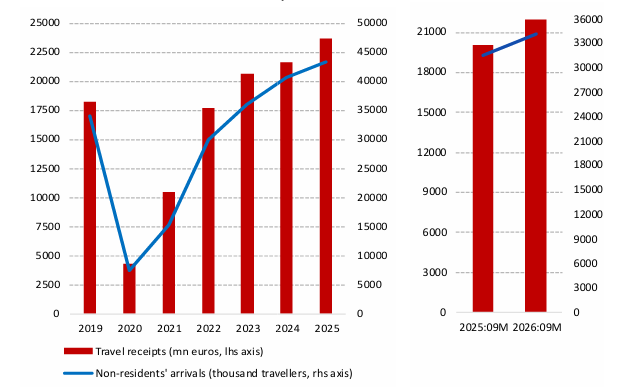
Greece’s travel receipts for the first nine months of 2026 are in, showing continued success and nearly 10% growth over the same period the previous year, thanks to increases in both arrivals and average spending.
Provisional Bank of Greece figures show the country took €21.96 billion for the first three quarters of the year, up by €1.93 billion, or 9.7%, year-on-year. Inbound travel was a significant factor behind that rise, up by 8.3%, to hit 34.2 million arrivals. Those tourists also spent more during their stay, with average expenditure per trip rising by 1.5%.
Tourists from other European countries, especially eurozone nations, form an important part of the economic picture for Greece. Receipts from EU residents went up by 11.5% to €12.1 billion. Germans and Brits feature as the two most valuable source markets, but Italian arrivals boomed to reach third place with 17.3% more visitors (2.29 million in total) from Italy, who spent 26.2% more than the previous year (totalling €1.45 billion).
Notable European exceptions, however, were the subset of European countries that are not in the EU, whose residents spent 7.3% less year-on-year to fall to €2.1 billion. And France not only sent fewer visitors to Greece, with arrivals down by 6.7% to 1.59 million, but their spending was lower than in 2025 too, falling by 7.5% to €1 billion.
Receipts from all other non-EU countries taken together, however, increased by 7.8%, reaching €8.8 billion. The detail here is interesting. Spending by US visitors went up by 15.2% to €1.66 billion, even though there was a 4.7% decline in US arrivals.

Looking at the September 2026 shoulder season, Greek officials said receipts were again up by 11.1% year-on-year to hit €3.7 billion. This time though, the arrivals did not hold up as strongly, only increasing 0.6%. As arrivals and spending among French, UK, and US visitors fell, the Germans played an important role, with receipts from German visitors up 48.6%. Their contribution helped to keep spending overall robust, with the data indicating a 10.2% jump in average expenditure per trip.
Overall, tourism’s value to the Greek economy is uncontested, and various outlets have noted that net income from travel services over the first three quarters of the year was enough to cover 75.4% of the goods balance deficit, and accounted for 93.3% of total net receipts from services. September’s net receipts from travel offset the goods deficit by over 100%.