

A survey of travellers’ use of artificial intelligence (AI) found that, rather than relying on it to plan holidays, they prefer to use it for practical tasks such as monitoring room rates for price drops or acting as a real-time translator.
Much has been said about AI’s influence on travel and the assistance it can provide, as well as the possibility that it could eventually replace human travel agents. However, as the technology becomes more widespread, a more nuanced picture is emerging.
A survey conducted in July by Mews, a hospitality technology company, of 3,250 travellers in France, Germany, Italy, the Netherlands, Spain, Sweden, the UK and the US revealed a clear distinction between tasks that travellers are happy to delegate to AI and those that they would rather handle themselves.
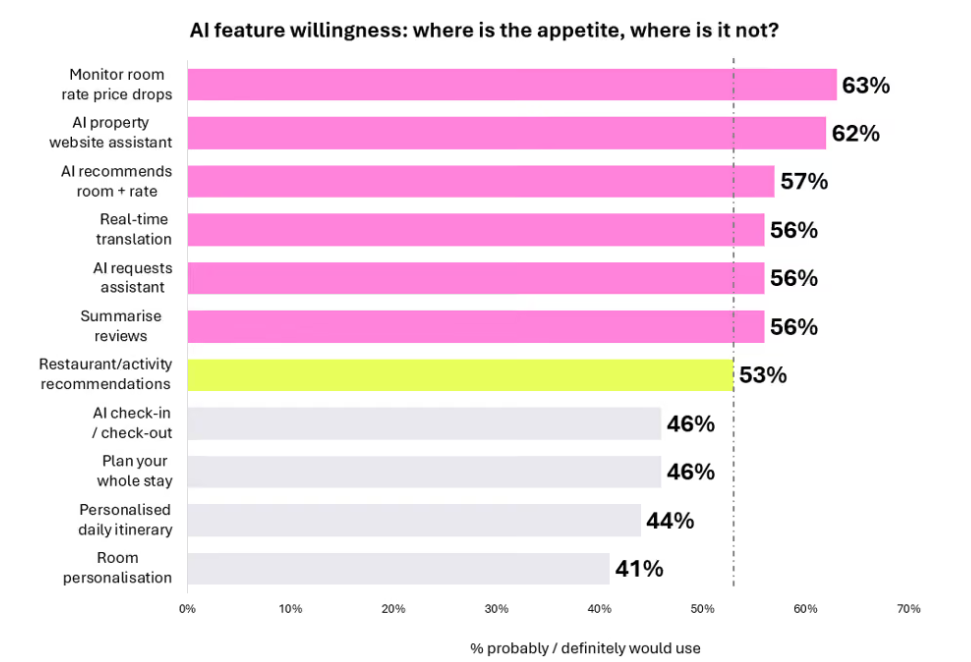
While 63% would use AI to monitor hotel room rates for price drops and 56% for real-time translations, only 44% would use it to plan their itineraries and 41% to personalise their hotel rooms.
The results clearly favoured letting the machine handle tasks requiring little human input, such as recommending room rates (57%) or summarising reviews (56%). Travellers were also relatively open to AI recommending restaurants and activities (53%) but were less enthusiastic about using it for check-in and check-out (46%) or planning their entire stay (46%).
Travellers also seem more comfortable receiving AI-generated recommendations based on information they have willingly shared, such as their stated preferences (61%) or previous hotel stays (56%), than on data gathered from their online behaviour (43%) or from external sources, including social media (34%).
American travellers were found to be the most comfortable with AI drawing on their previous hotel stays to make recommendations (63%).
These findings provide an interesting addition to previous research on the adoption of AI in the travel industry. As reported by Travel Tomorrow in August, 54% of US travellers had already used AI to plan a trip, while 75% intended to do so in the future. However, the latest survey suggests that using AI to plan a holiday does not necessarily mean letting it make the decisions.
Spaniards, on the other hand, place particular importance on transparency: 72% said they would be more willing to use AI-enabled services if they had greater control over their personal data.
The study also found that travellers in all eight countries were less willing to rely on AI to manage aspects of their stay than to help them plan ahead.
British travellers are particularly reluctant to embrace personalisation during their stays, with only 30% considering it important, compared to an average of 40% across all countries surveyed.
Meanwhile, Italians and Spaniards are the most enthusiastic about AI. In Italy, 58% expect hotels to offer digital check-ins. Spain shows the highest proportion of positive attitudes towards AI (58%).
“Having clever technology is great, but firstly, we should know whether guests want a task done for them or want to be part of it. Get that wrong and even good AI feels intrusive”, Josef Starýchfojtů, Chief Product and Technology Officer (CPTO) of Mews, said.
For hoteliers, this translates into reassurance that AI can handle routine tasks, thereby freeing up staff to focus on areas that technology cannot replace, such as personal attention, meeting individual needs, and human interaction.
“We’re building for human hospitality: technology handles the mundane, repetitive admin, and hotel teams have more time for their guests”, Starýchfojtů concluded.