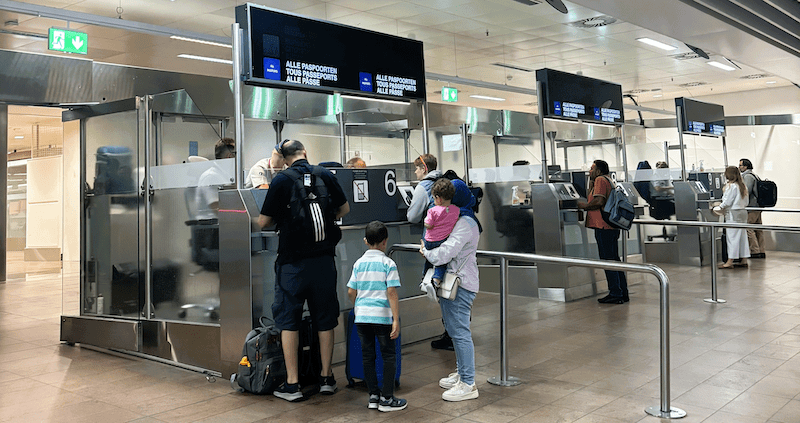



Non-European travellers faced waiting times of up to five hours at Brussels Airport last week, as technical problems with the European Union’s Entry/Exit System (EES) once again caused severe congestion at border controls.
Brussels Airport has confirmed the lengthy queues, which mainly affected passengers arriving from outside the Schengen Area and required to pass through passport control before entering Belgium.
The disruption was mainly linked to technical issues affecting EES, the EU’s biometric border registration system for non-EU nationals travelling for short stays. IT problems sometimes slowed down checks considerably, leading to exceptionally long waiting times.
The latest incident comes after months of warnings from airports and airlines about the impact of the new system on passenger flows across Europe.
Opnieuw chaos op #BrusselsAirport vanochtend, nu voor de transferpassagiers. De rijen aan de paspoortcontrole slingeren door de hele terminal. Tientallen gezinnen missen hun aansluitende vlucht. Onaanvaardbaar: hier is dringend een structurele oplossing nodig. pic.twitter.com/TpNK0HqzrC
— Michael Freilich, MP (@MichaelFreilich) September 24, 2026
From four-hour warnings to five-hour queues
The EES began its phased rollout in October 2025 and became fully operational across participating European borders in April 2026. It replaces the manual stamping of passports by electronically registering non-EU nationals entering and leaving the Schengen Area.
The system records travellers’ passport information, as well as biometric data including facial images and fingerprints. It is intended to modernise border management, identify overstayers and make it easier to detect cases of identity and document fraud.
Brussels Airport invested heavily in preparing for the system, installing 12 additional border control booths at arrivals, equipping 33 booths with facial-recognition cameras and providing 61 self-service pre-registration kiosks.
However, the rollout has repeatedly encountered operational problems.
As early as February, Travel Tomorrow reported that ACI EUROPE, Airlines for Europe (A4E) and the International Air Transport Association (IATA) were warning that EES could result in queues of four hours or more during periods of heavy traffic.
The organisations pointed to insufficient staffing, technical problems with automated border systems and the limited deployment of pre-registration tools as key concerns.
Brussels Airport itself experienced an early warning of the system’s vulnerability in February, when an e-gate failure forced passport checks to be carried out manually, resulting in waits of up to 90 minutes.
The situation deteriorated as the proportion of travellers registered under EES increased. In March, Brussels Airport called for greater flexibility in the implementation of the system after waiting times reached two hours at departures and more than three hours at arrivals. Nearly 600 passengers missed flights over four days, according to the airport.
More passengers sent to staffed border controls
One of the problems at Brussels Airport concerns how non-European passengers can use automated border infrastructure.
Until April, passengers from certain countries, including the United States, could register through EES kiosks and subsequently use automated gates to cross the border.
That is no longer possible, meaning more travellers now have to pass through staffed border-control posts. Combined with technical difficulties affecting EES, the change can create bottlenecks when large numbers of passengers arrive within a short period.
The airport says work is ongoing to find structural solutions to the congestion.
The issue comes as passenger traffic at Brussels Airport continues to grow. Around 5.2 million passengers were expected to use the airport during July and August alone, 4% more than during the same period in 2025.
IATA warned of six-hour waits
The five-hour queues come only weeks after the aviation industry renewed its concerns about EES.
At an EU media briefing in Brussels on 3 September, IATA called for greater flexibility in the implementation of the system, arguing that airports should retain the possibility of partially suspending EES procedures when infrastructurecannot cope with passenger volumes.
The association identified four conditions it said were necessary for the system to operate reliably: adequate staffing at border crossings, stable hardware and software, functioning self-service kiosks and automated gates, and wider use of pre-registration tools.
Asked about previous industry warnings of queues lasting as long as six hours, Thomas Reynaert, IATA’s Senior Vice President for External Affairs, said such waiting times were “certainly not an exaggeration”, noting that extreme cases had already occurred during the summer.
The latest disruption at Brussels Airport appears to reinforce those concerns. While EES was designed to modernise Europe’s external borders and eventually make controls more efficient, its implementation continues to create significant operational challenges almost a year after its rollout began.