

A Ryanair flight carrying 171 passengers was forced to declare a fuel emergency after three aborted landing attempts during Storm Amy, eventually touching down at Manchester Airport with just 363 kg of fuel remaining.
The incident occurred on 3 October 2025 aboard flight FR3418, a Boeing 737-800 travelling from Pisa International Airport in Italy to Glasgow Prestwick Airport. A newly published investigation by the UK’s Air Accidents Investigation Branch (AAIB) classified the event as a “serious incident”.
Ryanair 737 Pilots Lands at Manchester With Just Minutes of 363Kg Fuel✈️@Ryanair (FR) operated the @Boeing 737-800 involved in the serious incident, with the aircraft landing at Manchester Airport (MAN) after multiple weather-related diversions. The aircraft carried 171… pic.twitter.com/YsWiq1ncVH
— Aviation A2z (@Aviationa2z) September 25, 2026
With severe weather forecast across Scotland and northern England, the crew had taken on additional fuel before departure to account for possible delays and diversions. Storm Amy was bringing strong to gale-force winds, weather fronts and prolonged rainfall to the region.
Three aborted landings
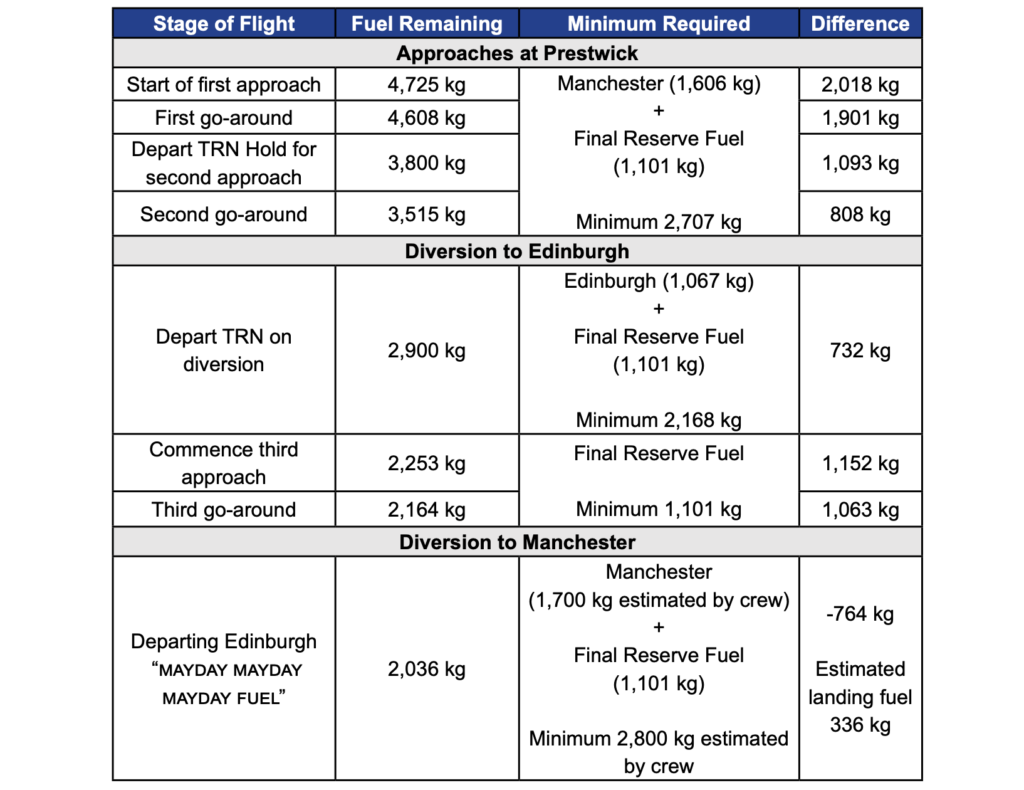
On approach to Prestwick, the aircraft encountered turbulent conditions and triggered a windshear warning at an altitude of 264 feet, requiring the pilots to abandon the landing. A second attempt ended in another windshear warning and go-around.
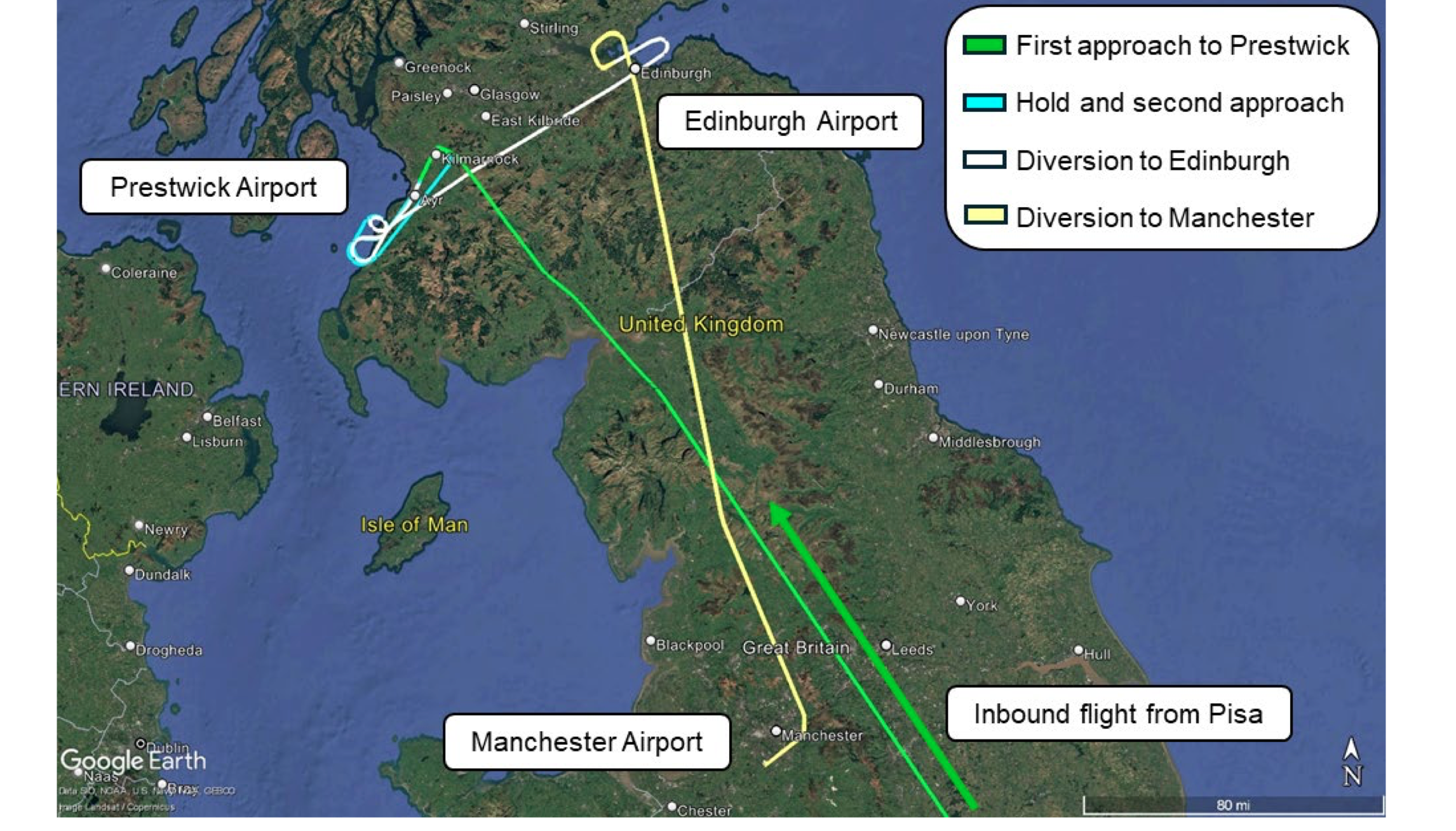
The crew then requested a diversion to Manchester Airport, which had already been selected as their preferred alternative because of more favourable weather conditions. However, the request was refused and the aircraft was instead diverted to Edinburgh. According to the AAIB, a “breakdown of communication” at Manchester Airport led to the request being rejected even though airport policy meant it should have been accepted.
Conditions in Edinburgh proved little better. A third windshear warning forced the pilots to abandon another landing attempt, while the aircraft’s fuel reserves continued to fall.
The commander subsequently decided to head to Manchester. By then, calculations showed the aircraft would arrive with substantially less fuel than its required final reserve of around 1,100 kg. The crew declared “MAYDAY MAYDAY MAYDAY FUEL” and requested an immediate diversion.
363 kg of fuel remaining
The aircraft landed safely in Manchester with 363 kg of fuel remaining, significantly below its final reserve requirement. By the time it had taxied and its engines were shut down, that figure had fallen to 240 kg.
The AAIB found that the crew faced a high workload and considerable stress as the fuel situation deteriorated. Investigators noted that, once heading towards Manchester, the pilots did not consider alternatives such as Newcastle Airport, which was closer.
The report concluded that it was unlikely the aircraft would have had enough fuel available to perform another go-around at Manchester.
Following the incident, Manchester Airport reiterated to stakeholders that diversion requests should be accepted when the airport has capacity and that the decision does not rest with an aircraft’s handling agent.
The aircraft, carrying six crew members in addition to the 171 passengers, landed without injuries or reported damage.