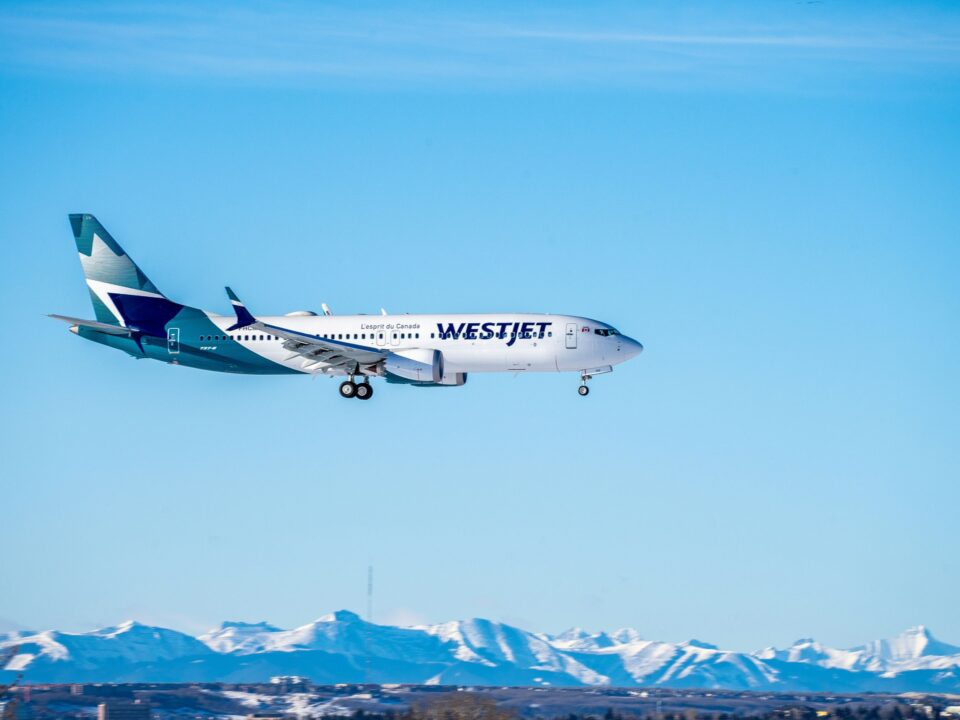



Targeting the relatively small number of flights that create the most warming aircraft contrails could delay aviation’s contribution to global heating by about a decade, according to research commissioned by campaign group Transport & Environment (T&E).
The study, produced by Klima Consulting and authored by former IPCC scientist Olivier Boucher, models contrail mitigation beginning in 2030 and reaching 50% effectiveness by 2040. On that pathway, aviation would reach a global warming contribution of 0.08°C in 2050 rather than 2040. The estimated avoided warming is around 0.025°C by mid-century and 0.049°C by 2070, T&E said.
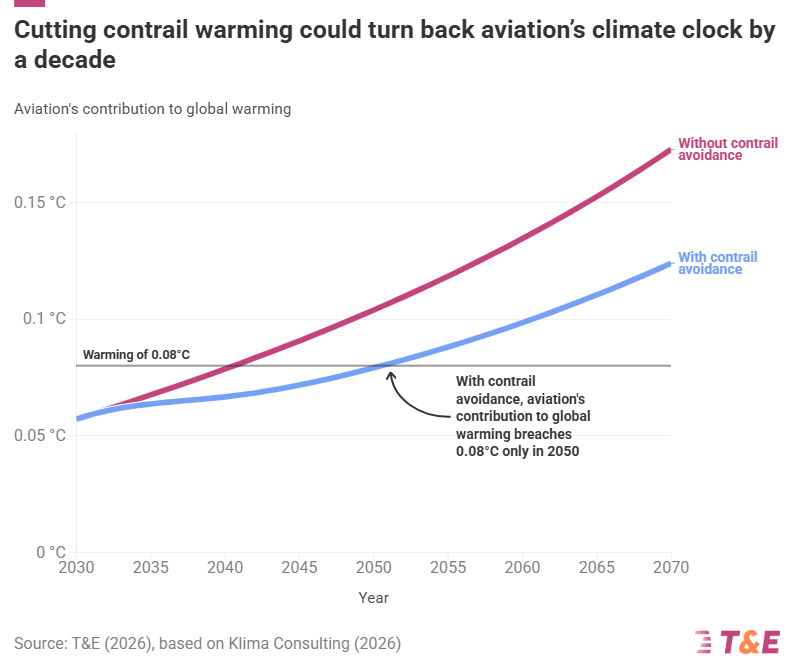
Contrails form when aircraft exhaust meets sufficiently cold, humid air. While many vanish quickly, persistent trails can spread into cirrus cloud and trap outgoing heat. Their overall warming effect is considered comparable with aviation’s accumulated carbon dioxide emissions, yet it is far more concentrated: 2019 data indicate that around 3% of flights generated 80% of contrail warming. Night-time and winter services are prominent targets because, after dark, contrails trap heat without reflecting incoming sunlight.
At current traffic levels, halving contrail warming could avoid an estimated 67 million to 225 million tonnes of CO₂-equivalent climate impact each year, measured over a 100-year period—roughly 7% to 23% of aviation’s projected 2025 CO₂ emissions. It could also preserve three to five percentage points of the world’s 2025–2050 temperature budget under a 2°C pathway, reporting by Sustainability Online emphasises.
Avoidance would not require eliminating every trail. Airlines could use forecasts to adjust departure times, cruising altitudes, or routes, while air traffic managers could steer flights around high-risk patches of the upper atmosphere. Selective use of lower-soot fuels is another option. Small trials have already shown that rerouting can prevent contrails with limited extra fuel burn, although researchers say larger tests across varied weather and airspace are needed, according to Aerospace Global News.
Forecasting humidity at cruising altitude remains a major challenge, as do questions about contrails’ interaction with natural clouds. Even so, the report argues that the underlying physics is established enough for action. Europe began monitoring aviation’s non-CO₂ effects in 2025, while a North Atlantic trial involving the UK government and air traffic services is due to test avoidance at oceanic-airspace scale.
For the travel sector, often berated for its high emissions record, the contrails approach promises a rare, near-term climate gain without wholesale disruption to networks, because interventions can concentrate on the most damaging flights. T&E is urging the European Union to extend non-CO₂ monitoring to all flights in 2027, and to reward carriers that avoid contrails through the Emissions Trading System. But the benefits last only while avoidance continues. The study is explicit that operational fixes must complement—not displace—lasting cuts in aviation CO₂, including cleaner fuels, more efficient aircraft, and measures addressing demand.