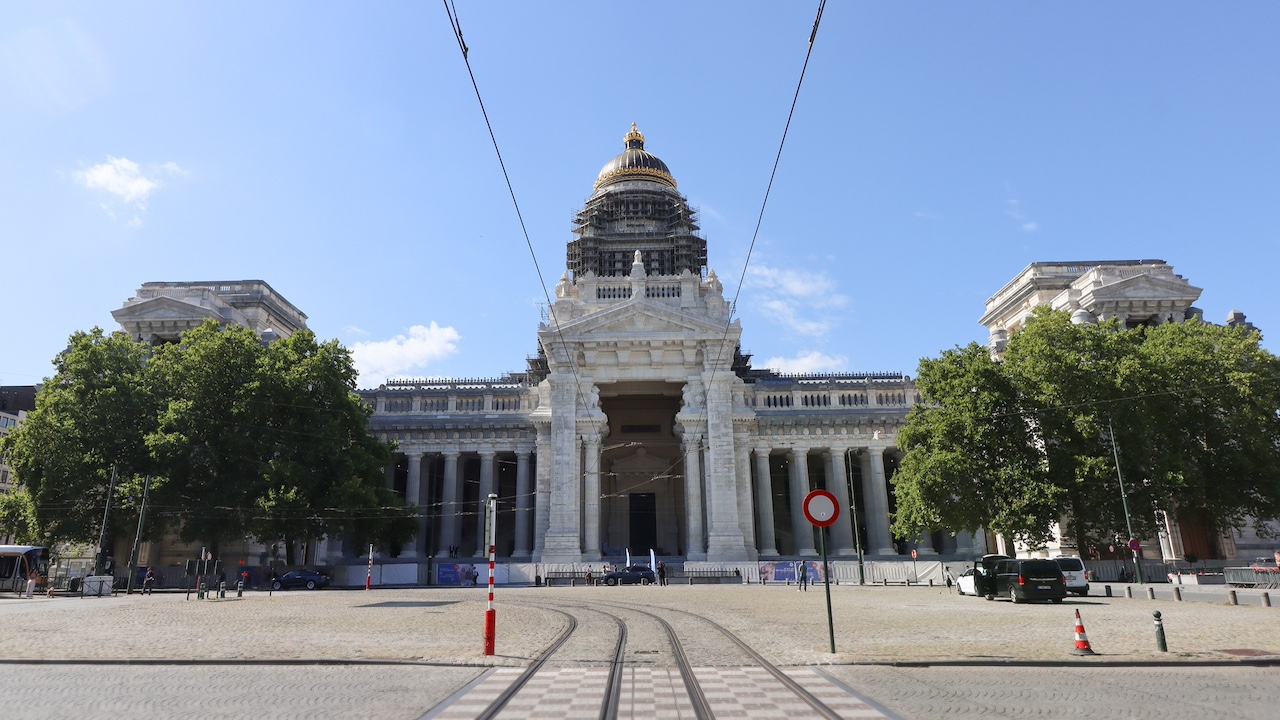



Justice has finally been done to one of Brussels’ most iconic buildings, as the scaffolding that had obscured the Palais de Justice’s monumental façade for the better part of the last 40 years has finally been removed, revealing Joseph Poelaert’s intricate and eclectic architecture in all its restored glory, unobstructed by cranes and metal.
The façade overlooking the square named after the architect was officially unveiled last week, following three years of restoration work. The ceremony was attended by Federal Justice Minister Annelies Verlinden, Minister of Public Action and Modernisation Vanessa Matz (Les Engagés), architects, and several of the hundred or so people involved in the project.
Verlinden (CD&V) described the completion of the first phase as a “success”, offering “hope and perspective for the future of the building, and, by extension, for the justice department”. She added that “the public should have access to the justice system in a building whose appearance reflects the dignity of the system itself”.
@mydayinbrussels The main façade of Brussels' Palace of Justice is finally visible again. The building has been hidden behind scaffolding since the early 1980s, making the scaffolding almost as famous as the monument itself. Now, in 2026, the front façade facing Place Poelaert is finally being uncovered after a major restoration. The Palace of Justice was inaugurated in 1883 and remains one of the largest courthouses ever built. The crazy part? The entire restoration project still isn't finished. Current estimates put the final completion around 2035. 📍 Palace of Justice, Brussels #bruxelles #architecture #palace #classical #facade ♬ original sound – MyDayinBrussels
Built between 1866 and 1883, the Palais de Justice remains one of Brussels’ defining landmarks. Sitting high above the city on the royal axis, it symbolically links the country’s executive, legislative and judicial branches in a straight line.
With a total surface area of 80,000 square metres and an imposing dome, it remains one of the world’s largest courthouses.
This iconic building, had, however, become better known in recent decades for the metal tubes holding it together than for its architecture.
The first scaffolding was erected in 1984, and a section covering the main façade was added twenty years later to protect against falling stones. The situation went from bad to worse, as restoration plans were repeatedly delayed due to disagreements between the various bodies involved, primarily concerning funding and who should pay the substantial costs.
At one point, the scaffolding itself even needed reinforcing before restoration work on the building could begin.
The newly completed phase covered 22,750 square metres of the façade and the Cour d’Honneur, taking three years and €31.7 million.
Each section of natural stone and decorative element was inspected, cleaned and, where necessary, repaired or replaced, with the aim of preserving as much of the original material as possible.
Replacement stones were sourced from the same regions as the originals, including Comblanchien limestones from Burgundy and Belgium’s famous pierre bleue (blue limestone) from Soignies.
Two corner stones weighing four tonnes each were also replaced 28 metres above ground, requiring some acrobatics.
Around 140 windows and 60 doors were restored, along with the monumental bronze door and four marble statues representing notable figures from Greek and Roman legal and political history: Lycurgus, Demosthenes, Cicero and Ulpian.
The peristyle, zinc roofs and 3,500 square metres of natural stone flooring were also restored, ready once again to bear the footsteps of robed judges and the general public.
“The restoration combined cutting-edge techniques with centuries-old craftsmanship,” said Isolde Verhulst, architect at PERSPECTIV architecten.
The main entrance from Place Poelaert is set to open in September, with a new entrance for people with reduced mobility.
Nevertheless, the Palais’s trials and tribulations are far from over. Scaffolding remains on other parts of the building and a second restoration phase focusing on the dome is scheduled to begin in 2027. The remaining façades will follow, with the exterior restoration currently scheduled for completion by 2035.
If all goes according to plan – and that is a big “if”, given the building’s history – it could all be completed by 2040.
As the saying goes, good things come to those who wait, and for now, the first battle has finally been won. Locals can once again point with pride to one of the capital’s most extraordinary monuments without having to explain the tragicomic story of the ageing scaffolding that has hidden it from view for so long.