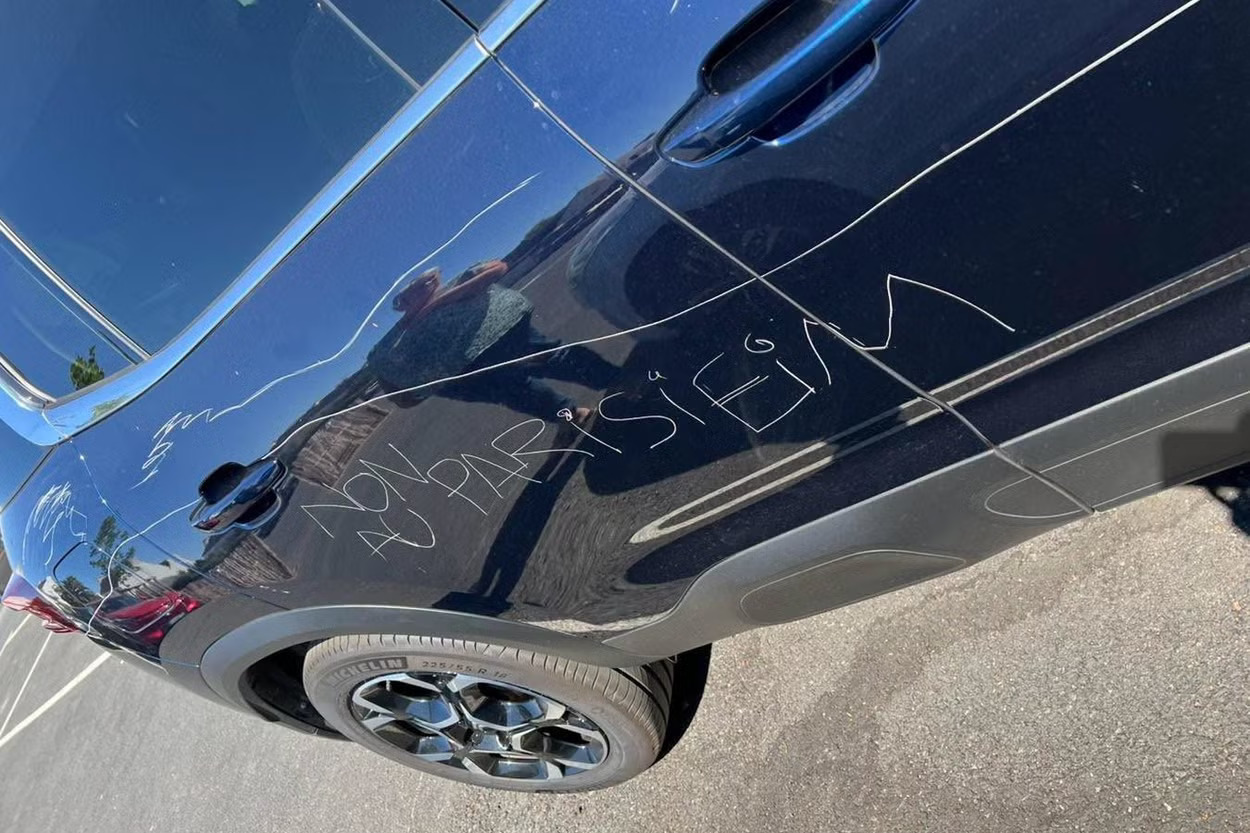



Parisians might want to reconsider heading to Brittany for their holidays next year after a number of cars were defaced with anti-Parisian messages and tourists were subjected to insults.
“Parisians out!” read a sign in Plogoff; “Non aux Parisiens” was scratched into a car in Plobannalec-Lesconil, while in Penmarc’h tourists were told they were less desirable than migrants.
Parisians have long had a reputation for their character and moodiness, with a clear line often drawn between “the French” and “the Parisians”. Has the war between the two turned more brutal this summer?
Several cars bearing Île-de-France licence plates were vandalised in the Finistère seaside town of Plobannalec-Lesconil, with inscriptions reading “non au Parisieim” [sic] and “Parigots dehors” – parigot being a derogatory slang term for a Parisian.
Mayor Loïc Le Fur expressed his “disgust” on social media, calling the vandalism “deeply shocking”.
“Our municipality has always been, and must remain, an open, welcoming and respectful municipality for everyone. I offer my full support, and that of the council, to the victims of this vandalism.”
He did not say whether that “support” extended to paying for the damage.
The hostility was not confined to Finistère. In Saint-Suliac, Ille-et-Vilaine, graffiti appeared on private properties, reading “Bobos out” and “Saint-Suliac is losing its soul”.
“Refugees welcome, tourists go home”
Parisians were not the only ones targeted. After severe heatwaves and wildfires swept through southern France this summer, tourists flocked to the cooler coasts of Brittany in search of some fresh air, placing an additional burden on towns and villages unaccustomed to and, in some cases, unprepared for such numbers.
In Penmarc’h, the words “Refugees welcome, tourists go home!” were daubed on a wall, while a jogger was verbally abused by two people on a bike after telling them, when asked, that she was not from the area.
The town’s mayor, David Le Berre, also took to social media to denounce the phenomenon. He insisted that the behaviour had nothing to do with “the welcoming spirit of Penmarc’h”, promised that the graffiti would be removed promptly and “firmly condemned” any form of verbal abuse.
Penmarc’h has around 5,600 residents, but its population triples to more than 17,000 in summer, straining roads, parking and a housing market already squeezed by second homes.
Between April and September last year, Finistère recorded 7.4 million overnight stays, making it the most visited department in Brittany. According to 2023 figures from Tourisme Bretagne, French tourists account for four-fifths of overnight stays in the region, with nearly a third coming from the greater Paris Île-de-France area.
But is this really new? Anne Gallo-Kerleau, president of Tourisme Bretagne, told Le Parisien that such expressions of discontent had always existed, and she denied that the incidents resulted from an exceptional influx of visitors this summer. She said that July visitor numbers were no higher than usual. A Tourisme Bretagne study cited by the newspaper found that 89% of Bretons consider tourism acceptable.
@rmc_off 🔴 Des tags anti-touristes en Bretagne… Plusieurs voitures immatriculées en région parisienne ont été rayées la semaine dernière dans le Finistère Sud avec messages hostiles comme "Parigot, dehors" ou encore "Non aux Parisiens."
♬ son original – RMC
Coolcations bring new pressures
If forecasts and travel trends are anything to go by, more holidaymakers will continue to desert the increasingly scorched Mediterranean south in favour of “coolcations” along the Channel and Atlantic coasts.
Brittany is not the only region experiencing a backlash. On the Île de Ré, “Parisians go home” leaflets have reportedly been circulated, and the situation in Corsica has reportedly become more threatening. A dormant independence movement resurfaced this summer to warn second-home owners: “Do not consider yourselves safe on our national territory.”