

Istanbul Airport has overtaken London Heathrow as Europe’s busiest airport by passenger numbers, adding fresh weight to the British hub’s argument that it needs a third runway to remain competitive with rapidly expanding European and global rivals.
Heathrow handled 7.86 million passengers in July 2026, compared with 8.15 million at Istanbul Airport, a difference of almost 300,000 passengers. Heathrow’s traffic fell by 1.5% compared with July last year, while Istanbul recorded year-on-year growth of 2.3%.
July got summer off to a flying start at Heathrow, with more than 7.85 million passengers travelling through the UK's hub airport. Heathrow also recorded its busiest day of 2026 so far on 19 July, welcoming 267,000 passengers, with popular destinations including Italy and Spain… pic.twitter.com/SvxDVXibU2
— HeathrowNews (@HeathrowNews) August 11, 2026
The result marks a significant change at the top of European aviation. According to annual figures from Airports Council International (ACI), Heathrow was Europe’s busiest airport every year between 1996 and 2019. It lost the position during the Covid-19 pandemic before reclaiming it in 2023.
Heathrow nevertheless remains extremely busy. Some 267,000 passengers passed through the airport on 19 July, its busiest day of 2026 so far, as the summer holiday season got underway.
Several new airlines also began serving Heathrow in July, including ITA Airways, Alaska Airlines and Riyadh Air, which the airport said demonstrated continued demand from carriers seeking access to the capacity-constrained hub.
Middle East traffic falls by 20%
One factor behind Heathrow’s weaker July performance was disruption to Middle Eastern traffic amid the conflict involving Iran, Israel and the United States.
Passenger numbers on Heathrow’s Middle East routes were down 20.2% year-on-year during July, contributing significantly to the overall decline.
The result contrasts with Heathrow’s record-breaking performance last summer. As Travel Tomorrow reported in September 2025, the airport became the first in Europe to handle more than eight million passengers in a single month when 8.04 million people passed through its terminals in August 2025.
Heathrow subsequently finished 2025 with 84.46 million passengers. However, the airport has repeatedly warned that further growth is increasingly constrained by its infrastructure, with its two runways operating at near-full capacity.
“Case for expansion has never been clearer”
Heathrow has seized on Istanbul’s rise to strengthen its case for the controversial construction of a third runway.
“The case for expansion has never been clearer, as Heathrow was overtaken in July by Istanbul airport as the busiest hub in Europe,” the airport said. “Our plans will ensure the country gets the infrastructure it needs to stay competitive and will deliver all-important economic growth.”
Heathrow’s proposed £33 billion expansion would allow the airport to accommodate up to 150 million passengers a year, significantly above current levels.
Chief executive Thomas Woldbye has argued that expansion is necessary if the UK wants to retain one of Europe’s leading international hubs and benefit from the additional trade, investment and tourism generated by greater connectivity.
“Expanding Heathrow will help ensure the UK remains home to Europe’s leading hub and continues to benefit from the trade, investment and tourism that increased connectivity will bring,” he said.
The UK government has been moving forward with the planning framework for expansion, although the project remains politically contentious due to concerns surrounding its environmental impact, financing and the concentration of infrastructure investment in London.
The planning costs alone for Heathrow’s third runway were projected to exceed £1 billion. The airport has sought permission to recover expansion-related expenditure through higher charges, with its average passenger charge previously expected to rise from £28.46 (€32.80) to £33.26 (€38.33) by 2027.
#ExpansionExplained: Some people have asked ‘How will Heathrow expansion create the space needed for future growth?’ Ben Wheeldon answers your question ⬇️
— HeathrowNews (@HeathrowNews) August 12, 2026
As Heathrow’s Expansion Major Programme Director, Ben explains that @HeathrowAirport is currently operating at 99% capacity… pic.twitter.com/TC3mSXEVtn
Istanbul benefits from room to grow
Istanbul’s rapid expansion also highlights the fundamentally different constraints facing the two airports.
The current Istanbul Airport opened in late 2018 on a vast new site outside the city, gradually replacing Atatürk Airport as Istanbul’s principal international gateway. Unlike Heathrow, which is surrounded by densely populated areas of west London, Istanbul has considerably more physical room for expansion and can operate 24 hours a day.
Its geographic position between Europe, Asia and the Middle East has also helped establish it as an increasingly important connecting hub, supported by the extensive international network of Turkish Airlines.
Istanbul Airport chief executive Selahattin Bilgen described overtaking Heathrow as “a significant milestone”, pointing to the airport’s ability to operate three independent runways simultaneously, 24 hours a day.
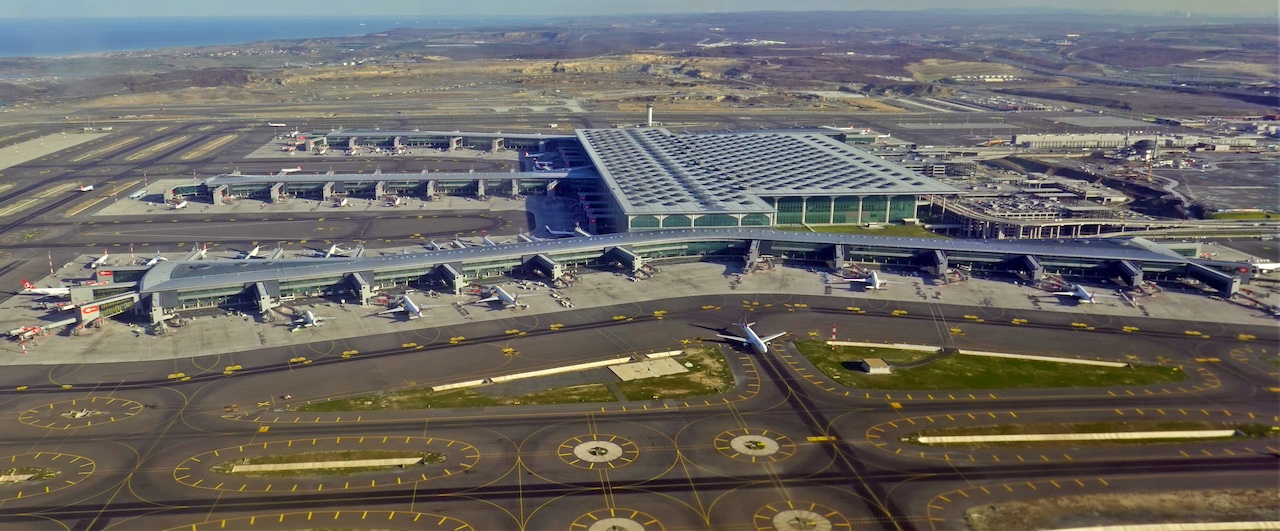
“Thanks to our three independent runways, which can be operated simultaneously 24 hours a day, our advanced operational capabilities and high capacity, we have successfully overcome the capacity constraints faced by many major global hub airports,” he said.
A fourth runway is expected to become operational by the end of 2026, providing further capacity for airlines and passengers.
The contrast with Heathrow is particularly striking. While Istanbul continues to add runway capacity, Heathrow is attempting to secure approval for a third runway after decades of political and legal debate.
Elsewhere in the UK, July was a record month for both London Stansted and Manchester Airport. Stansted welcomed 3.1 million passengers, up 6.3% year-on-year, while Manchester handled 3.4 million.
With Istanbul continuing to expand while Heathrow’s future capacity remains dependent on approval for a third runway, the battle to be Europe’s leading aviation hub is increasingly becoming a question not simply of passenger demand, but of how much room airports have left to grow.