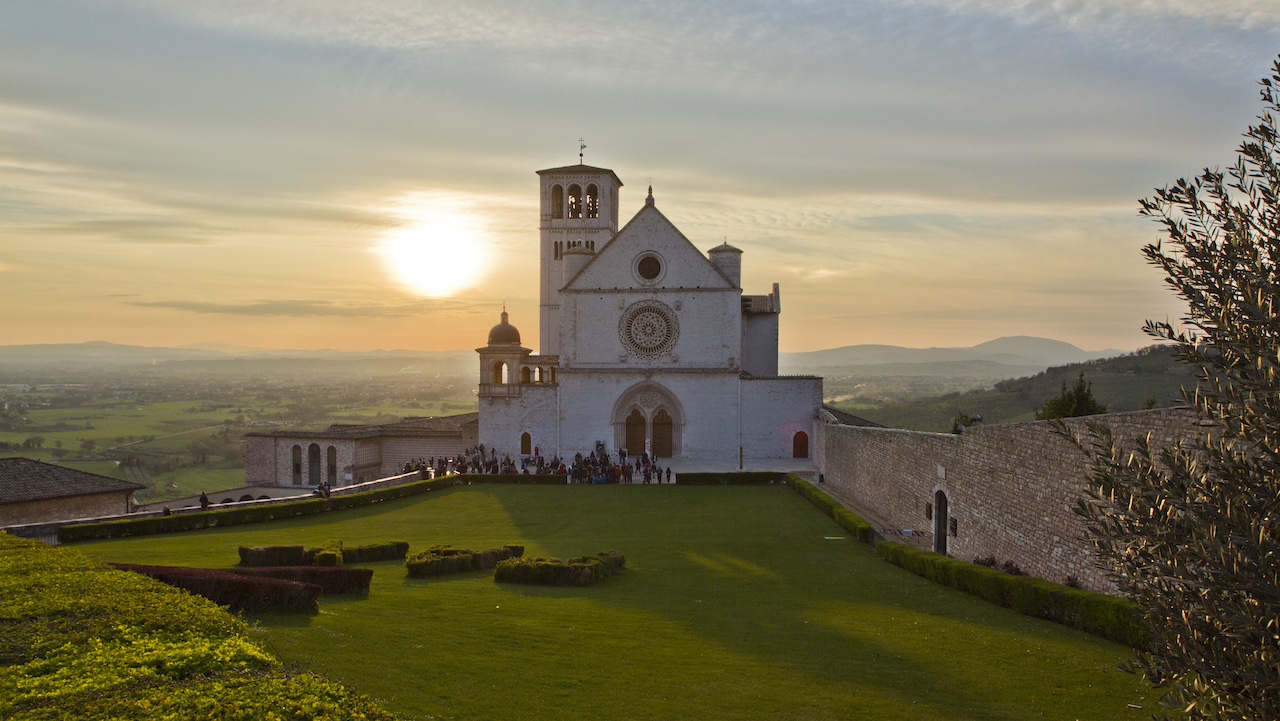


A new long-distance hiking network in Italy brings together a variety of ancient trails linked to Francis of Assisi, giving today’s walkers a choice of pilgrimage walks that all converge on the saint’s birth and burial place.
The Cammino di Francesco – Il Cammino della Luce (The Way of Francis – The Way of Light) extends over 1,546 km and spans six different regions (Abruzzo, Emilia-Romagna, Lazio, Marche, Tuscany, and Umbria), borrowing existing trails, such as Rimini to La Verna’s mountain sanctuary, known as the place where the saint supposedly became the first person to experience stigmata wounds.
The project is the result of years of cross-regional work by the Vie e Cammini di Francesco Association, and its inauguration by tourism minister Gianmarco Mazzi at the end of 30 July coincides with the saint’s 800th anniversary. The Pope visited Assisi on 6 August as part of the celebrations.
Embracing medieval villages and unspoilt landscapes in regions such as Tuscany and Umbria, sometimes described as Italy’s “green heart” and often considered the country’s most beautiful, all the routes have been mapped and approved by the national anniversary committee and can be consulted on Italy’s official tourism platform, Italia.it.
There prospective hikers will find maps, suggested itineraries, and planning tools. The website describes the network as “Italy’s prime walking experience” with walks combining “spirituality, nature and culture in a unique experience in the heart of Italy” that “conveys the identity, beauty and spiritual dimension this country.”
Before setting out, walkers can apply for a “pilgrim’s passport” online, for themselves and their pet (in line with Francis’s love of all creatures) and have it stamped to mark the successful completion of different stages of the journey. A special challenge comes in the form of the last 100km of the trip to the saint’s tomb, which, if done on foot (or the last 200km by bike), will be rewarded by a completion certificate.
Launching the network, Pietro Cannella, Italy’s Undersecretary of Culture, said the saint “embodies values that are part of our country’s deepest identity,” through a “love for creation, his closeness to the most vulnerable, his dialogue with those who are different and his choice of peace as a path to coexistence.”
He added that the “true meaning” of the project was “uniting places, institutions, and people around a shared heritage, making culture a tool for national cohesion and international dialogue.”
Cultural attractions have become the number one reason why tourists visit Italy in the last ten years, and the country is leaning into their development and accessibility.