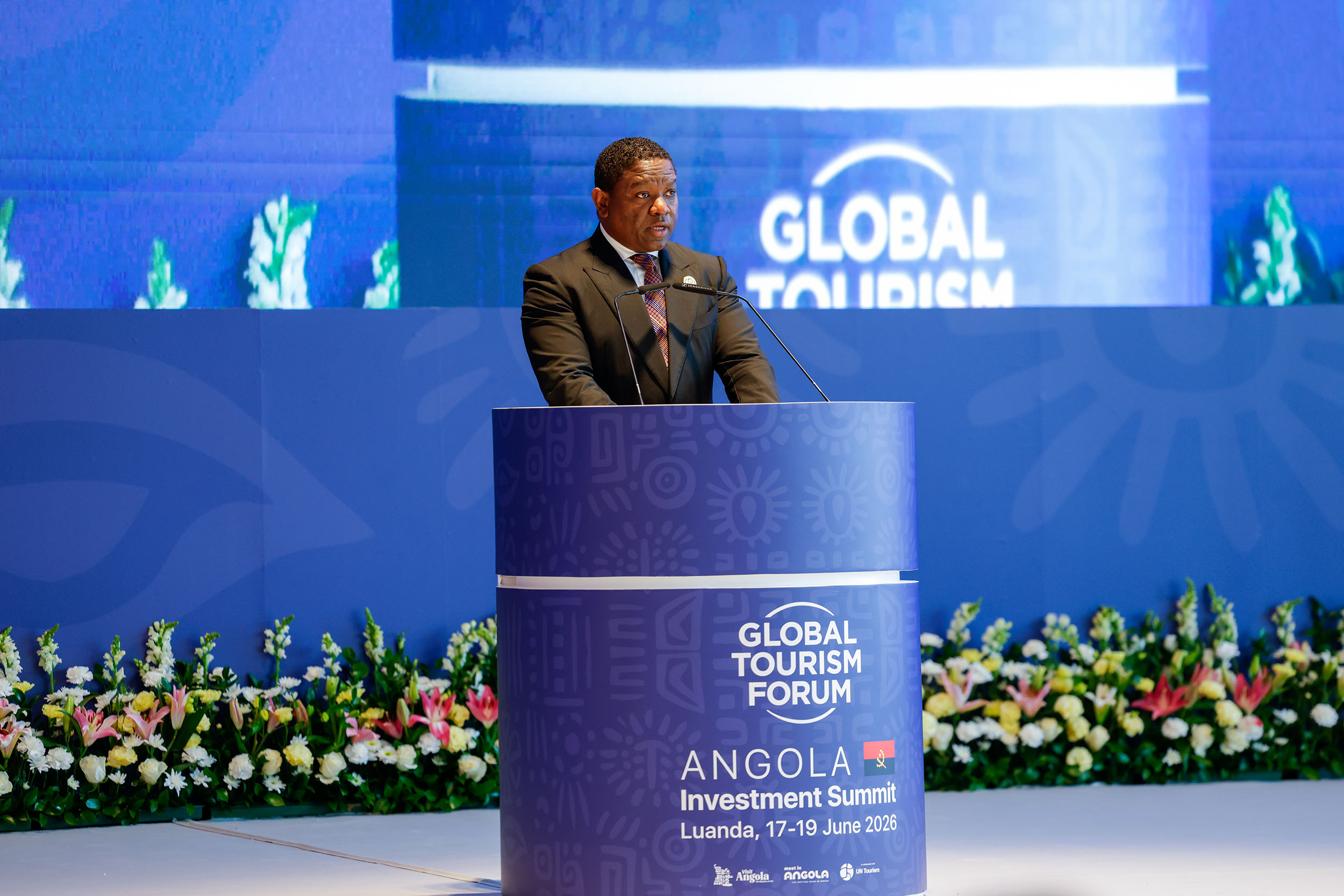


Angola has entered a new phase in its tourism development and is ready to compete as one of Africa’s most attractive destinations for investment, Tourism Minister Márcio Daniel told delegates at the Global Tourism Forum Angola Investment Summit in Luanda.
Speaking before President João Lourenço, Mozambique’s President Daniel Chapo, Namibia’s Prime Minister, ministers, investors and tourism leaders, Daniel said tourism is no longer viewed simply as a sector with future potential but has become a national economic priority and a central pillar of Angola’s diversification strategy.
He described the summit as more than an international conference, calling it “an instrument of transformation” designed to position Angola among Africa’s leading tourism and investment destinations.
Tourism moves to the centre of Angola’s economic strategy
According to the minister, tourism should be seen not only as a leisure industry but also as a driver of employment, infrastructure, foreign investment, mobility, culture and national development.
He argued that, while Angola has long been recognised for its natural resources, the country is now inviting investors to focus on the wealth above the ground, including its landscapes, coastline, rivers, forests, wildlife, culture, gastronomy and hospitality.
Daniel highlighted Angola’s more than 1,600 kilometres of Atlantic coastline, the Namibe Desert, Kalandula Falls, the Okavango region, national parks and natural reserves as tourism assets capable of competing with the continent’s best-known destinations.
Beyond its landscapes, he also pointed to the country’s people, describing the energy and hospitality of Angolans as an advantage that cannot be replicated elsewhere.
A window of opportunity for investors
One of the keynote’s central messages was that Angola remains at an early stage of its tourism development, creating what Daniel described as a rare opportunity for investors.
“Those who enter early do not only buy an asset; they help shape a market,” he said.
Rather than allowing the summit to become simply a forum for discussion, the government wants it to generate concrete partnerships, investment decisions and tourism projects.
He also linked Angola’s ambitions to broader global tourism trends, arguing that the sector has become one of the world’s strongest engines of inclusive economic growth. The challenge, he said, is identifying which destinations are best positioned to capture the next wave of tourism investment.
“Angola’s answer is clear: the country is prepared,” he said.
Infrastructure and investment tools
Daniel highlighted the government’s efforts to create the conditions needed for sustainable tourism growth.
He said more than €500 million has already been approved for integrated infrastructure projects across the country’s main tourism regions, aimed at improving accessibility, developing tourism zones and making destinations more attractive to private investors.
Among the initiatives already launched are the national tourism brand Visit Angola: The Rhythm of Life, the meetings and events platform Meet in Angola: The Meeting Room in Africa, the opening of Dr António Agostinho Neto International Airport and the future Palácio de Convenções, which is expected to accommodate more than 3,000 delegates.
The minister argued, however, that successful tourism development depends on more than infrastructure.
“It requires an ecosystem,” he said, explaining that Angola is bringing together investors, banks, tour operators, digital platforms and public institutions to make tourism projects more visible and financially viable.
As part of that strategy, he presented the Angola Tourism Investment Guide, describing it as a practical roadmap that provides investors with information on priority regions, available projects and investment opportunities.
“Angola does not only want to say it has potential,” he said. “Angola wants to show where the opportunities are.”
Building confidence in the tourism sector
Daniel also pointed to growing investor confidence in Angola’s non-oil economy.
While tourism still represents only a small share of the country’s foreign direct investment, he argued that this reflects the sector’s untapped potential rather than a weakness.
He added that Angola’s role as one of the co-founders of the UN Tourism Platform for Africa’s Sustainable Tourism Investment (UNTPAS) demonstrates the country’s ambition to play a more active role in global tourism investment.
For international investors, he said, Angola offers a combination of natural assets, government commitment, expanding infrastructure, improving connectivity and a clear strategy for economic diversification.
“The moment is now”
Concluding his address, Daniel called on both domestic and international investors to see themselves not simply as builders of hotels, resorts or convention centres, but as partners in creating a new tourism destination.
He described tourism as Angola’s “green oil”, arguing that unlike finite natural resources, it can continue generating value if properly managed and protected.
“The market is open, the projects are prepared, the moment is now,” he concluded, expressing hope that the summit would be remembered not for its speeches but for the partnerships, investments and decisions it helped generate.