
On Thursday, 4 June 2026, a Nepali climbing guide called Hillary Dawa Sherpa, who went missing six days earlier on Mount Everest, was found crawling down to Base Camp. While his family had already started organising funeral rites, other guides are calling his rescue a miracle.
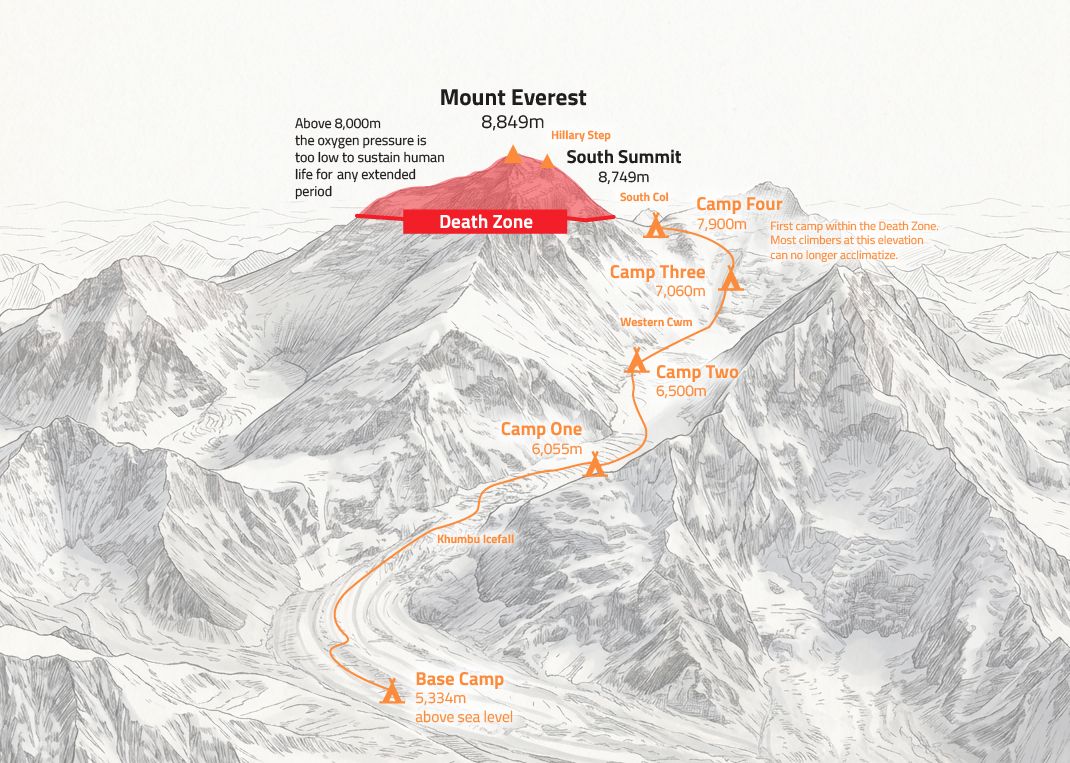
On 29 May 2026, 52-year-old climbing guide Hillary Dawa Sherpa was last seen while pausing at Mount Everest’s Camp 3, located at an altitude of 7,060 meters. Soon after, his client and the rest of his climbing team from Kathmandu-based company Nepal Mount Everest noticed he was missing.
As the party was one of the last to descend the mountain before the end of the climbing season and as the ladders across the Khumbu Icefall had reportedly already been dismantled, they had little other choice than to complete their descent. When search helicopters found no trace of the guide, the choice was made not to assemble a search team to go looking for Hillary Dawa Sherpa. Since that decision has sparked a lot of debate, people are especially questioning the working circumstances of the Nepali guides on the mountain.
Finally, on 4 June 2026, while his family had already started to organise funeral rites as they had lost all hope of being reunited, Hillary Dawa Sherpa was spotted climbing down the ice at Mount Everest’s Base Camp. Members of the Sagarmatha Pollution Control Committee (SPCC), who are in charge of setting up and removing routes, ropes, and ladders through the Khumbu Icefall at the start and the end of the season, were the ones who found the climbing guide.
“When we first heard about it, we could not be sure if that person was indeed our father. So to be certain we asked for photos to be sent and then only we were sure and very happy,” Hillary Dawa’s daughter, Mendo Lhamu, told the Associated Press.
After the people from the Sagarmatha Pollution Control Committee gave Hillary Dawa Sherpa some much-needed food and water, the guide was reportedly carried down the mountain on the back of another climber. Once arrived, he was airlifted to a hospital located in the Nepalese capital Kathmandu. According to news agency Reuters, he was suffering from frostbite and some other complications.
@thetimes A Nepali climbing guide lost on Mount Everest for six days managed to crawl alone to near base camp. Dawa Sherpa’s wife had given up on the mountaineer and had begun to offer the last rites. He was left by his climbing party on the upper reaches of the world’s highest mountain in bitter conditions early on May 30. In his fifties and better known as “Hillary”, after the climber Edmund Hillary, he was found on Thursday morning near base camp by the Sagarmatha Pollution Control Committee, a Nepali team that helps set routes on Everest and cleans up waste on the mountain. Sherpa’s wife, Damu, said her family was overjoyed. “We were very happy to hear the news, we had given up hope,” she said. “We also began puja [death prayers] yesterday.” He was recovering from “some frostbite” but was conscious, she said. Click the link to read more #mounteverest #sherpa #nepali #climbing #worldnews ♬ original sound – The Times and Sunday Times
“This is nothing short of a miracle surviving so many days in the mountains facing such harsh condition,” Ang Tshering Sherpa, another climbing guide, said in an interview with AP.
According to a video statement posted after his rescue, the guide fell into a crevasse near Camp 1, located at approximately 6,000 meters. He was only able to free himself after having spent two days inside the icy fissure, at which point he started his perilous descent without food or oxygen bottles.
A busy season
Hillary Dawa Sherpa’s story, considered by many as a miraculous event, comes at the end of the busiest season ever on Mount Everest, which started on 29 April 2026 after weeks of delays caused by a massive serac, a large block of glacier ice that experts warned could collapse at any moment.
Overall, more than 1,000 people summited the south side of the mountain, with 20 May registering no less than a record 274 climbers; images of people queuing at the so-called death zone made global headlines, once again raising the question of how responsible it is to climb Mount Everest in a world hit by climate change and overcrowding.