

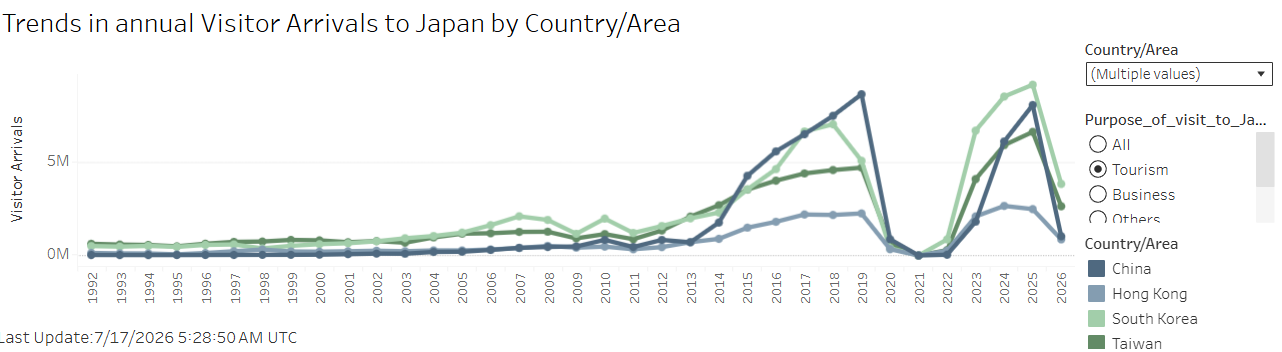
Japan’s meteoric post-COVID-19 tourism growth has experienced a drop in visitor numbers for the first time in six years, with the decline blamed on a whopping fall in visitors from China.
Official figures from the Japan National Tourism Organization (JNTO) reveal foreign arrival numbers fell by almost half a million in the first two quarters of 2026, to hit 21 million, two percent lower year-on-year.
Chinese visitor numbers fell by 56% following a Chinese government travel advisory late in 2025, urging its citizens to avoid Japan due to geopolitical tensions over the status of Taiwan. Flight capacity between the two nations was also slashed.
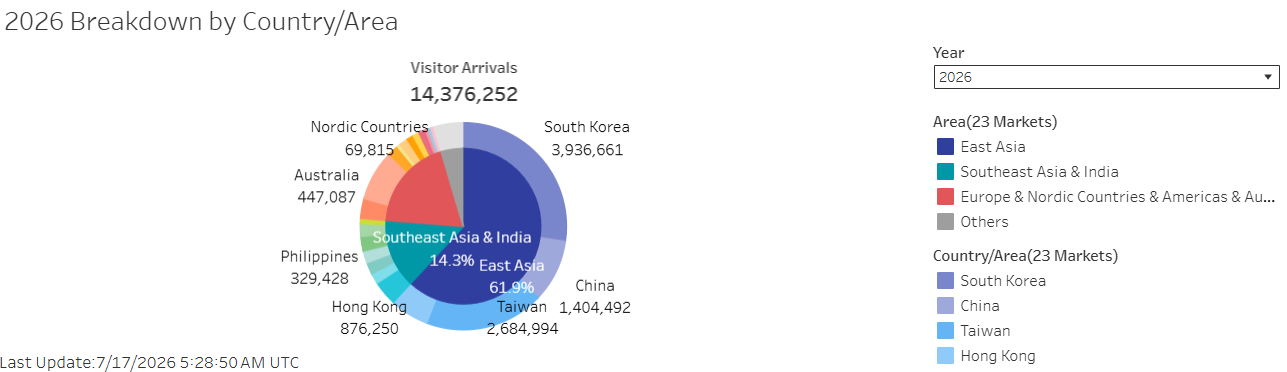
China is usually a top source market for Japan but has since been overtaken by South Korea and Taiwan. South Korea took the top spot, sending 5.46 million visitors, an increase of 18.6%. Taiwan sent almost four million, the second-highest number of visitors, and a rise of 21%.
Vietnam and Malaysia sent more visitors than the previous year, and overall, Southeast Asia represented 11.2% of all visitors to Japan (351,000 in total). But, like China, Thailand and the Philippines declined as source markets.
Despite the drop in visitors, commentators note that overseas travellers in Japan spent around 2.5096 trillion yen (US$14.49 billion), a 0.2 percent increase compared to the same period in 2025.
Part of the explanation is that other markets continued to show steady growth. US visitor numbers, the highest spenders, increased by 2.7% to around 354,000, and visitor numbers from France, Italy, the Nordics, Spain, and the UK all reached new records in June. Visitor numbers from India also went up an impressive 26%, and the Middle East sent nearly 30% more visitors than the same period in the year before.
Foreign visitors to Japan numbered a record 43 million in 2025, after a 16% year-on-year increase. Despite some concerns about overtourism that have led to increases in tourist taxes, tourist charges for Mount Fuji walking trails, and clashes between tourists and geisha culture in Kyoto, Japanese tourism officials are still looking to boost visitor numbers to 60 million by 2030.
Their strategy is to spread footfall, promote repeat visits, and encourage higher tourist spending—some of which the latest data shows is working, but Da Zhigang, a research fellow at the Institute of Northeast Asian Studies of the Heilongjiang Academy of Social Sciences, told the Global Times on Monday that there are “realities” at stake that the Japanese government will be “well aware of.” He explained that “The importance of the Chinese tourist market cannot simply be replaced by an increase in visitors from other countries,” and urged the government to work on improving China-Japan relations.