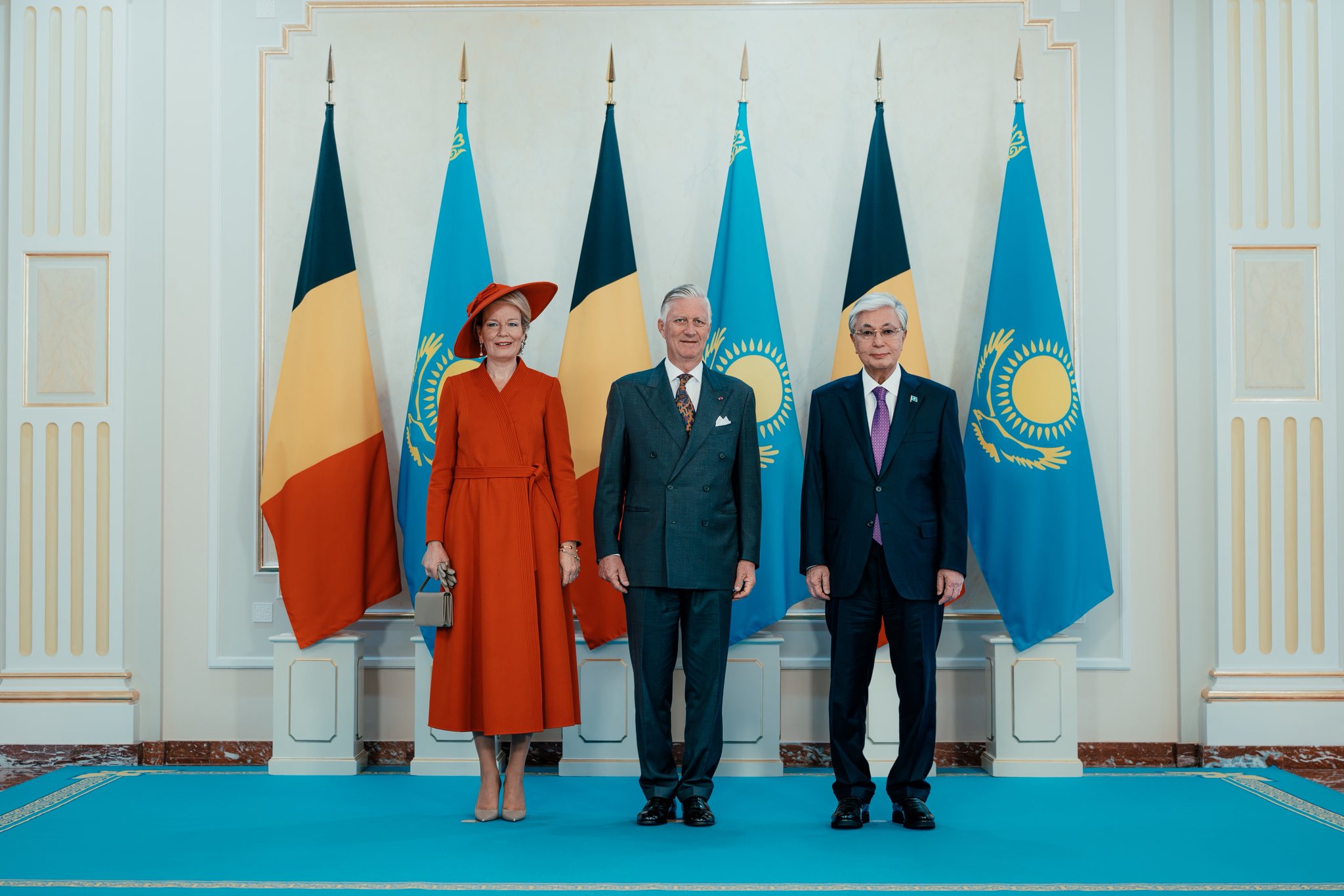


King Philippe and Queen Mathilde’s first state visit to Kazakhstan, held from 12 to 14 October 2026, placed tourism, cultural exchange and transport connectivity alongside the economic priorities shaping Belgium’s relationship with Central Asia.
The visit included high-level talks with President Kassym-Jomart Tokayev, a business council, a rectors’ forum and cultural engagements in Astana and Almaty. It was Philippe’s first visit to Kazakhstan as King and Belgium’s first state visit to Central Asia. He had previously travelled to the country as Crown Prince in 2002, 2009 and 2010.
While critical minerals, energy and artificial intelligence featured prominently in the discussions, the programme also highlighted opportunities to encourage travel, connect cultural institutions and expand exchanges between students, researchers and businesses.
Tourism receives royal backing
Tourism featured explicitly in Philippe’s address to the fourth Kazakh-Belgian Business Council on 13 October. Speaking to business representatives from both countries, the King identified the sector as an area with considerable potential for closer cooperation.
“Kazakhstan offers extraordinary landscapes and a rich cultural heritage,” he said, expressing confidence that more Belgians would discover the country in the coming years. His remarks placed tourism alongside the industrial and infrastructure partnerships discussed during the visit.
The endorsement came as Kazakhstan continues to expand its visitor economy. As Travel Tomorrow previously reported, the country recorded 15.7 million foreign visits in 2025, including 11.1 million classified as tourism visits, while investment in the sector reached approximately €2.4 billion.
Accommodation capacity also increased, with 179 additional facilities and more than 7,000 beds, bringing the national total to 4,482 establishments offering over 232,000 beds.
The royal itinerary brought attention to two complementary destinations. Astana combines contemporary architecture with national museums and institutions, while Almaty offers cultural attractions and access to the Trans-Ili Alatau mountains. Travel Tomorrow has previously explored the two cities’ growing tourism appeal, including opportunities to combine a stay in Almaty with skiing, hiking and mountain excursions.
Museums bring cultural diplomacy into focus
Cultural cooperation provided some of the visit’s most visible encounters. On 13 October, Tokayev accompanied Philippe and Mathilde to the National Museum of Kazakhstan in Astana, where works by Belgian artist James Ensor were displayed alongside the institution’s presentation of Kazakhstan’s heritage.
The exhibition brought a major figure in Belgian art into a Kazakh cultural setting, giving the royal programme a tangible expression of exchange between the two countries.
The visit ended at the Almaty Museum of Arts, where the royal couple explored modern and contemporary works by Kazakh and international artists. A performance presented through cooperation with KANAL-Centre Pompidou in Brussels illustrated the links developing between cultural institutions in the two cities.
These exchanges also broaden the country’s international tourism profile. Alongside landscapes and historic traditions, contemporary museums offer another reason to visit and opportunities to encounter Kazakhstan through its artists. Partnerships with European institutions can sustain that dialogue through exhibitions, performances and professional collaboration beyond the official visit.
Linking the Middle Corridor with European transport networks
Transport and logistics were central to the talks, particularly the Trans-Caspian International Transport Route, commonly known as the Middle Corridor.
Tokayev and Philippe highlighted the route’s growing role in connecting Asia and Europe in their joint statement. At the Business Council, the King called for closer integration with European ports, railways and logistics hubs, emphasising Belgium’s expertise through the Port of Antwerp-Bruges.
Tokayev proposed closer practical cooperation between Antwerp-Bruges and Kazakhstan’s Caspian ports of Aktau and Kuryk. Kazakhstan is investing in railways, roads, seaports and terminals along the corridor, while Belgian experience in port management and multimodal logistics could support its development.
The discussions centred on freight connectivity and resilient supply chains. They reflected a wider effort to connect Kazakhstan’s infrastructure with established European transport networks as trade routes evolve.
For both countries, the partnership builds on their geographical positions: Belgium as an entry point to European markets and Kazakhstan as a transit country connecting different parts of Eurasia.
University exchanges build longer-term connections
Academic cooperation added another dimension to the visit. The Kazakhstan-Belgium Rectors’ Forum brought together leaders from 29 universities and research organisations at Astana’s Alem.ai International Centre.
More than 20 agreements and memorandums were signed, covering academic mobility, joint programmes and research. Participating Belgian institutions included Ghent University, KU Leuven and the University of Mons.
Artificial intelligence featured prominently, with discussions addressing its use in teaching, research and university management. Language education, translation and multilingual academic communication were also on the agenda, alongside opportunities for research internships and joint qualifications.
The joint statement endorsed academic mobility and partnerships between universities and research centres. Such initiatives create opportunities for repeated travel and sustained professional contact, extending the relationship beyond government and business delegations.
Travel facilitation remains a separate priority
Closer academic and professional links also underline the importance of travel procedures. Travel Tomorrow reported in March that Kazakhstan and the EU were approaching the final phase of negotiations on visa facilitation, alongside discussions on readmission.
A future agreement could simplify procedures for Kazakh citizens travelling to Europe, supporting tourism, business visits and educational exchanges.
During the royal visit, the two countries welcomed the entry into force of a protocol concerning visa exemptions for holders of service passports travelling between Kazakhstan and the Benelux countries. This is a separate diplomatic arrangement and does not introduce a general visa exemption for ordinary travellers.
Kazakhstan’s flag flied over Brussels’ Grand-Place
While the royal couple were in Kazakhstan, a public celebration brought Kazakh culture into the centre of Brussels.
On 12 October, Kazakhstan’s national flag was raised at Brussels City Hall on the Grand-Place for the first time, marking both the state visit and the country’s 35th anniversary of independence.
Supported by the City of Brussels and Belgium’s foreign ministry, the ceremony brought together embassy representatives, Kazakh students, community members and visitors. Students in traditional dress performed music and a festive flash mob, while guests sampled Kazakh dishes.
At one of Belgium’s best-known visitor landmarks, the celebration brought the diplomatic occasion into public view. Alongside museum partnerships and university exchanges, it gave residents and tourists an opportunity to encounter Kazakhstan through its culture and the people sharing it.
The outcomes of the state visit will be presented on Friday, 23 October, at the Press Club Brussels Europe.