
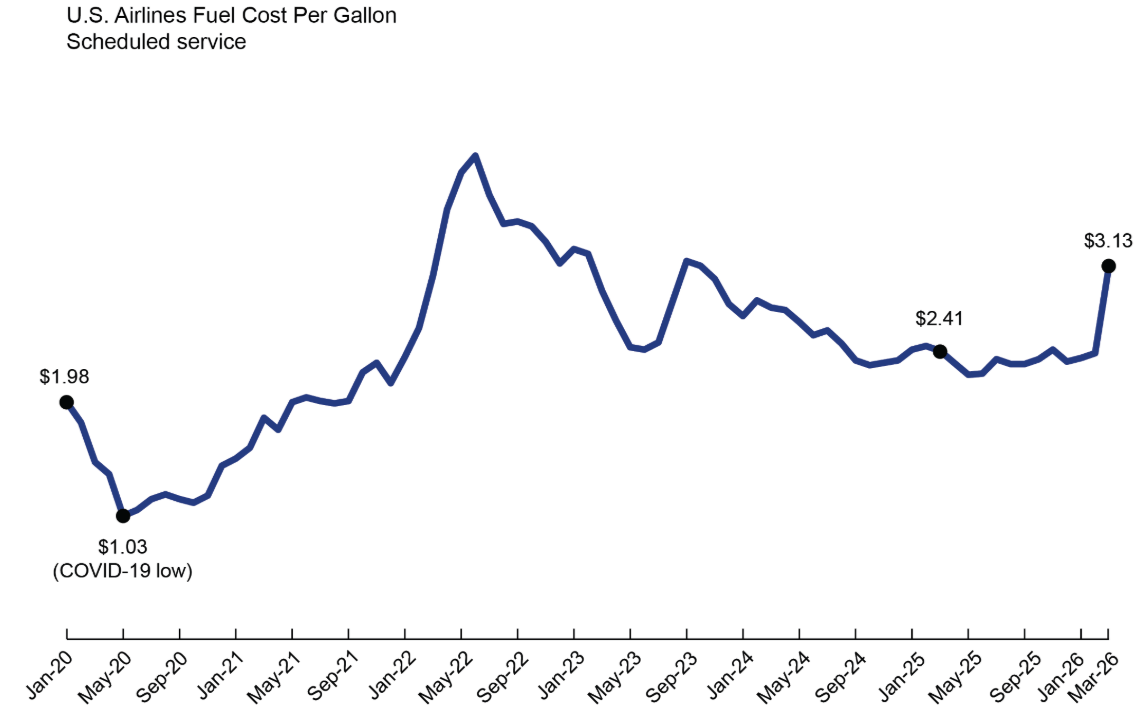
As the conflict in the Middle East persists, the direct impact on jet fuel prices is being felt more than ever in the United States, where airline fuel costs soared to $6.5 billion in April, a 78% increase compared to 2025, according to the US Department of Transportation (USDOT).
Jet fuel Prices jumped by 26% from March to April alone, eventually reaching $4.11 per gallon, an increase of $1.81 year-on-year, and putting further strain on an industry already grappling with mounting operational costs.
Airlines have been trying to absorb the impact by adjusting fares, reviewing baggage fees, reducing frequencies on some routes and consolidating flights to avoid flying with empty seats. However, reducing services comes with its own risks, including losing valuable airport slots on competitive routes.
This pressure is particularly significant in a market dominated by four major carriers: Delta Air Lines, United Airlines, American Airlines, and Southwest Airlines, which together account for around 80% of the US domestic passenger market.
In its latest annual report, released last Sunday, the International Air Transport Association (IATA), the global trade organisation which represents around 370 airlines and over 85% of global air traffic, warned that the outlook for the industry has worsened.
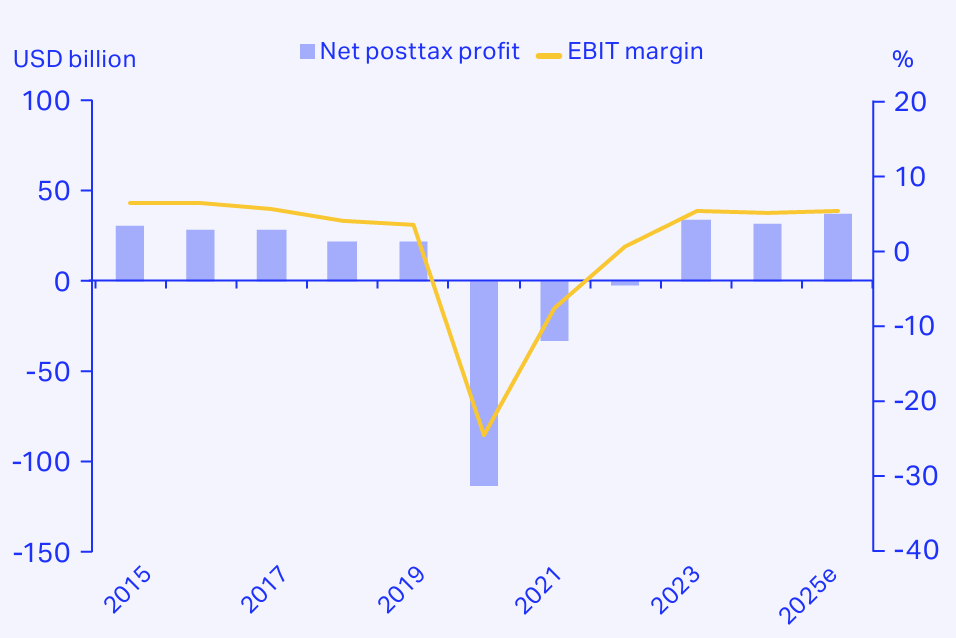
It now expects combined airline net profits to reach $23 billion in 2026, which is well below its previous projection of $41 billion, and significantly lower than the $45 billion recorded in 2025.
According to IATA, the industry’s fuel bill is expected to reach $350 billion this year, up from $252 billion in 2025.
Speaking at the association’s 82nd annual summit in Rio de Janeiro, IATA warned that, while a fuel shortage remains unlikely, rising prices alone could add almost $100 billion to the aviation sector’s costs.
“Smaller carriers that started the year with weak balance sheets are certainly struggling”, Willie Walsh, Director General of IATA, said.
Flights inside the US have risen by about 31% this year, while international flights departing from the US are up by 22%, according to KAYAK price comparisons between 2025 and 2026.
In addition to higher prices, regional tensions and airspace closures have forced some airlines to cancel or reroute flights, creating longer journeys and increasing fuel consumption.
Fuel accounts for roughly a third of airline operating costs.
Walsh said that the conflict in Iran and rising fuel costs “have worsened the outlook for airlines”.
He added that part of the additional cost had been recovered “by adjusting prices and improving efficiency”, but warned that this would not be enough to maintain previous levels of profitability.
People want to fly. ✈️
— IATA (@IATA) June 7, 2026
Demand is strong—but Middle East disruptions & high fuel costs are set to halve airline profitability.
2026 net profit: $23B (vs $45B in 2025)
Margin: 2.0%
Per passenger: $4.50
More from Willie Walsh at #IATAAGM 🇧🇷 ⬇️ pic.twitter.com/SYF10k9Iez
The war started on 28 February 2026 with a joint US-Israeli attack targeting Iran’s nuclear and ballistic missile infrastructure. It quickly expanded across the region after the Islamic Republic retaliated against Israel and several Gulf countries, forcing airlines to avoid large parts of Middle Eastern airspace. The situation worsened as Tehran closed the Strait of Hormuz, one of the world’s most strategic maritime routes and a vital passage for oil supplies, adding further pressure on fuel markets.
Washington and Tehran are currently negotiating a possible end to the conflict. However, the outcome remains uncertain, with sporadic fighting continuing between the various parties involved.
Profits are now expected to shrink from $45 billion in 2025 to $23 billion in 2026, while margins are forecast to fall from 4.2% to 2%.
With summer travel approaching and the United States preparing to welcome millions of visitors for the 2026 FIFA World Cup, the challenges posed by higher fares, volatile fuel prices and geopolitical uncertainty are becoming increasingly apparent.