

The World Travel & Tourism Council (WTTC) has published its latest findings during its Leadership Cruise in Egypt, sending one clear message to the world: tourism always recovers.
Titled Accelerating Travel & Tourism – Global Evidence from Four Decades of Crisis, the study analyses 100 significant crises over 40 years. Developed in partnership with Chemonics International and the George Washington University Business School, it was launched aboard the Crystal Serenity while transiting the Suez Canal.
Day 2 of the Leadership Cruise 2026 brought another day of powerful conversations aboard Crystal Serenity, through the Suez Canal.
— WTTC (@WTTC) May 9, 2026
From connectivity and talent to AI, entrepreneurship, and the power of major events.
Global leaders from governments and the private sector united… pic.twitter.com/rUj25mDK9B
The choice of the location was highly symbolic, given ongoing disruptions in the Strait of Hormuz and the Red Sea last year, reinforcing the idea that global connectivity and cooperation are fundamental to recovery.
The report finds that not a single destination has suffered permanent tourism collapse. Recovery is the norm, and in most cases, the sector emerges stronger. Furthermore, the authors stress that the only real variable is speed and that this is a policy choice.
“Resilience is built into the sector’s DNA”, explained WTTC President & CEO Gloria Guevara, adding that the question is not “if” the sector will recover, but “when” and “how quickly we choose to enable that recovery”.
The report highlights several notable recoveries: Phuket’s recovery after the 2004 tsunami and its record arrivals by 2010, despite the 2008 financial crisis; Tunisia’s record 8.3 million arrivals just three years after the 2015 attacks; and Nepal’s recovery after the earthquake in the same year.
The biggest test was the pandemic, with international arrivals collapsing by 72% in 2020. However, the sector recovered to reach 2019 levels by 2024, surpassing them in 2025 with record visitor spending of $2.02 trillion.
The launch comes against a backdrop of ongoing geopolitical uncertainty, particularly in the Middle East. A recent report by the European Travel Commission (ETC) found that, rather than curbing Europeans’ desire to travel, the crisis is changing their choice of destination.
Global Travel & Tourism contributes $11.6 trillion to GDP and supports 366 million jobs.
— WTTC (@WTTC) May 11, 2026
It is one of the most resilient sectors in the global economy – and we have the data to prove it.
✅ World Travel & Tourism Council has launched its latest report: Travel & Tourism Always… pic.twitter.com/5vHeCx7qMp
In 2025, travel and tourism contributed $11.6 trillion to the global GDP, accounting for almost 10% of the world economy, and supported 366 million jobs worldwide, or one in nine.
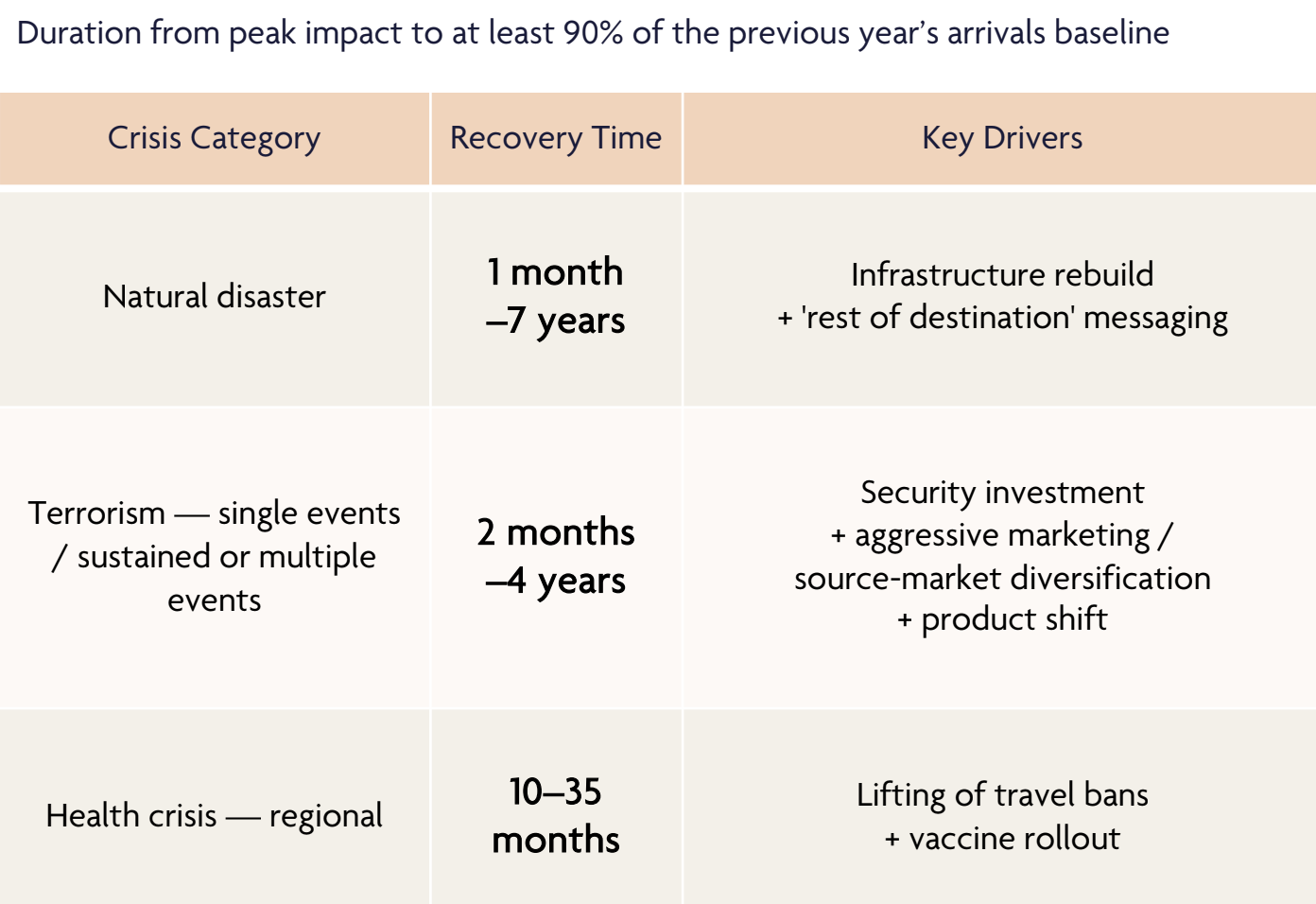
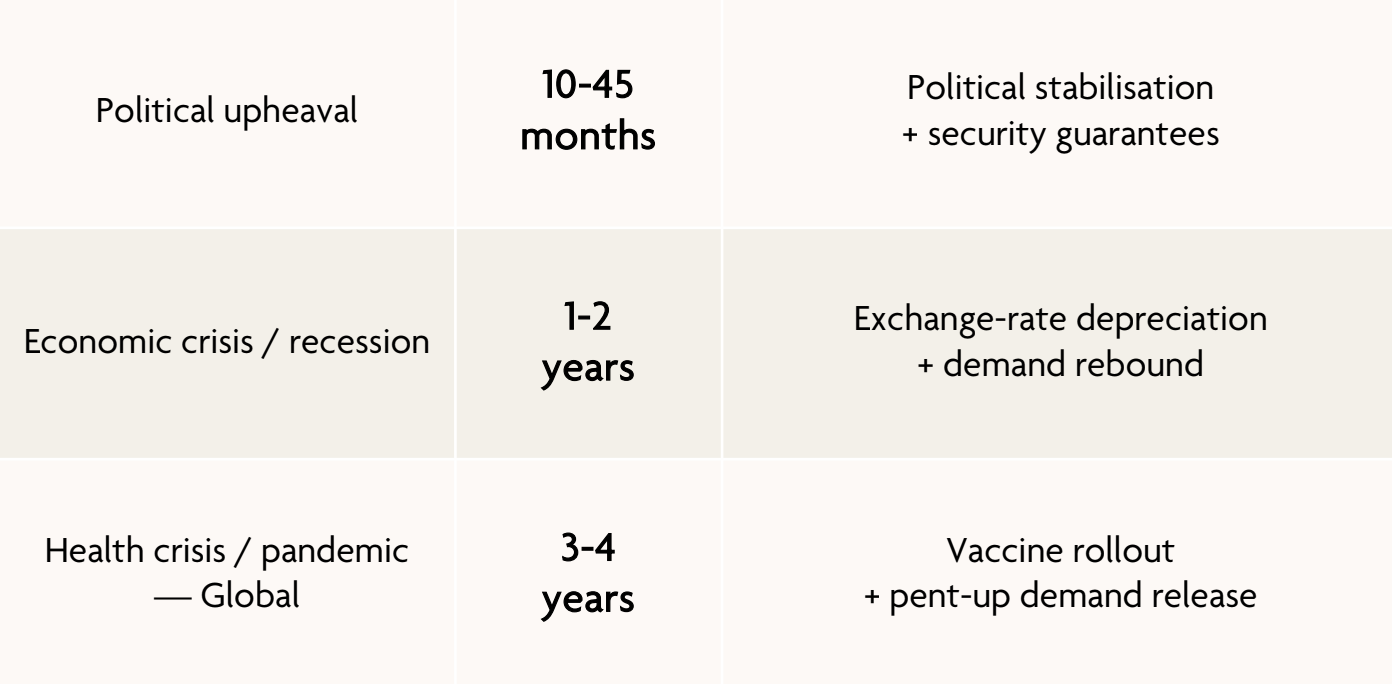
Recovery timelines vary by crisis category: natural disasters can take anywhere from one month to seven years to recover from, depending on the extent of infrastructure damage; terrorism-related events generally require between two months and four years; regional health crises take between 10 and 35 months; and economic recessions typically resolve within one to two years.
However, none of this is accidental, and the report shows that crises often create opportunities for transformation, investment and diversification.
“The destinations that emerged stronger were those that combined leadership, public–private coordination and sustained support for the small businesses and communities that form the backbone of the visitor economy”, explained Ibrahim Osta, Senior Economic Growth Director and Global Tourism Lead at Chemonics International.
This week, @WTTC hosted its first-ever Leadership Cruise – bringing together over 300 leaders from the public and private sector aboard the Crystal Serenity.
— WTTC (@WTTC) May 7, 2026
🇪🇬 Egypt was the perfect setting. A nation that has turned resilience into results – with Travel & Tourism contributing… pic.twitter.com/QpOIFXBWlc
The report backs this up by identifying four key pillars for resilient recovery: restoring traveller confidence; ensuring business continuity, especially with regard to air connectivity and SMEs; delivering swift institutional responses; and using disruption as a driver of structural adaptation. The report also identifies five evidence-based principles for a faster rebound: investing countercyclically during the crisis trough; protecting SMEs; maintaining air connectivity; avoiding overreaction in messaging and policy; and building forward through diversification.
Crises, in other words, are also opportunities, and the old maxim that what doesn’t kill you makes you stronger seems particularly apt here. Destinations that treat them as such come back stronger.