

Despite the hurdles thrown at the aviation industry and the threats hanging over it, European tourism shows no signs of weakening – quite the contrary, according to the latest figures from the European Travel Commission (ETC).
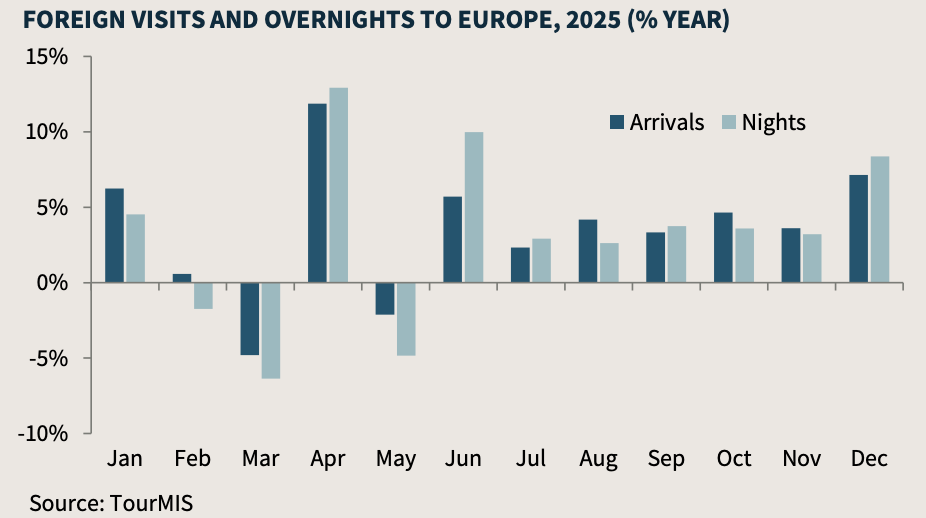
The ETC’s latest report, European Tourism: Trends & Prospects, published in April 2026, paints a record picture of arrivals and overnight stays since the beginning of the year, with a 5.6% increase in international tourist arrivals and a 5.5% increase in overnight stays.
This is despite the ongoing geopolitical crisis in the Middle East, which continues to affect the aviation and tourism industries worldwide. Against the backdrop of dire predictions, Europe appears to have been barely affected in practice. The physical constraints are all present: airspace closures, high jet fuel prices, costly reroutings, cancellations and reduced flight frequencies.
One reason for this is that Europe is considered a fairly stable and secure destination compared to other parts of the world that are currently deemed riskier or more difficult to reach without stopovers or flying over sensitive airspaces.
Another contributing factor has been an exceptionally good snow season, much to the delight of ski and winter sports enthusiasts. This coincided with the Winter Olympics in Italy, resulting in a welcome surge in winter demand. Italy saw a 14% increase, while Austria recorded 7%, France 5%, and Germany 2.7%.
More broadly, Northern Europe and winter destinations reported a 13% rise in arrivals in January and February – the strongest regional performance of early 2026. Ireland posted a remarkable 30% increase, while Finland saw a 12% rise, both of which were partly driven by growing business travel.
At the other end of the weather spectrum, Europe’s sunny Mediterranean destinations provided an appealing getaway from the harsh winter experienced elsewhere. Greece saw a 33% increase in arrivals in the first part of the year, followed by Cyprus with 9%, Croatia with 8%, and Spain with 2%. However, overnight stays did not always increase at the same rate, reflecting a trend already observed across Europe, where travellers increasingly favour shorter and more selective trips.
Miguel Sanz, President of the European Travel Commission, noted that “Europe’s tourism sector has shown a strong start to early 2026, underlining the resilience of travel demand amid a more complex global environment.”
The report identifies three main ways in which the conflict could still impact European tourism: higher travel costs; airlines consolidating routes to save money; and disrupted connectivity, particularly through major hubs such as Dubai, which has experienced repeated airspace closures since February 2026. This has led to weakened long-haul demand. Not to mention the fear of jet fuel shortages should the situation drag on, as warned by the International Air Transport Association (IATA).
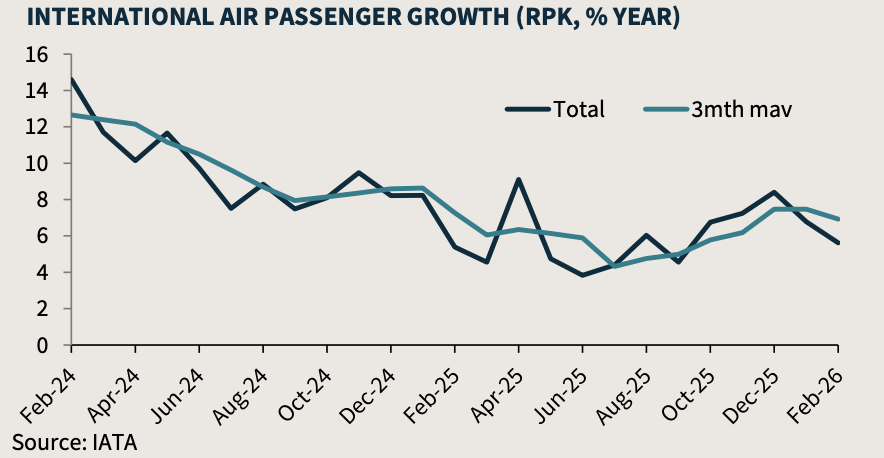
Tourism Economics estimated that a two-month-long conflict could put around 103 million nights of international overnight stays in Europe at risk in 2026, roughly 4% of the total. As the conflict has now exceeded that timeframe, the impact could yet prove to be more significant, although the overall scale remains difficult to predict.
For now, strong intra-regional demand is providing a cushion. While long-haul visitors may be staying away or travelling less, Europeans are increasingly choosing destinations closer to home, balancing things out. This behaviour is expected to continue until at least the end of 2026.
As has been observed in the past, tensions in the Middle East have historically led to greater interest in European Mediterranean destinations, which are seen as safer and more accessible.
“While tensions in the Middle East are adding pressure on costs and connectivity, Europe continues to benefit from strong intra-regional demand and its reputation as a safe destination. Maintaining competitiveness will require a continued focus on stable connectivity and value for money in the months ahead,” Sanz concluded.