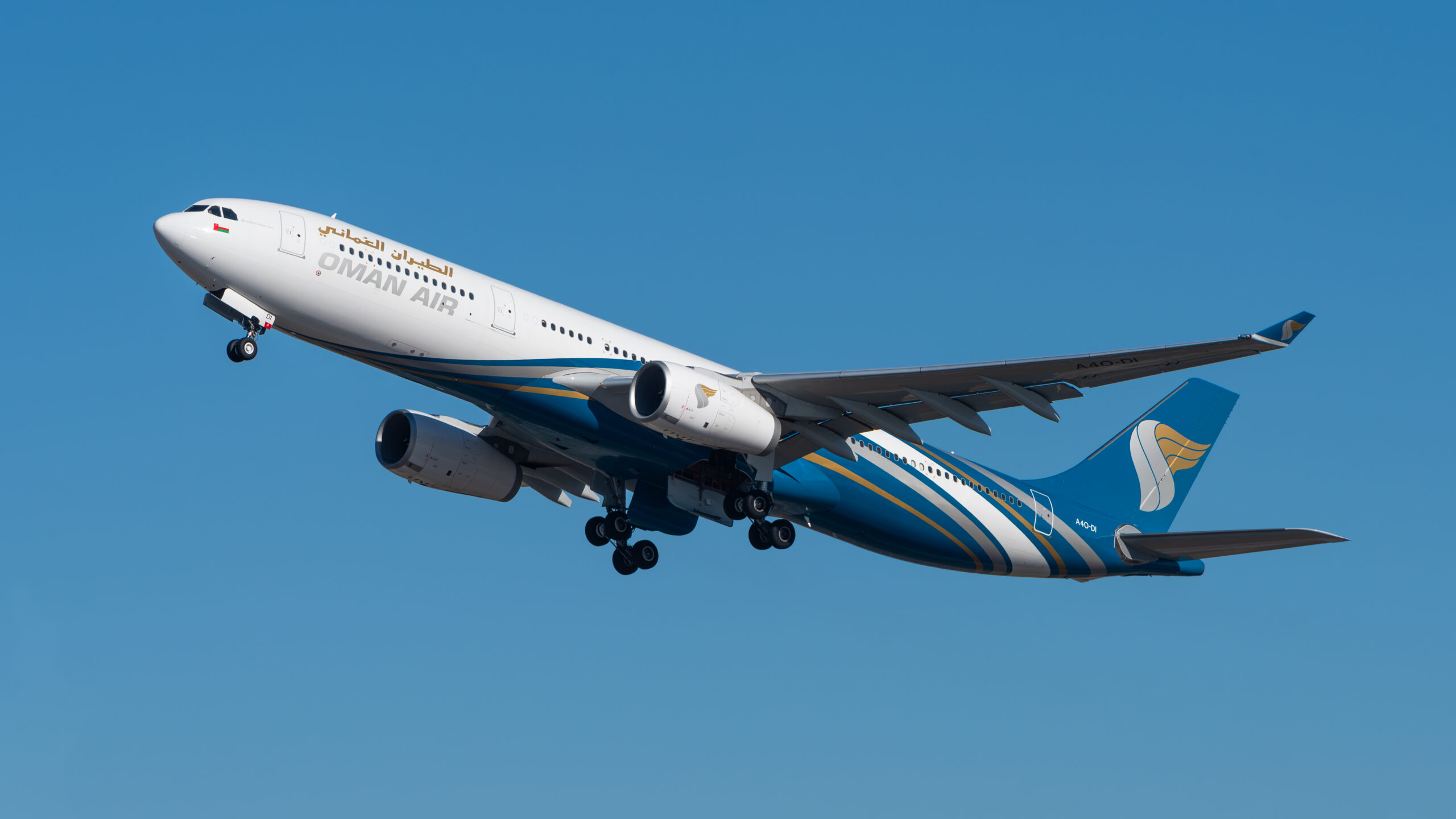



Oman Air announced on Sunday that it would suspend flights to nine destinations in the Middle East due to the volatile security situation triggered by the escalating military conflict, which has led to multiple airspace closures across the region.
The conflict began with the United States and Israel attacking Iran, and quickly escalated when Iran responded by launching missiles and drones at at least eight countries, including Israel, Saudi Arabia, Jordan, Qatar, Bahrain, Kuwait and the UAE.
The destinations affected for the week of 9–15 March are Amman (Jordan), Dubai (UAE), Manama (Bahrain), Doha (Qatar), Dammam (Saudi Arabia), Kuwait City (Kuwait), Baghdad (Iraq), Khasab (Oman), and Copenhagen (Denmark), whose route normally passes over Iraqi airspace.
⚠️ Dear valued guests,
— Oman Air (@omanair) March 8, 2026
Due to ongoing regional airspace closures, the following flights have been cancelled:
Monday, 9 March through Sunday, 15 March 2026:
All flights to and from Amman (AMM), Dubai (DXB), Bahrain (BAH), Doha (DOH), Dammam (DMM), Kuwait (KWI), Copenhagen… pic.twitter.com/eemDExKHXD
In a statement posted on X on Sunday morning, the airline said it remained committed to supporting travellers during the disruption. It highlighted that it had already operated almost 80 extra flights and helped 97,000 passengers get home during the crisis.
The carrier added that, while a limited number of regional routes have been temporarily impacted due to airspace closures, the vast majority of its international network, which spans Europe, Southeast Asia and Africa, continues to operate as planned. It said additional flights have been scheduled “where operationally possible” to help passengers reach their destinations.
To assist travellers seeking to exit the region via Oman, the airline said it had organised bus services for passengers crossing the land border from the United Arab Emirates. Last week, unusually heavy traffic was reported on the desert roads leading to Oman, which are usually quiet, as travellers sought alternative routes out of the Gulf while flights were disrupted.
I crossed over to Oman from Dubai yesterday via the Hatta border
— Soups Ranjan (@soupsranjan) March 5, 2026
Muscat airport is open for flights while Dubai airspace remains closed till March 7
Muscat is safe and calm (3rd pic). Almost surreal in this madness. People are kind and welcoming. I would come back here for… pic.twitter.com/WnEaqzhzmF
Oman Air apologised for the inconvenience caused, explaining that the cancellations were necessary due to ongoing airspace closures and safety considerations. Like many other airlines in the region, Oman Air advised passengers to check its website or official communication channels for the latest updates, and to make any changes only through official booking platforms.
Last week, scams targeting passengers stranded in the UAE were reported, with fraudsters posing as airline staff or crisis support agents approaching passengers on social media and requesting booking references and personal details.
When announcing the measures, the airline said that additional flights had been arranged over the weekend to destinations including Istanbul, Cairo, Kuala Lumpur, London Heathrow, Mumbai, Rome and Bangkok, to accommodate affected travellers. More extra services were scheduled for Monday, 9 March, including flights to London, Milan, Rome, Istanbul, Amsterdam, Cairo, Bangkok and Jeddah.
Despite these efforts to increase capacity, some passengers have voiced their frustration online. One traveller wrote on X that his flight had been cancelled earlier in the week and that he was still waiting for a refund, while another complained about the prices being charged for replacement flights.
With oil prices surging to around $110 per barrel on Monday morning amid fears that the conflict could disrupt regional energy supplies, airlines across the region are also facing sharply rising operating costs.
Many carriers in the Middle East have been forced to cancel or reroute flights due to ongoing missile and drone activity affecting airspace across the region, and are struggling to adapt to the rapidly evolving situation.