



I was asked by John-Likita M Best of the National Institute for Policy and Strategic Studies in Nigeria to articulate an academic response to a stimulating piece of work he has done, placing Responsible Tourism within a framework drawn from Genesis. John-Likita has produced a set of learning objectives for Responsible Tourism and discussion questions.
The presentation I prepared for the launch event of John-Likita’s work is available on YouTube.
The Responsible Tourism movement arose towards the end of the last century as people became increasingly concerned about the parroting of sustainability whilst taking no discernible actions to achieve it. Sustainability still lacks a substantive definition against which delivery can be judged.
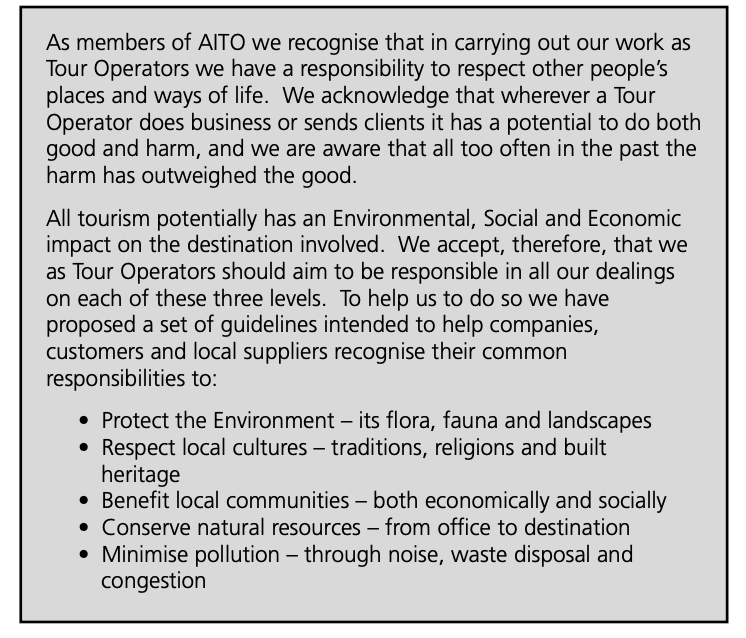
The UK volunteering charity VSO surveyed its volunteers around the world about the key issues facing the communities they worked in. Tourism came out top; a year or two later, it would have been HIV AIDS. I was invited to take part in their campaign for ethical tourism and funded to undertake some research with AITO members into how viable this approach is. Working with Richard Hearn, founder and then MD of Inntravel, we surveyed the membership and their views on adopting an ethical policy commitment.
We were surprised, perhaps more accurately amazed, by the volume, detail, and quality of the responses we received telling us about what AITO members were doing in the destination in 1999. We asked AITO members the open question: “What motivates you, or might motivate you, to follow an ethical trading policy?” The answers were then clustered, each reply being placed in only one cluster according to the balance of their response.
Ethical Motivations reported by AITO Members in Summer 1999:
| Moral imperative/personal values/common decency/conscience/guilt 22% | Desire to preserve destination/maintain quality of the product (culture/environment/facilities) 17% |
| Personal interest in ethical issues/local politics/concern for environment/culture 14% | Desire for partnership with locals/ treat people fairly -benefits communities and also enhances supplier/staff loyalty 7% |
It is striking that none of the individual owners or managers surveyed identified a commercial or market advantage. There is arguably an enlightened self-interest in the benefits of partnership and enhancing supplier and staff loyalty. However, the AITO owners and managers reported to their trade association that their motivation was largely personal or ethical (36%). One in six was concerned for the quality of the destination and the product. One in 14 saw it as part of their approach to doing business based on partnership and loyalty to suppliers and staff. Asked separately about how they characterised their supply chain, two-thirds saw their suppliers as like-minded partners, working with common goals.
Thirty-three members, about a fifth of the membership, reported that they were working with or investing in local projects intended to improve the situation of local people, to contribute to conservation or improve the local environment. One in three companies was making charitable donations to destinations. Half of respondents reported that they were concerned about the impact of tourism at locations featured in their brochures, and one in five reported concern about the impacts of their own company in destinations.
The final question canvassed their view on whether AITO members should share a stated commitment to ethical tour operations: 52% felt that they should, 20% sat on the fence, and 27% said that they should not. The AITO sub-committee concluded that the survey revealed “unexpectedly extensive good practice in responsible tourism”, that members operating within Europe as well as further afield were engaged, and that individual AITO members were making a significant difference.
AITO’s Responsible Tourism Committee. Chaired by Richard Hearn, concluded that by “working together as AITO we can have a bigger impact, whether in initiatives which involve the whole membership or through members who share a common approach or a common destination working together to make change.” After that survey, the AITO Responsible Tourism Committee grew from three member companies to seven. However, it felt unable to commit to the word ethical, which it thought “carried with it unacceptable implications and inferences,” and its recommendation to adopt a set of advisory rather than prescriptive guidelines was agreed in May 2000.
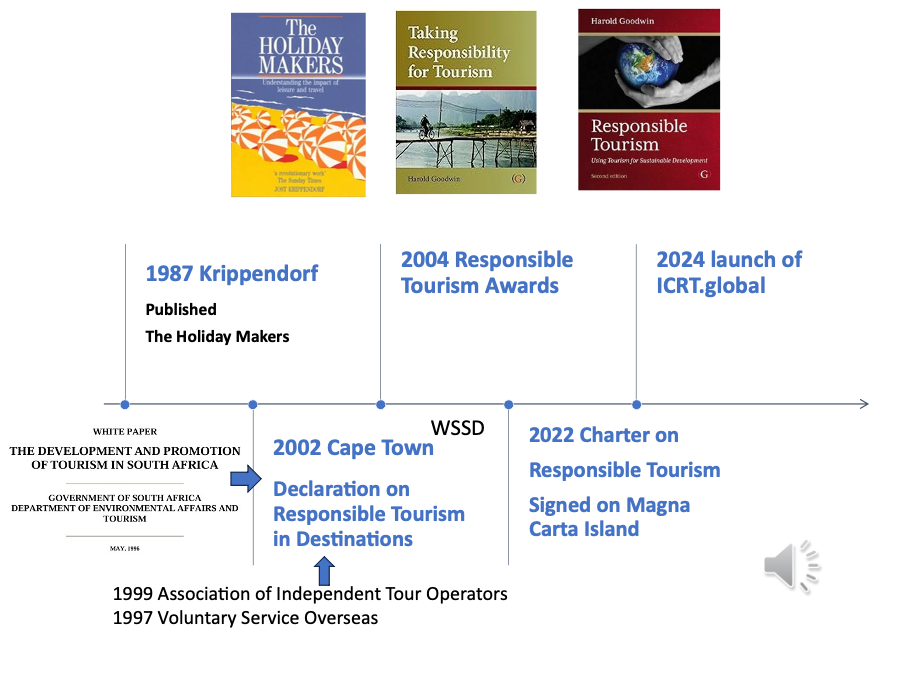
South Africa was the first country explicitly to commit to Responsible Tourism in its national policies. When the African National Congress took power in South Africa in 1994, it had not developed a tourism strategy. Under apartheid, the industry had been very limited due to anti-apartheid boycotts and the security situation. It was out of the democratisation of South Africa and the need to harness tourism for economic and social development in the new South Africa that the concept of Responsible Tourism was first used in a national government policy.
The 1996 White Paper was conventionally titled: The Development and Promotion of Tourism in South Africa. However, the ANC’s policy on tourism was radical in both the South African and international context. Responsible Tourism was in the graphics on the cover of the White Paper and used throughout. Responsible Tourism was defined in the White Paper as:
“…tourism that promotes responsibility to the environment through its sustainable use; responsibility to involve local communities in the tourism industry; responsibility for the safety and security of visitors and responsible government, employees, employers, unions and local communities.”
The new government recognised the breadth of opportunities which tourism could offer the country and in particular the informal sector:
“The tourism industry accommodates a thriving and dynamic informal sector – from craft and fruit vendors to beach vendors, chair rentals, and others. … there are many business opportunities to involve previously neglected groups in the tourism business: entertainment, laundry and transportation services, craft rental; arts, craft and curios sales; tour guides and walking tours of places of interest; teaching of African languages and customs to interested visitors; restaurants emphasising local cuisine; guest houses; beach manicures and pedicures; and much more.”
Tourism was identified as a missed opportunity. There had been “limited integration of local communities and neglected groups into tourism”, which presented a significant opportunity for South Africa to create employment, draw on a multiplicity of skills, create entrepreneurial opportunities, bring development to rural areas and generate foreign-exchange earnings. Tourism was seen as a way of establishing a taste, and therefore an export market, for South African products such as wine. The paper also stated, “all the final touches (value) have to be added in South Africa… the value added in final stages of production is created in South Africa.” This was the “final good”: one of the advantages of tourism is the opportunity to capture the final retail value of the product in the country.
In 2002, these two strands of work came together and resulted in the Cape Town Conference on Responsible Tourism in Destinations held as an official side event to the World Summit on Sustainable Development in Johannesburg. The conference produced the Cape Town Declaration on Responsible Tourism in Destinations, the founding document of the Responsible Tourism Movement.