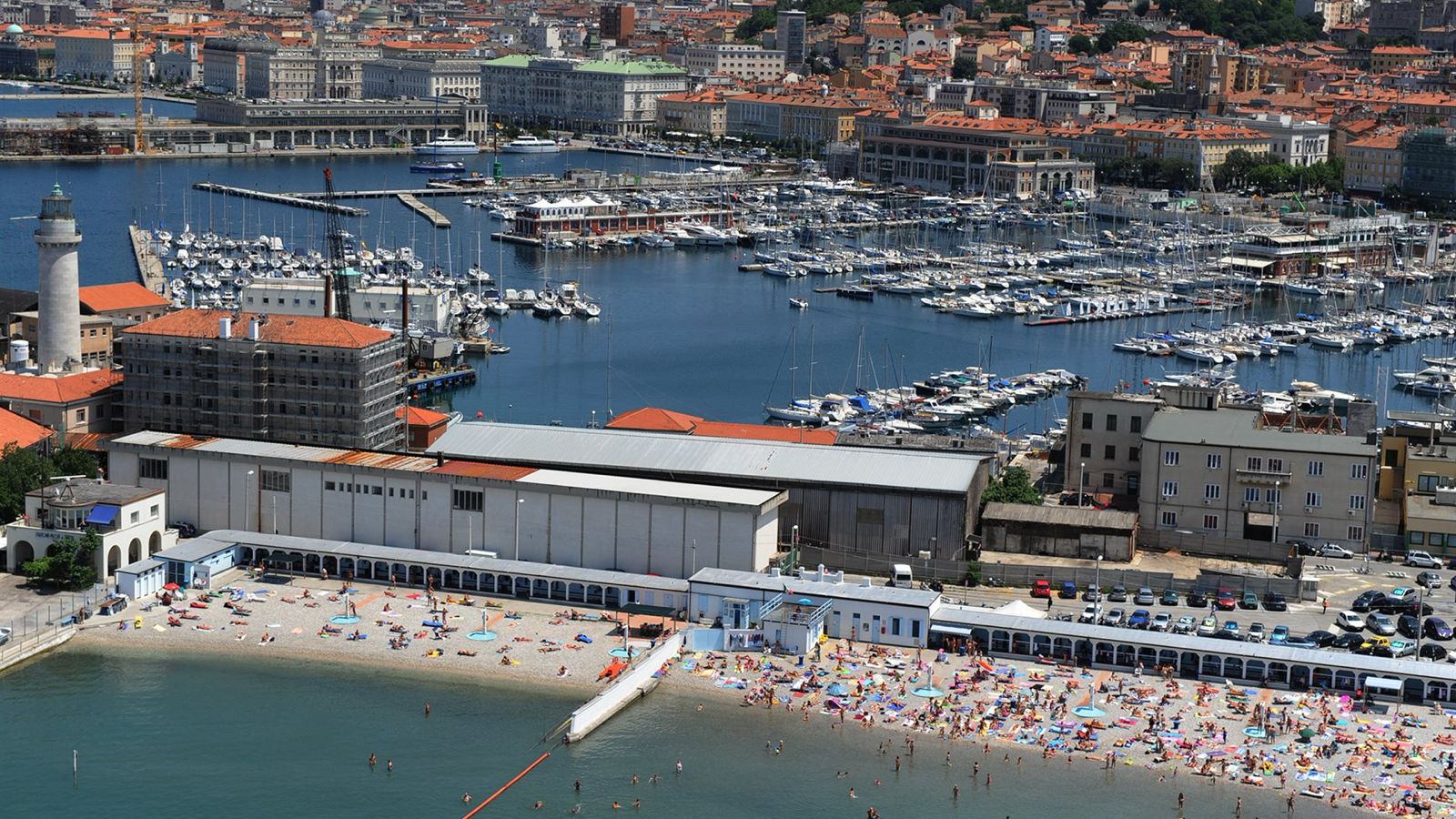



A recent dispute between tourists and local beachgoers has drawn attention to one of Europe’s most unusual seaside destinations. Bagno Marino La Lanterna, better known as Pedocin, is a public beach in the Italian city of Trieste that is believed to be the last in Europe where men and women are separated by a permanent wall. The incident began when a tourist entered the men’s section and was reminded of the beach’s rules by a local visitor. Although staff quickly intervened, the disagreement reignited a long-running debate over whether the beach represents an important cultural tradition or an outdated custom.
Pedocin has followed the same basic layout for more than a century. A white wall divides the beach into two sections, with men using one side and women the other. Children are allowed to stay on either side, while some exceptions are made, for example for parents or carers assisting a family member. Couples and friends are also free to meet in the sea beyond the buoys, where the separation ends. Visitors choose to enter the beach knowing its rules, making the arrangement a voluntary tradition rather than an obligation.
The beach officially opened in 1903, when Trieste was still part of the Austro-Hungarian Empire. At the time, gender-separated bathing areas were common across many parts of Europe because of public decency laws. Similar beaches could be found in countries including Germany and elsewhere in northern Europe, but they gradually disappeared as social attitudes changed. Pedocin is one of the few places where the tradition survived, turning it into a distinctive part of Trieste’s identity that has endured through two world wars, political change and shifting social norms.
The wall has not survived simply because it has always been there. In the 1950s, local authorities considered removing it in the hope of attracting more visitors and encouraging tourism. However, many residents, particularly women, preferred to keep the separation because they appreciated the atmosphere it created. Many regular visitors describe the beach as a place where generations of families return every summer and neighbours know one another. As one local visitor explained: “It’s our tradition. People from outside sometimes don’t understand it, but nobody is forced to be here.” Following the recent dispute, Trieste mayor Roberto Dipiazza also defended the beach on social media, describing Pedocin as “a unique feature of the city” and an important part of Trieste’s identity.
Trieste,
— W̾a̾l̾t̾e̾r̾ ̾l̾'̾A̾p̾o̾l̾i̾d̾e̾ 𝐏𝐡𝐃 ⚔️ (@ApolideL) March 19, 2023
stabilimento Pedocin
📷 2023. pic.twitter.com/7UHymofNuK
Not everyone shares that opinion. Critics argue that a publicly operated beach should no longer separate visitors based on gender and see the wall as a reminder of social conventions from another era. During the recent disagreement, one tourist reportedly described the arrangement as “an absurd and medieval custom” after being asked to respect the beach’s rules. The incident quickly attracted attention in Italy and reopened discussions about whether historic traditions should be preserved when they no longer reflect modern society. At the same time, many Trieste residents responded by defending Pedocin as a unique part of their city’s heritage rather than a form of discrimination.
The debate comes at a time when Pedocin is also investing in its future. The beach has recently introduced a Seatrac Mover, a device that allows people with reduced mobility to enter the sea independently without assistance. Two new reading areas with bookcrossing facilities have also been created, allowing visitors to borrow, leave or exchange books while spending the day at the beach. These additions are part of a wider effort by the municipality to make the historic site more accessible, inclusive and welcoming to visitors of all ages.
Ho superato la prova costume! Come?
— Susanna sicily (@SusannaSicily) June 23, 2026
Nessun intervento estetico, nessuna dieta, ma solo un biglietto per Trieste. Ho deciso che il mio lido sarà il Pedocin, dove le balene femmine nuotano felici al riparo dai capitoni maschi 😜 pic.twitter.com/PoMWZPaTTt
The improvements appear to have been well received. A recent satisfaction survey carried out among visitors gave Pedocin an average score of 4.6 out of 5. Beachgoers particularly praised the friendliness of the staff, the cleanliness of the facilities and the comfortable environment, while the opening hours received a perfect score. More than 120 years after it first welcomed bathers, Pedocin continues to combine a tradition found nowhere else in Europe with new initiatives that respond to the needs of today’s visitors.