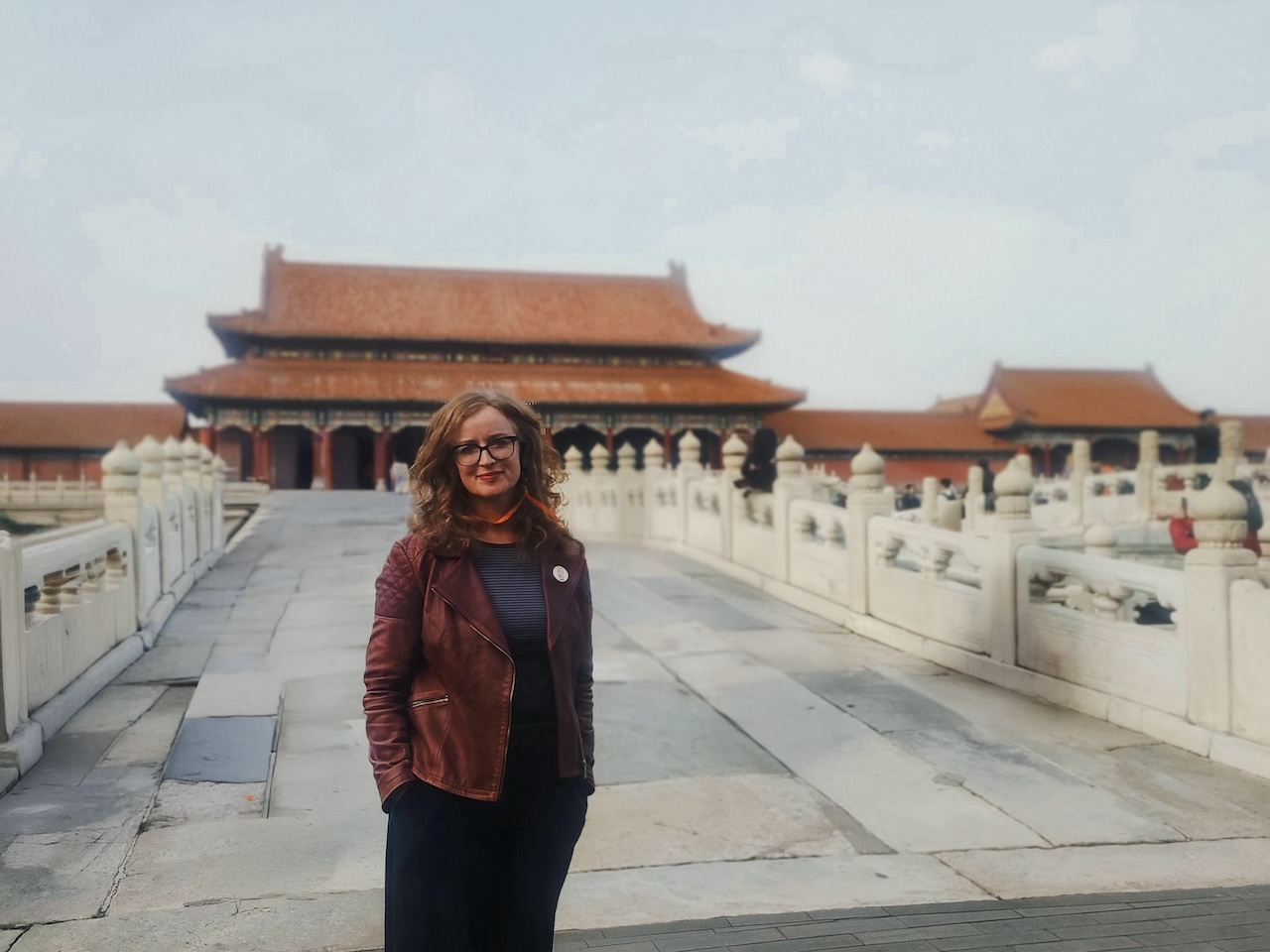


It may not be forbidden to the public any longer, as the world’s most-visited museum with 17 million visitors in 2024, but entering Beijing’s Forbidden City still felt to me like a transgression – a special moment in time that takes the visitor from the noisy stop-start of car-flooded streets and the monolithic cityscape of the Chinese capital, into a privileged oasis of beauty with a name alone that’s enough to tempt travel lovers from the world over.
Be careful: in parts of this 13th-century dynastic palace guests are still not allowed to take photographs. Signs, and guards, make it clear, and somehow this rule builds the sense of a place of mystery and secrets. The arches of the Gate of Heavenly Peace bring visitors in from the north side of Tiananmen Square, and wherever one enters, a raised threshold, about 30 centimetres high, must be crossed. Folk wisdom says the barrier wards off evil spirits, while others relate it to imperial hierarchy – signs of which are everywhere, after all, 24 emperors lived here over five centuries. These days, tickets become available to book online seven days in advance.
@bastien.larnaud The Forbidden City, the largest palace in the world – 720 000 square meters, more than 8700 rooms 🐉 Check the original video on my Instagram bastienlarnaud #china #forbiddencity #beijing #history #travel ♬ 光亮(大型纪录片《紫禁城》主题歌) – 周深
Once inside, I joined a gentle and unregulated flow of visitors moving from one vast space to another, yet with a seemingly unending sequence of 90 courtyards, a supposed 9,999 rooms, (nine and its multiples were considered powerful “yang” numbers), plus limits on tickets to protect the heritage, the site never feels crowded.
Indeed, there are 720,000m2 to explore here, more than 100 football pitches. It’s thus advisable to abandon all hope of seeing or remembering everything. I found having a guide helpful, but even then, and despite my efforts to focus on the information shared over an earpiece and carefully inscribed noticeboards, this writer and completionist’s experience became a dreamlike stream of consciousness – and was perhaps best that way.
Just like the Forbidden City, the Chinese tourism market is huge, and that goes for domestic visitor numbers too. The Forbidden City attracts people from all over the country, many of them dressed for the occasion in historic Chinese costumes, whether Hanfu, Changpao, or Qipao, or various ethnic Chinese robes. It’s a striking sight, and impossible to imagine a European equivalent where visitors in their dozens turn up to Versailles dressed as Marie Antoinette. It may seem quaint, but the phenomenon reveals how the modern Chinese imagination is driven by popular historical drama series and social media – these mostly young visitors dress up in rented outfits to create content for their online presence, offering followers a historical fantasy and a sense of connection to the past.
Those in costume do not seem to mind when other visitors take their photo either, which I discovered to be a wonderful bonus because, against expansive carved white walkways, even huge structures with hip roofs and glazed tiles appear somehow modest, making it tough for an amateur photographer like me to capture an image adequately showing the grandeur of the place. The spectacle of costumed influencers provided a useful focal point.
Concentrating on the City’s details is also revelatory. Take the unsettling poetry of place names in the complex, such as the Palace of Earthly Tranquillity, topped by double eaves and a harmonious nine bays by three in size, where Emperors traditionally had sex with their new wives. Then there’s the Palace of Tranquil Longevity, which sounds exactly like a care facility for the elderly, built by the 18th-century Qianlong Emperor in anticipation of his own abdication. Amusingly, its “Studio of Exhaustion From Diligent Service” (to which I think we can all aspire), somehow captures the Chinese work ethic and sense of duty.
Elsewhere, in triple-level courtyards, more than a thousand carved dragon heads serve as rain-gutter gargoyles. Red portals bear golden studs, again in multiples of nine. Giant red and gold, and purple thrones sit empty inside buildings placed precisely along the City’s all-important meridian line. Pairs of massive bronze lions symbolise imperial power and protection, the male with a globe-like ball beneath its paw, the female with a cub representing family and prosperity. Turtle statues, for steadfastness and peace, raise their heads to the sky.
Other treasures that caught my eye in the City include a massive jade sculpture, weighing 5,000kg and depicting the myth of Yu the Great’s efforts to control the Yellow River. Nicknamed “China’s Sorrow” for the devastation its floods used to cause, the Yellow River has now been tamed by several infrastructure projects, including the Sanmenxia and Xiaolangdi dams. Collections also include over 28,000 jade artefacts, the same number of handwritten verses, 350,000 ceramics, 1,500 clocks and watches, and more than 22,000 oracle bones – whose cracks were once used to divine outcomes from military engagements to harvests.
Just when I began to think the Forbidden City had nothing more to yield, towards the East and West Prosperity Gates, further, more human-scale courtyards unfold, blessed by graceful trees and spectacular in the autumn. My top tip: leave time during your visit to linger here, perhaps around the Palace of Compassion and Tranquillity, where, in the words of one of our guides: “the moments when the sun brushes the glazed tiles and shadows dance between the vermilion corridors stay etched in one’s memory forever.”